home I index I latest I glossary I introductions I e-mail I about this site
St Mary, Hackford


Follow these journeys as they happen at Last Of England Twitter.
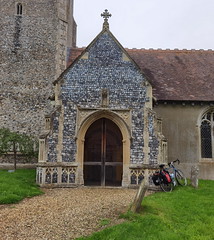
St Mary, Hackford The area between Attleborough and Dereham is one of the most intensely agricultural parts of Norfolk, and although there are some larger villages nearby, Hackford barely exists other than a narrow straggle along the lonely lanes. The church sits beside a couple of modern houses, but as I recalled thinking when I'd come this way before, if you turn your back on them you could be in any century. The church unfolds in
time from east to west, the chancel coming before the
Black Death and the rebuilding of the nave begun
afterwards, with the tower coming last. A bequest of the
1520s to it was only to be paid when work was underway,
so we may assume it was completed not very long before
the Reformation intervened. The battlements seem to top
out at a curious level, very close to the bell windows,
so perhaps it was never actually finished according to
the original plan. A Norman doorway on the north side of
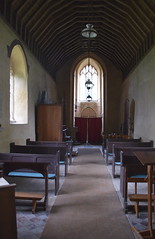
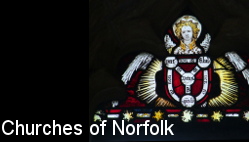
the nave tells of the church that was here before. You step down into the long interior which is charmingly rustic, owing as much to Diocesan architect Hubert Green's 1880s restoration as it does to the time in which it was built. Green's painted texts above the arches seem as ancient and remote now as the 14th Century font with its passion symbols on the shields. The screen has gone, but what survives gives us some idea of that it would once have looked like. Set in a recess on the north side of the nave, the rood loft stairs ascend in a straight line from about a metre above the nave floor to where the bottom of the rood loft would have been. It seems likely that wooden steps would have been set at the bottom of the stairway. At the top, an ornately carved wooden upright set into the wall must have been one of the supports for the rood loft, an unusual survival. There is a niche below it and four further elaborate niches, two each side of the chancel arch, and so all in all the rood screen must have been quite a sight in this narrow space with its accompanying statues when all the candles were alight. Up in the chancel, the sedilia is little more than a window seat now, but has access to the piscina beside it through a niche, which seems to have been a local fashion. The wooden furnishings, like the roof, are pretty much all Green's, but are good of their kind. The little organ with its crockets and spires is a 19th Century period piece. The small George II royal arms are unremarkable, but are curiously similar to the huge set at nearby Wymondham. A single 15th Century censing angel, reset in a north nave window and possibly upside down, bears silent medieval witness to all this, the last survivor. Simon Knott, August 2021 Follow these journeys as they happen at Last Of England Twitter.
|
|
|||||||||||||||||||||||||||||||||||||||||||||||||||||||
home I index I latest I introductions I e-mail I about
this site I glossary
Norwich I ruined churches I desktop backgrounds I round tower churches
links I small
print I www.simonknott.co.uk I www.suffolkchurches.co.uk