home I index I latest I glossary I introductions I e-mail I about this site
St Mary, Gunthorpe
Follow these journeys as they happen at Last Of England Twitter.
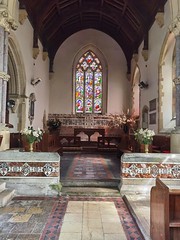
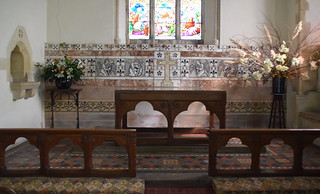
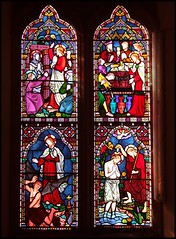
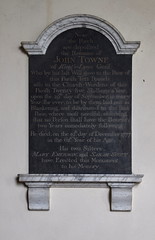
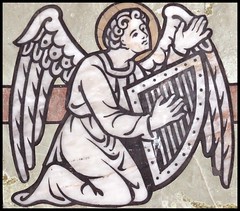
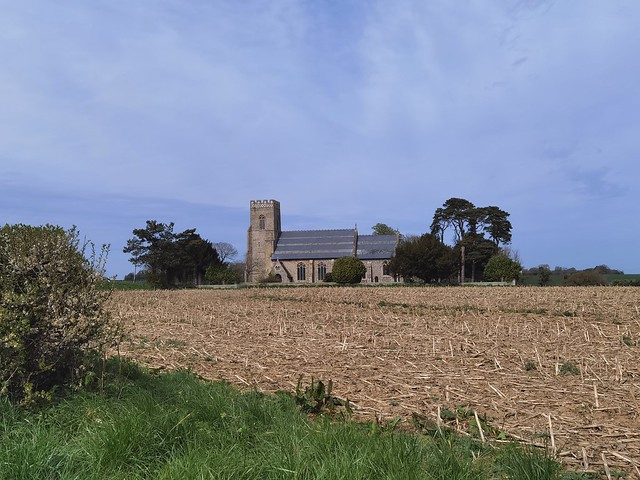
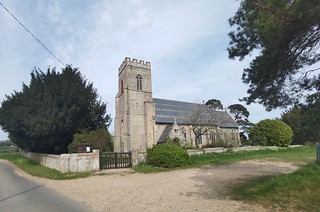
St Mary, Gunthorpe When I first came here back in 2008 it was a church I thought I already knew, for I had often seen it off in the fields, poking its ancient head above a copse about a half a mile from the Holt to Fakenham road. Of course, I knew nothing of Gunthorpe, the place, for the name was merely a word on a map, to be confused perhaps with Gunton and Thorpe, parishes adjacent to each other on the other side of North Walsham. Proust writes in his great novel In Search of Lost Time of the way in which placenames absorb the images we have of them, and so perhaps I would have expected something rugged, a fortress-like citadel on a hill. Nonsense of course, and coming to the church for the first time I knew it for what it was. At the churchyard gate stands the war memorial, a few cottages beyond, the cross standing in their view as a memory of a recent past, a Gunthorpe still touched a century on by the loss of its sons. Returning to Gunthorpe in 2022, I remembered it. The church and cottages sit in the fields about half a mile to the north of the straggling village. The building is imposing, seeming larger than it is. The attractive flushwork parapet of the tower is a pre-ecclesiological gothick fancy of 1808. However, St Mary was substantially rebuilt in the 1860s by Frederick Preedy. The chancel is all his, and much of the exterior was refaced under steeply pitched roofs, resulting in a rather severe-looking building. Pevsner tells us that the work was bankrolled by Canon John Henry Sparke of Gunthorpe Hall, who was lord of the manor, patron and rector here for the middle forty years of the 19th Century. He must have liked Preedy's work very much, for you step inside to find the church almost completely furnished to that architect's design. Pevsner observes that his work here is a little laboured, which some might think an understatement, although it does make for a fascinating period piece, being so complete. Canon Sparke was clearly not short of a few bob. The chancel arch was rebuilt with columns of Italian marble, and French-style capitals. Beneath, a low screen is decorated with marble inlay which is matched by the wall behind the altar which forms a marble reredos depicting four angel musicians. The four Evangelists might have been expected instead, but as the late Tom Muckley observed when I pointed this out, we are in north Norfolk. The east window by William Warrington came as part of the rebuilding of the chancel, and then over the next half a dozen years Preedy himself provided glass for other windows. He reordered the chancel floor, moving the ledger stones to the sides where they now lie under the choir stalls, and laying an elegant mosaic of tiles up the centre. It works reasonably well, but all in all there is the sense that this is an urban space, inorganic and suited for the triumphant Anglicanism of the late 19th and early 20th Centuries. One of the early 18th Century ledger stones has a garlanded skull flanked by an olive branch and a frond, a grandeur of a very different age. By comparison, the narrow nave is hushed and austere, as if cowed by the grandeur beyond and around it. The 15th Century font has seated figures alternating with the symbols of the Evangelists.. Opposite the south doorway, a memory of John Towne, a Gentleman of Kings Lynn, who died in 1777, and by his last will gave to the poor Ten Pounds, also to the churchwardens of this parish Twenty Five Shillings a year upon the 29th day of September in every year for ever, to be by them laid out in blanketing, and distributed to the said poor, where most needful; observing that no person shall have the benefit two years immediately following. John Towne knew a very different Church of England to the one that this church was redesigned for, and it is an interesting thought that when Canon John Henry Sparke began his incumbency here in 1831 it was still pretty much the building that Towne had known. Over the next forty years the Anglican revival would transform Gunthorpe church, and thousands of churches all over England. Simon Knott, May 2022 Follow these journeys as they happen at Last Of England Twitter.
|
|
|||||||||||||||||||||||||||||||||||||||||||||||||||||||
home I index I latest I introductions I e-mail I about
this site I glossary
Norwich I ruined churches I desktop backgrounds I round tower churches
links I small
print I www.simonknott.co.uk I www.suffolkchurches.co.uk