home I index I latest I glossary I introductions I e-mail I about this site
St Mary, Gressenhall


Follow these journeys as they happen at Last Of England Twitter.
| St Mary,
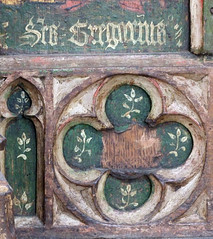
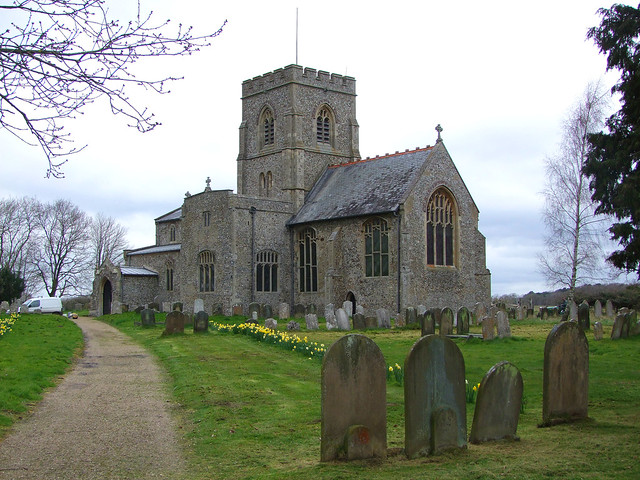
Gressenhall Gressenhall is a large village not far from Dereham. It sprawls along the gentle valley, merging into neighbouring Beetley, and is home to the Dereham Union workhouse building, which is today the Museum of Norfolk Life. If Dereham has commuters then Gressenhall and Beetley are exactly the kind of places that they would live I suppose, but there is nothing suburban about Gressenhall. It is a pretty place with its village green and cottages, and I like it a lot. The parish church of St Mary is a good mile outside the village, set in the narrow sunken lanes to the south. Some churches like this seem to be hiding away, but St Mary is a large, impressive building, sitting boldly in the fields as if it was the church of some great French abbey. Pevsner gets it exactly right when he says the core is Norman but the effect is entirely of a big, prosperous Perp church. Simon Cotton tells me that the dedication of this church before the Reformation was to the Assumption of the Blessed Virgin as evidenced by several wills, including that of John Schawe in 1518 who asked that his body be buried in ye church of or Lady th Assumption in Gressenhale. The wide, sloping churchyard is a perfect foil to the bulk of the exterior. The birdsong in the quiet air seems to intensify the church's sense of remoteness. You step into a similarly quiet and still interior. As with many central-towered churches there is a sense of rooms that open up off each of other, the aisles, chancel and the transepts forming separate spaces of their own. High above the tower arch, a double headed window gives a nod to the Norman origins of the place, but otherwise this feels an early 20th Century space in a medieval shell, with curated survivals. Propped up against the south wall are some panels from the rood screen. They depict St Leonard, St Augustine, St Gregory and St Michael. The 16th Century iconoclasts went to town here, but the figure of St Michael was clearly very fine. In the spandrels above, a hunter faces off a wild man while eagles and angels keep watch on below. All of them have been thoroughly defaced, but enough survives to show what was once here.
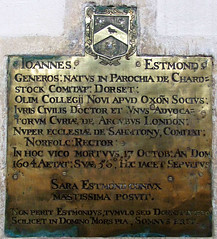
The 15th Century font has also been enthusiastically vandalised, telling us something perhaps about the response to the Tudor Reformation in this parish. And yet it is just a typical late medieval East Anglian font, with angels and shields which were perhaps once painted. On one panel in particular the iconoclasm was clearly furious. I wonder what it depicted. The Victorian restoration removed a 17th Century west gallery, but a memory of it survives because of a ledger stone in the nave. Here resteth the body of Robert Halcot of Gressen Hall yoman hooe departed this life the 2 daye of November anno dom 1640 it tells us, and goes on to note that him have wee for a time lost who bilt this galery att his own cost. The secular tone of the inscription is typical of those puritan days, but the carving of it is particularly crude. This is emphasised by the Latin inscription on the nearby brass to Sarah Estmond of some thirty years earlier, which retains some of the elegance of earlier times, and reminds us as if we needed it that fundamentalism always comes at a price to artistic flowering.
Set in the wall is an alabaster relief of the martyrdom of St Stephen. He kneels, and is stoned to death. Such reliefs were once common as parts of altar pieces, but few survived the 16th century Anglican enthusiasm for the destruction of images, and those that did were broken up and discarded, to be found centuries later under floorboards and sealed up in walls. The brilliant Musée national du Moyen Âge in Paris has a large room of complete English alabasters of the 14th and 15th Centuries, probably more than survive in the whole of England. Simon Knott, October 2020 Follow these journeys as they happen at Last Of England Twitter. |




|
|||||||||||||||||||||||||||||||||||||||||||||||||||||||
|
|||||||||||||||||||||||||||||||||||||||||||||||||||||||
home I index I latest I introductions I e-mail I about
this site I glossary
Norwich I ruined churches I desktop backgrounds I round tower churches
links I small
print I www.simonknott.co.uk I www.suffolkchurches.co.uk