home I index I latest I glossary I introductions I e-mail I about this site
St Peter, Great Walsingham



Follow these journeys as they happen at Last Of England Twitter.
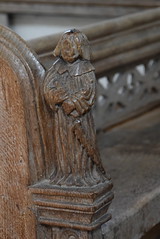
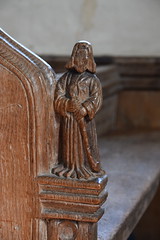
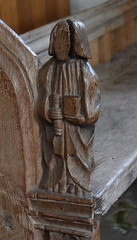
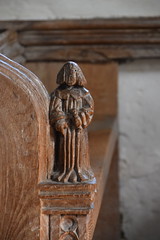
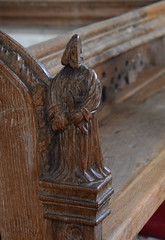
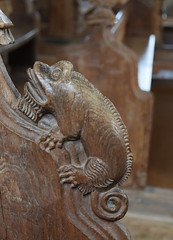
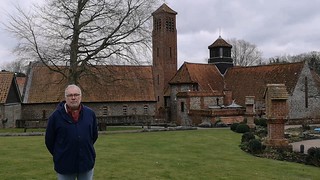
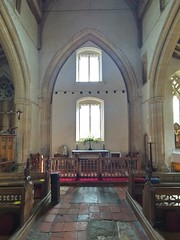
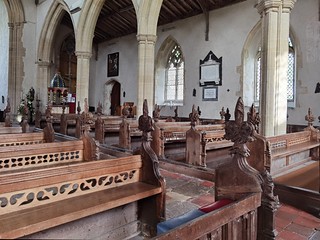
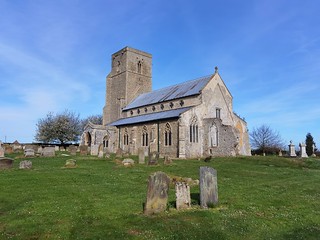
St Peter, Great Walsingham Great Walsingham and Little Walsingham almost merge, and the parish church of Great Walsingham sits just beyond the houses of Little Walsingham on the west side of the River Stiffkey. The churchyard is separated from the narrow lane by a wide field, which in modern times has become the car park. The church is a fine sight from the lane, and even Pevsner was moved to describe it as a singularly beautiful church... the felicitous effect is gained against heavy odds, for the church lacks its chancel. The effect from outside is pretty much all of the second half of the 14th Century, that beautiful mature Decorated style which even then is beginning to hint at a desire for more light, the window tracery taller, the quatrefoil windows of the clerestory abundant. The substantial aisles seem to hug the building to the ground, making of it a sprawling beast. The later porch with its two large image niches does not intrude, and even the new east wall with its two domestic windows, one above the other, is charming. And there's more to come, because you step into a church which is at one with its exterior, a harmony rarely found, a space of light and air, of white walls and old wood. The range of tracery-backed 15th Century benches, rustic in their way but suiting their church entirely, include figures of the apostles holding their symbols, including Andrew, Simon, John, James the Less, Matthew and Bartholomew. Another figure looks as if he might be a 15th Century merchant. Could it be the donor?
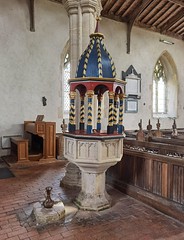
An ornate 17th
Century font cover is the only vivid splash of colour at
the west end of the nave, and looking east there is
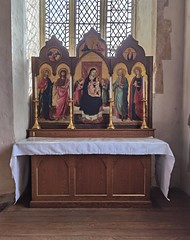
another at the end of the south aisle, a gilt reredos in
an Italian style depicting the evangelists St Matthew and
St Luke with St John the Baptist and St Mary Magdalene
flanking the Blessed Virgin and Christchild. Beside it,
an aumbry has its original door still in place, an
unusual survival. There is no modern glass, but high in
the tracery of the north aisle there are some 15th
Century survivals, fragments from two Coronation of the
Blessed Virgin scenes. Swirling around them are demons
with big noses. The pulpit is dated 1613, but it appears
to be made out of panels from a rood screen or rood loft.
Perhaps 1613 was the year that they were put together? Simon Knott, May 2022 Follow these journeys as they happen at Last Of England Twitter.
|
|
|||||||||||||||||||||||||||||||||||||||||||||||||||||||
home I index I latest I introductions I e-mail I about
this site I glossary
Norwich I ruined churches I desktop backgrounds I round tower churches
links I small
print I www.simonknott.co.uk I www.suffolkchurches.co.uk