| |
|
St
Michael, Great Moulton Great Moulton, or Moulton St
Michael as it is sometimes known to distinguish it from
Norfolk's two other Moultons, neither of which is
particularly nearby, is one of those parishes that
straggles around lanes, clustering into groups of houses,
with a pub, a shop, a hall and a couple of churches. You
get the feeling you could live here without having to
leave it very often. The village was also once home to
one of the last surviving tin churches in East Anglia,
Great Moulton Congregational. The building is now on
display at the museum of East Anglian Life in Stowmarket.
Its former near-neighbour, St Michael, sits fairly close
to the Norwich to London railway line, which cuts through
the middle of the village, which is itself only just off
of the main A140 Ipswich to Norwich road.
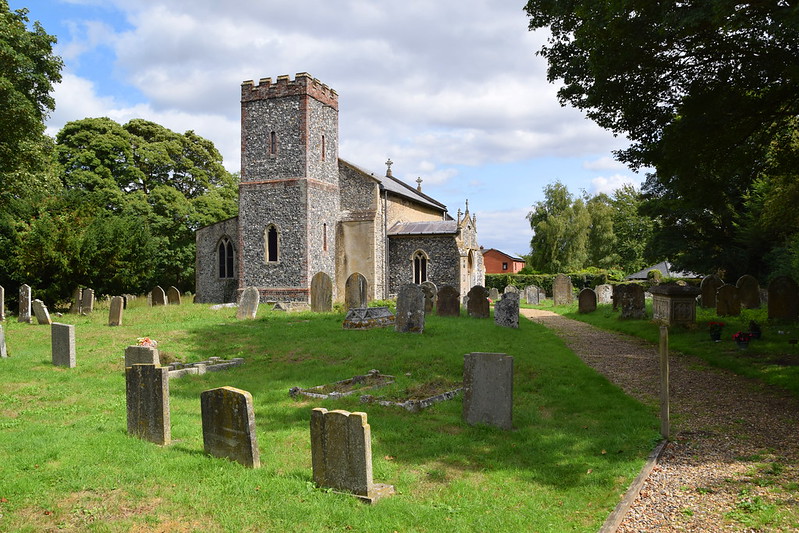
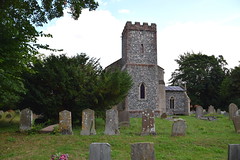
And yet, the church is secretive. You approach it up a
narrow lane, and as the small graveyard opens up the
little church presents itself to you, tower end first.
Everything is small and to scale, and there is a
crispness to the bright flint and red brick of the tower
that is reminiscent of 19th century village churches on
the south coast of England, or in the north of Ireland.
This is because the tower was completely rebuilt in the
late 1880s, along with the north aisle.
As you walk up to the church, there is an ancient
tombchest in the churchyard beside the path. The panels
cannot be any later than the early 16th century, which
would make this one of the earliest graveyard memorials
in East Anglia. However, the top does not match, and the
panels almost certainly came from elsewhere, probably
inside a church, and it is unlikely to have been this
one. Most likely, they were reused for their current
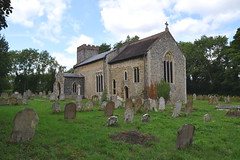
purpose in the 18th century. Continuing eastwards, you
can look back at the church and see that the chancel is
earlier than the nave, and is nearly as big. This is a
juxtaposition that is repeated at several larger churches
around here, including nearby Carleton Rode.
Great Moulton is one of the Pilgrim Group of parishes,
which are all very welcoming, and a pleasure to visit.
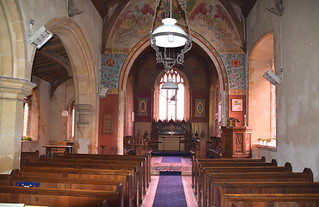
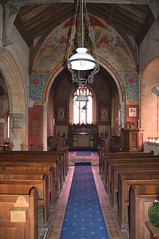
However, one thing you'll notice immediately as you step
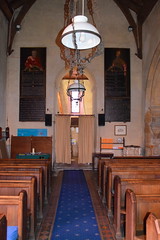
through the door is quite how dark it is inside. I have
been here on a bright day in late winter, the white light
slanting across the graveyard, and on a day in high
summer when the sky was cloudless, a fierce warm light
filling the churchyard, but very little of it seems to
get inside the church. This is largely because of the
lack of windows in the western part of the nave. There is
just one window in the south wall, at the east end. It is
a truncated three-light 14th century one, which creates a
pool of light before the chancel arch, but not much else.
The small triple lancet east window of the chancel seems
to punch a hole in the darkness rather than relieve it,
but as we will see, the gloom is a special part of the
atmosphere at Great Moulton. For as your eyes become
accustomed to the light, you see that St Michael
underwent a dramatic redecoration in the early years of
the 20th century.
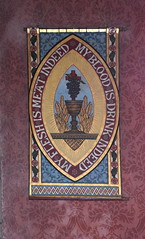
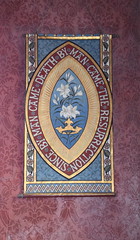
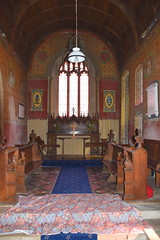
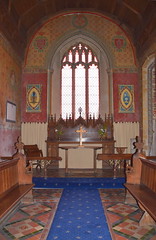
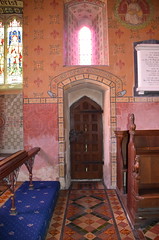
The walls are painted in pastel shades, and those in the
chancel are stencilled with flowers, fleurs de lys and
portraits of the four Evangelists. The window splays are
full of intricate vinework, and scrolls containing
Biblical quotations run along the walls. The scheme was
topped off by a gorgeous large scale St Michael killing a
dragon over the chancel arch, completed in 1909. Pevsner
thought it was terrible, and you wouldn't want to find it
in every church, but I am glad it has survived here.
Once, many
churches had late 19th and early 20th century stencilling
- you can see something on a much larger scale nearby at
North Tuddenham - but virtually all of them had their
walls whitewashed in the 1950s and 1960s when this kind
of decoration fell from favour. Their survival here gives
St Michael a most pleasing atmosphere that cries out for
the flickering of oil lamps and smoky candles. The walls
are matched by floor tiling in the nave, which is less
successful, or perhaps it is only more familiar.
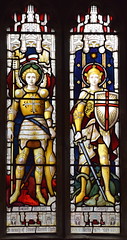
A south chancel window depicts St Michael and St George,
in the typical martial poses of Clayton & Bell glass.
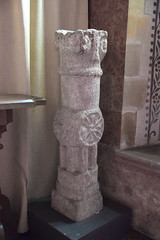
A curiosity nearby is a Norman pillar, perhaps part of an
old doorway. When Pevsner came this way he found it
outside the church, but it has been rescued and brought
into the sanctuary.
Just as the darkness acts as a counterpoint to the
decoration, so it must have suited the seriousness of the
17th and 18th century English Church. There are some
fascinating survivals of those centuries at the west end
of the church, high up in the darkness so that you
probably won't even notice them unless you know they are
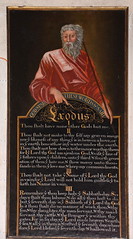
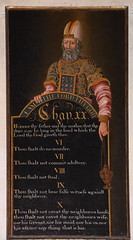
there. Firstly, either side of the tower arch are the two
decalogue boards moved from the chancel by the
Victorians. As is often the case with earlier sets, they
include depictions of the two law-bringers, Moses and
Aaron, one at the top of each board.
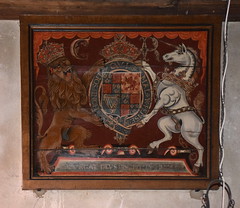
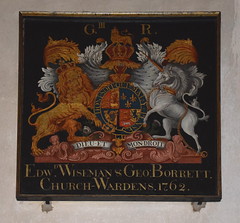
Secondly, there are two sets of royal arms, one above the
north door and one above the south. Neither has endured
the passage of time without damage, but both are
interesting. Those above the south door, on canvas, are
to George III, and carry the names of churchwardens
Edward Wiseman and George Borrett, and the date 1762. The
set above the north door, painted on board, is not clear
at all, but appears to be a rarer set to Charles I. I say
appears, because although they have Charles's initials,
they carry the motto Exurgat Deus Dissipentur Inimici,
which was that of Charles's predecessor James I.
There is an 18th century charity board in the north
aisle, and it must be said that this aisle feels
thoroughly rustic, without the urban patina so much
Victorian work has. It could almost be medieval, if you
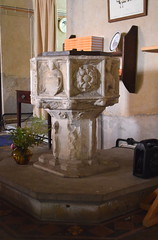
didn't know. The font is a grand 15th century one with
lions and fleurons on the bowl. The stem has been
vandalised, and when Mortlock came this way the lions
around the base had been replaced with plaster ones. But
these are now gone. The oldest thing inside the church is
actually the original 14th century chancel arch, which
was not rebuilt. It has little heads at 30cm intervals. I
wonder how many are portraits of parishioners of the
time?
This is a lovely church, quite unlike any other in this
part of Norfolk, with a special character and atmosphere
all of its own.
|
|
|