home I index I latest I glossary I introductions I e-mail I about this site
All Saints, Great Melton

Follow these journeys as they happen at Last Of England Twitter.
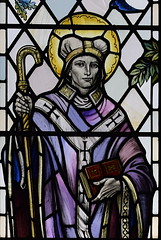
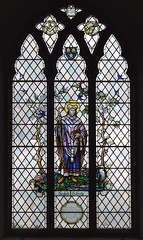
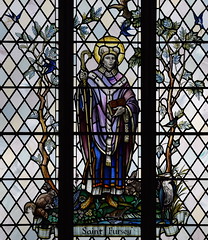
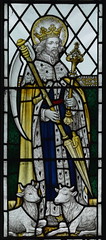
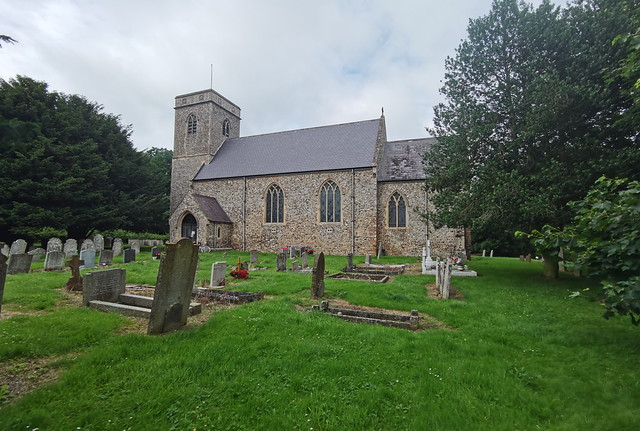
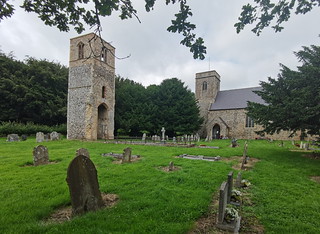
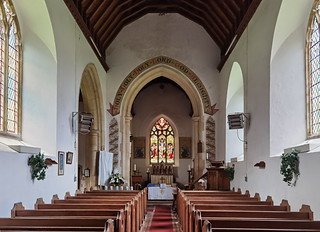
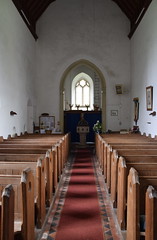
All Saints, Great Melton The long quiet lanes of rural mid-Norfolk hold few surprises, but to come around the corner and meet the twin 15th Century towers of the Great Melton churches in their wide, tidy churchyard is one of them. The southerly tower is of the ruined St Mary, the other of All Saints, the working church, but their stories are slightly complicated, because until the late 19th Century it was St Mary that was the working church and All Saints was almost derelict. The decision was made to consolidate the two and to build a bigger church than St Mary against the tower of All Saints. In the 1880s St Mary was demolished and the materials used to rebuild All Saints on the scale we now see it. The architect was Joseph Pearce, and the style was a spare, even stern Gothic perhaps more typical of domestic buildings in that decade. The walls are curiously high for the length of the church, although this is broken up on the north side by a transept which houses the organ. You step into a warm welcoming interior that inevitably feels narrow and perhaps a bit cluttered thanks to the height of the nave in proportion to its width. Almost everything is of the 1880s and not much is from after, so this is a time capsule of a kind. What does come later is some good 20th Century glass on the south side of the nave. St Fursey is the 1960s work of Goddard & Gibbs, and he stands with animals at his feet and birds flying in the air around him. He is set in clear glass, a precedence set by the window to the east of him. This is older, by Horace Wilkinson in 1929, and depicts St Walstan holding his scythe and coronet with a pair of bullocks seated at his feet.
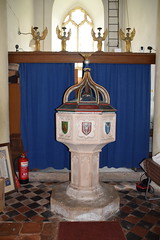
All Saints was obviously very High Church in its day, and there are still memories of this. The four angels from the riddle posts of the former Sarum screen line the top of the tower screen and look down on the painted font. Steps in the chancel rise to a small yet elegant altar and reredos with above it a rather remarkable east window. It is the 1880s work of Gibbs & Howard and thus was probably installed when the church was built. The firm had been established in the 1870s by young guns Isaac Gibbs and WIlliam Howard, both then only in their early twenties. Isaac Gibbs was the younger brother of the more famous Alexander Gibbs, but his work is in a quieter, distinctive, less expressionist style, much more in the Arts and Crafts tradition.The biggest scheme of his work in East Anglia is at Radwinter in north Essex, but he is here too, a Crucifixion flanked by English saints. They are St Etheldreda, St Ethelbert and St Erconwald on the left and St Alban, St Withburga and St Edmund on the right. The Light of the World glass in the chancel is also by the firm, but it is of twenty years later and by then they were past their splendid best. Simon Knott, July 2021 Follow these journeys as they happen at Last Of England Twitter. |



|
|||||||||||||||||||||||||||||||||||||||||||||||||||||||
home I index I latest I introductions I e-mail I about
this site I glossary
Norwich I ruined churches I desktop backgrounds I round tower churches
links I small
print I www.simonknott.co.uk I www.suffolkchurches.co.uk