| |
|
St James, Great Ellingham
Here we are in the agricultural
heartland of south Norfolk, in the rolling fields between
Norwich and Thetford. Attleborough is just a couple of
miles off, but otherwise Great Ellingham is the largest
village around here. And in this part of Norfolk it's
quite unusual to find a parish church with a village
spread around it. Great Ellingham is big enough to feel
like a proper place, and was once a substantial parish.
At the 1841 census the village had over a thousand
people, and could support two pubs, two beer houses, two
bakers and a butcher, as well as three blacksmiths, two
wheelwrights and a shoemaker. In common with much of the
rest of rural Norfolk, the population has declined since
then. The advent of supermarkets and the internal
combustion engine has seen off almost all the tradesmen.
But the large church still sits in its wide graveyard
surrounded by attractive houses. St James is the Lord of
all it surveys.
The church is typical of larger
East Anglian churches in that it has a long nave and
chancel, aisles and a clerestory. But what you see is
essentially a church of the early 14th century, the
Decorated period, with a spire of wood and lead, whereas
many of the big rebuilds in East Anglia are Perpendicular
work from a century or so later. The reason for this
prominence of later architecture is that the increased
prosperity of the region in the years after the Black
Death, and the renewed sense of mortality that the
pestilence encouraged, led to vast amounts of New Money
being spent on church rebuilds.
The Black Death carried off about half the population of
Norfolk. But this devastation was not evenly spread, and
the very young and the very old bore the brunt of the
disease. More people died in towns and cities than in the
countryside, and the poor suffered more than the rich.
However, the rich did suffer, and the old landed estates
were broken up where an owner died and no heir survived.
A rising merchant class pounced on the chance to buy
land, and the status that went with it. The new owners
rapidly became the ruling class. But there was still the
problem of death, especially when it came like a thief in
the night. The newly wealthy had to ensure that the poor
of the parish would pray for their souls if they met an
untimely end. A big new in-yer-face church was the best
way of doing this. Perhaps the newly rich themselves felt
insecure. Asserting their position in stone and bricks
must have helped their self-image. And there was also a
need to enforce control over the imagination of the
parishioners, because the naturally conservative East
Anglians did not always take kindly to the parvenus
of the newly moneyed, just as we did not easily warm to
vulgar Thatcherism half a millennium later.
But St James was not rebuilt. However, we should not
assume that this was because the parish was unusually
poor in the 15th century, or that the old order had not
changed, or that there was no wealthy benefactor. It may
simply be that the exterior was already so fine that all
the money was spent inside on furnishings.
The most singular aspect of the exterior is the
chequerwork. This is a decorative design whereby large
square blocks of knapped flint alternate with square
blocks of stone. Most famously in East Anglia it
decorates the mighty church at Southwold. Here at Great
Ellingham it is finer on the north side than on the
south. Perhaps the best view of all is from the
north-east corner of the graveyard, from where you can
see both the chequerwork and the glorious east window
with its flowing tracery.
Seeing such a grand exterior, you
may fear an overwhelming Victorianisation of the
interior. Bigger churches tended to be in poor condition
by the 19th century after long years of neglect, and the
Victorians could not often resist imposing a grand,
urban, anonymous interior on these large country
churches, quite out of keeping with the character and
history of the building. A good, or perhaps that should
be bad, example of that kind of thing around here is a
few miles off at Hingham. However, St James has the great
benefit of an interior which is at once wholly rustic and
grand, a difficult combination that always takes the
breath away when it works. It does here.
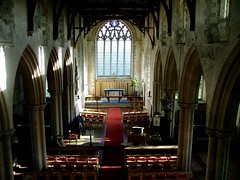
The tall unbroken nave and chancel are bright and open
beneath rank upon rank of ancient beams. A 15th Century
arch-braced roof crowns the nave, and there is one of the
late 18th Century in the chancel, which looks as if it
has been hewn out of rough timber. Best of all, you can
climb to the ringers gallery beneath the tower to see it
all at close quarters, and to gaze eastwards through a
forest of beams. The great east window carries the eye
onwards, and fills the building with light. Cautley
didn't think much of the chancel roof, but it has great
character, particularly the way that the carpenter
supported it by carrying the uprights over the clerestory
windows. Judging by the position of the corbels, this
must always have been the case.
Back on the ground, modern chairs and simple furnishings
create a welcoming feeling. The font, with shields in
lozenges, is 14th Century and must be contemporary with
the grand rebuilding of the time. When I first came here
at the start of the century it was still filled with holy
water to act as a stoup, and this combined with the smell
of incense gave a sense of the character of the worship
here.
The wide aisles are a pleasant place to wander, not least
because they are home to a variety of medieval survivals
and some good 20th Century work, a happy combination. The
lack of 19th Century glass means that they are filled
with light. Indeed, you would be hard pressed to find
anything of the 19th century at all here, which shows
considerable skill and sleight of hand on the part of the
Victorians, since the layout of the interior here is
certainly a 19th century reinvention of its medieval
past. During the 17th and 18th Centuries, St James would
have been more of a preaching house than a sacramental
space. A 20th Century restoration revealed the wall
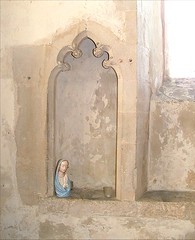
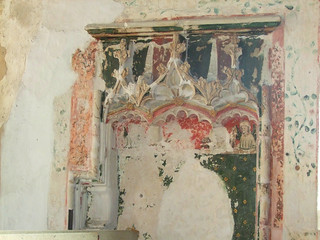
paintings. There is a large image niche near to the east
end of the south aisle that is thought to have once been
associated with the shrine to Our Lady of Ellingham. It
is painted in rich greens and reads, and includes angels
in exquisite detail at the top. A piscina on the far side
of the window embrasure is contemporary with it.
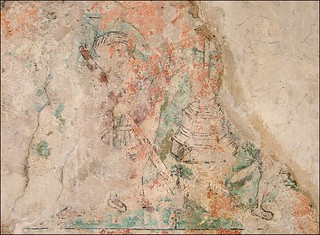 
An even more interesting painting
is at the west end of the aisle. It shows, or appears to
show, a traveller with a pilgrim staff approaching a
preaching cross, while on the far side a creature with a
tail walks away. The pilgrim figure has been variously
interpreted as St James or St Christopher, neither of
which is wholly satisfactory. This painting reminds me of
the boss in the porch at Norwich St Stephen which depicts
a cloaked figure, and a preaching cross, and what may be
a devil. The boss has also never been satisfactorily
explained.
In the north aisle the entrance to the rood loft stairs
shows that the screen stretched right the way across the
church, and must have been very impressive indeed,
especially in such a high space. Very little of it
survives. A few bays of the dado cordon off the chapel of
Our Lady in the south aisle, and there are some more
panels at the west end of that aisle near to the south
door.
The small amount of coloured glass
here dates from the 1920s and may have been the work of
King and Son. The evangelistic symbols are enamel work ,
and are signed C.C.T & J.H. fecit. St James
in the south aisle depicts the legend of Santiago de
Compostella, St James of the Field of Stars. As Mortlock
points out, the artist didn't realise that in the Legend
of St James the boat traditionally arrives without sails.
I said that this church is both rustic and grand, but it
is not a grandness which depended on the patronage of a
single landed family. There are few memorials, and these
are understated. Even the church's only brass, up in the
chancel, is a simple yet lovely image of a lady wearing a
rather ordinary head dress and gown. She is believed to
be Anne Conners, and to date from about 1500. All in all
the church of St James is a good example of the way that
centuries of both care and neglect can conspire to
produce something organically beautiful, a building that
feels loved and used, abounding in a character all of its
own.
Simon Knott, November 2020
Follow these journeys as they happen at Last Of England
Twitter.
|
|
|