home I index I latest I glossary I introductions I e-mail I about this site
St George, Gooderstone


Follow these journeys as they happen at Last Of England Twitter.
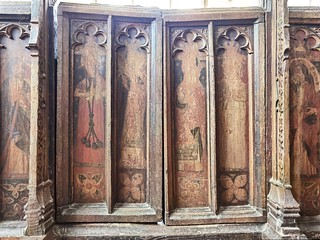
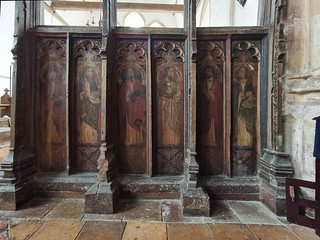
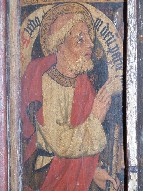
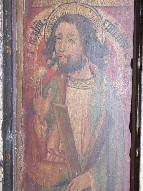
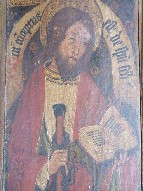
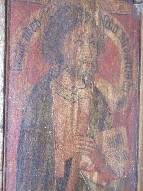
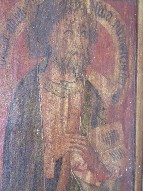
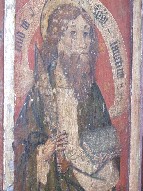
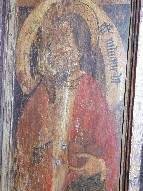
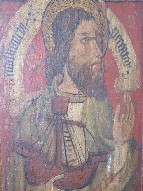
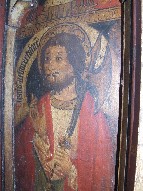
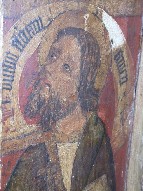
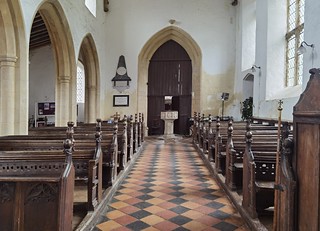
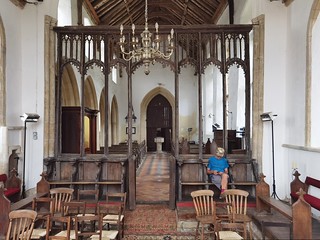
St George, Gooderstone The north Norfolk coast and the Broads are both popular with visitors, and that is one of the reasons why their churches are so well known. It would be difficult to argue that west Norfolk was familiar to tourists though. This is an industrious agricultural area, a landscape of narrow lanes which dogleg absent-mindedly through the heathland and woodlands, occasionally petering out altogether among the fields. The villages that are scattered through this landscape are often inconsequential, and surprisingly remote from each other. Gooderstone and its neighbour Foulden are larger places than most, but I doubt that too many outsiders have heard of them. Both villages have large churches which are near-twins to each other, one with a tower and one without, but both full of interest and character. Gooderstone's church is the one with the tower. This went up at the end of the 13th Century, roughly contemporarily with the chancel at the other end of the building. Next came the aisle and the porch with its circular curvilinear windows, and then towards the end of the medieval period the nave was raised with a clerestory, and the roof was rebuilt. Large Perpendicular windows were put in on the north side of the nave to fill the church with the rational light which suited the liturgical fashion of the time. You step through the south porch into a wide, open interior, full of light still thanks to the lack of coloured glass and, it must be said, a sympathetic 19th Century restoration. The interior is not as rough and ready as that of the church a few miles off at Foulden, but the big surprise here is a great sea of late medieval woodwork. Almost a full range of tracery-backed benches fill the nave and south aisle. There are similar benches in several churches around here, although none have anywhere near the number that are here at Gooderstone, but it is not hard to imagine that they were all produced by the same workshop. In the years after the Black Death there was a new urgency about reinforcing orthodox Catholic doctrine, a letting go of some of the superstitious local abuses of the past, an increasing suspicion of folkloric devotions. This was when the Seven Sacrament fonts and the wall paintings detailing the Works of Mercy and the Seven Deadly Sins began to appear, and Passion sequences that provided a scriptural framework for rosary prayers. For the first time, the priest stepped out of his domain in the chancel and made the nave his own, hence the need for these benches, so that parishioners could sit and listen to his homilies. It was the beginning of congregational worship, a full century at least before the Reformation. And the benches here are not the only manifestation of this time, for in every church in the land a rood and rood loft were erected above the chancel screen, which was often renewed for this purpose. The screen at Gooderstone is contemporary with the benches, about 1500, and it is remarkable in its way. Indeed, the late Sam Mortlock thought it was one of the most remarkable in England. Perhaps the most intriguing feature is the series of image brackets high up on the mullions, where statues of saints would have stood guard before the rood loft. There are the twelve Apostles on the dado, with the four Latin Doctors on the gates.
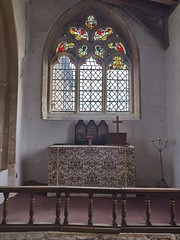
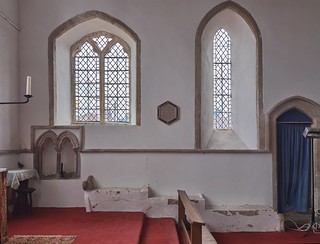
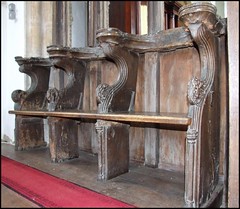
Up in the chancel, the remains of return stalls are set against the east side of the screen, though their former companions against the north and south walls are now gone. They would once have had misericord seats, but these have been replaced with wooden boards. The sedilia up in the sanctuary have been hacked away so that only the seats themselves have survived, but the double piscina to the east of them remains in use. And yet more survivals of the late medieval life of Gooderstone parish survive in the upper lights of the tracery of the south aisle east window. At the top, Christ sits in judgement. Below him, angels cense him and also the dead rising from their graves below him. This is not an unfamiliar scene in wall paintings, but I do not think I have seen it in glass anywhere else in East Anglia. But is the glass in its original configuration? It would be nice to think so. But I can't help wondering if the face of Christ is 14th Century, and the other glass is restored.
At the time of the 1851 census of Religious Worship, the population of the parish of Gooderstone was just over six hundred people, forty of whom attended morning worship along with the forty scholars who had no choice but to be there. This proportion is fairly typical of west Norfolk where there was not a lot of enthusiasm for the Established Church. The afternoon sermon was, as usual in East Anglia, more popular, the non-conformist sympathies of many of the parishioners preferring a bit of firebrand preaching to what were still seen as the rituals of the ruling classes. Even so, the average Sunday afternoon attendance at Gooderstone was only eighty. Simon Knott, August 2022 Follow these journeys as they happen at Last Of England Twitter.
|
|
|||||||||||||||||||||||||||||||||||||||||||||||||||||||
home I index I latest I introductions I e-mail I about
this site I glossary
Norwich I ruined churches I desktop backgrounds I round tower churches
links I small
print I www.simonknott.co.uk I www.suffolkchurches.co.uk