home I index I latest I glossary I introductions I e-mail I about this site
St Martin, Glandford

Follow these journeys as they happen at Last Of England Twitter.
| St
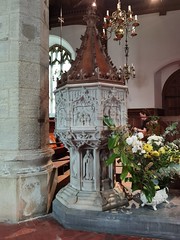
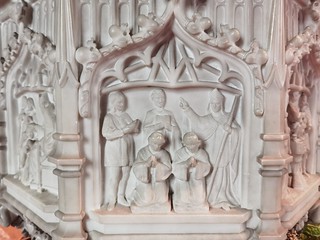
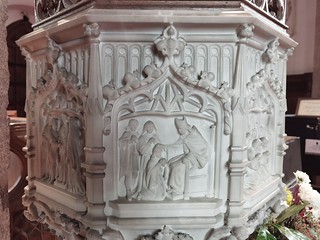
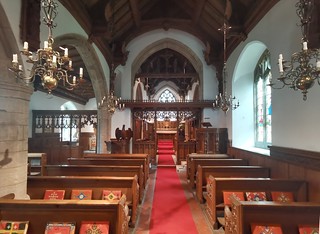
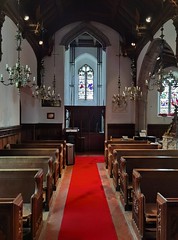
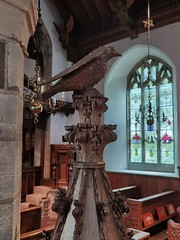
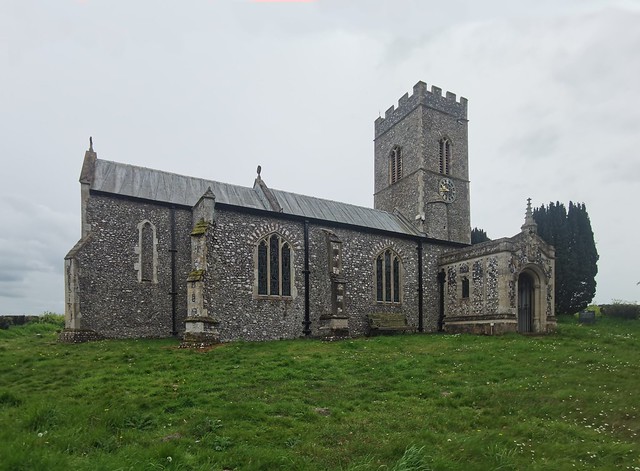
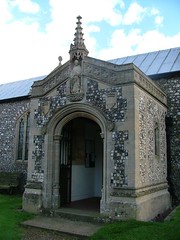
Martin, Glandford Glandford is a tiny village in an idyllic setting among the rolling north Norfolk hills, just before the fields and copses drop away to become the marshes and the sea. It sits within the wide purlieus of Bayfield Hall, and by the early years of the 18th Century the adjoining parishes of Glandford and Bayfield had the distinction of both having churches which were in ruins. As often in the arcane world of church administration, a rector was still appointed at Bayfield (population 21 at the 1851 census) with an income of £40 a year (about £8,000 in today's money), for which he would have to say a service once a year within the ruin of Bayfield church. Glandford (population 81) however came as part of the package for the rector of the joint benefice of Cockthorpe and Blakeney. Presumably parishioners would walk up the hill to Wiveton for services. To lose one church is unfortunate, to lose both looks like carelessness, but Sir Alfred Jodrell, the energetic heir to the Bayfield Hall estate, would change all that. In the 1890s he rebuilt Glandford village with, as Pevsner notes, flint and red-brick houses and cottages, most with shaped gables. And then, in 1896 his mother died, and he decided to rebuild Glandford church in her memory. The project took almost seven years to complete. All that remained of the old church was most of the tower, the north arcade and parts of the outer walls, and these were successfully cannibalised for the new building, which appears to have been much the same size and in the style of the old one, which is to say with a 14th Century-style tower and chancel and a 15th Century-style nave and north aisle. The tower contains a carillon of twelve small bells which play a variety of simple hymn tunes. The church sits in a tight churchyard fairly high up above the road. Below it is the famous Glandford Shell Museum, another of Jodrell's enthusiasms. Entrance is through the north porch which has a perky crocketted turret containing an image of the church's patron saint. Stepping inside is to enter one of the most opulent interiors of any of Norfolk's smaller churches, for no expense was spared by Jodrell in his attempt to recreate the glory of the late Middle Ages. The arcade is the only survival of the earlier church. Benches crowd the nave and aisle, and directly in front of you is the surprise of an early 20th Century Seven Sacrament font. It is said to be based on the early 16th Century one at Walsoken, but the style is very much that of its own date. It also, not unreasonably, depicts the practice of the times, so for example in the Baptism panel the baby is shown having water from the font poured over its head. On the Walsoken font the scene depicts the baby being totally immersed in the pre-Reformation practice.
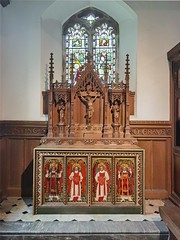
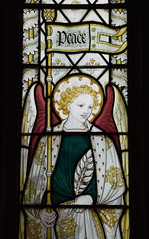
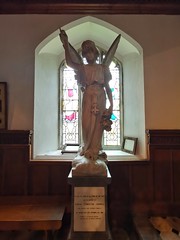
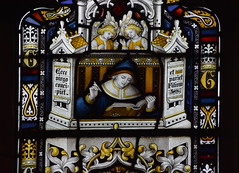
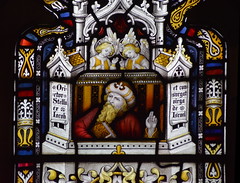
The most opulent part of the church is the chancel with its angel roof and its high stepped altar. The jewel-like effect of the interior is created by an almost complete scheme of glass by Herbert Bryans and Ernest Heasman depicting saints, among them St Martin, St George, St Mary Cleophas, St Mary Magdalene, St Mary Salome, St Barbara, St Christopher which I think suggests the full flood of Alfred Jodrell's Anglo-Catholicism, although that tide has obviously receded today. There are no dedicatory inscriptions, but the first two saints are often associated with war memorial windows, and there are also depictions of Peace and Justice, so I think that much of this glass dates from about 1920. Interestingly, Sir Alfred bankrolled the restoration of the north transept at Salle, which is also filled with glass by Bryans and Heasman. The earlier glass of 1906 in the east window is by Kempe & Co, and that in the north aisle chapel by Herbert Bryans of the same date. It is this chapel which is the dramatic focus of the church, for it forms a memorial to Adela Monckton Jodrell, Sir Alfred's mother. Under a richly panelled roof a grieving angel holds a wreath and points skywards. Pevsner records that it was the work of Pietro Bazzanti of Florence. Beside it, the altar is painted in an Arts and Crafts style with four angels. O Death where is they Sting? O Grave where is thy Victory? reads the inscription around the wall.
Coming back into the nave, the furnishings are all of the highest quality. A bench in the aisle features a dog on its end, said to be Sir Alfred's retriever but I did wonder if, as it is looking faithfully into the memorial chapel, if it had actually been his mother's. The pulpit features saints under canopies, and along with that on the benches and the roofs the carving was by the workshop of Walter Thompson & Frank McGinnity. A plaque on the wall commemorates the rebuilding, noting with precision that the work began on October 17th 1899 and was completed on 30th August 1906. It records the names of the persons who took part in the work. The architects were Messrs Hicks & Charlewood, and among the others listed are carvers, carpenters, bricklayers, stonemasons and, quaintly, helpers. Mortlock, a thoughtful commentator on East Anglian churches, considered not unfairly that although the overall effect is faintly overpowering, the whole building is a perfect example of what 19th Century craftsmen could achieve in the tradition of their 15th Century predecessors. Amen to that. Simon Knott, May 2023 Follow these journeys as they happen at Last Of England Twitter.
|
|
|||||||||||||||||||||||||||||||||||||||||||||||||||||||
home I index I latest I introductions I e-mail I about this site I glossary
links I small
print I www.simonknott.co.uk I www.suffolkchurches.co.uk
ruined churches I desktop backgrounds I round tower churches