home I index I latest I glossary I introductions I e-mail I about this site
St Helen, Gateley




Follow these journeys as they happen at Last Of England Twitter.
| St Helen,
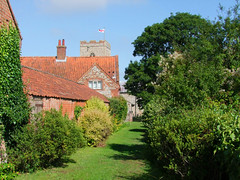
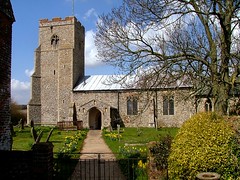
Gateley The greening of Norfolk happens so swiftly. After the relentless cold of winter, a few days of warm rain and sunshine bring about a sudden change, the recent buds relax and spread, and the countryside is transformed from its harsh monochrome into a thousand shades of gently blooming green. The lanes begin to narrow, the angelica and cow parsley erupting below thickening hedges, and the land becomes more secretive, its close-knit parishes hidden, the church towers in their huddled graveyards seeming more remote than when exposed in bare winter. If you live in the middle of a big
city, or in some sprawling suburban hinterland, it may be
hard for you to comprehend just how remote Gateley is.
You come along the little lane from Brisley, branching
off onto smaller lanes through rolling, high-copsed
farmland. If anything comes the other way there's
negotiating to be done, but nothing ever does. There is
no village, not even a hamlet, just occasional farms and
the odd row of cottages. If you stop the car there is an
intense quiet apart from the birds who know they own the
place. If another human being crosses your path it would
be something to remark upon, but none ever do. Nearer to
the church there is open parkland. A herd of deer, like a
fleet of silent and steadily moving ships, crops the new
spring grass that still shines from overnight rain.
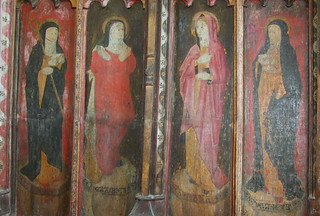
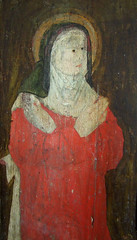
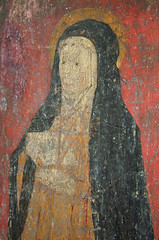
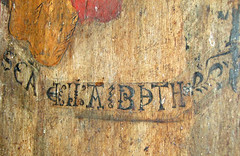
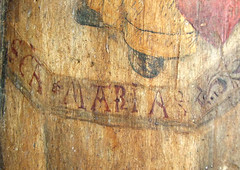
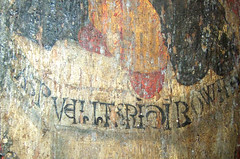
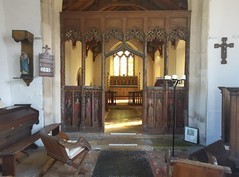
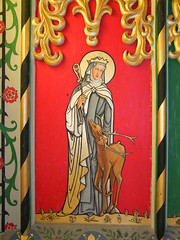
On the far left of the north side of the screen is St Etheldreda, foundress of the Diocese of Ely and shown here as a nun labelled in Latin, Scta Adria, which is to say St Audrey. She is probably the nun on the screen at nearby Litcham. Next, St Elizabeth, also with a nun's habit and her arms crossed. Beside her is the Blessed Virgin, who turns to face her cousin, and it is not hard to think that these two panels together form an image of the Visitation. The final figure on the south side is the first curiosity, the Mistress of Ridibowne, a local devotion. Virtually nothing is known about her. Ridibowne was probably either Redbowne in Lincolnshire or Redbowne in Hertfordshire. No other representation is known to exist, although she may be the unidentified figure holding a spray on the screen formerly at Babingley. Two early 16th Century wills point to other local devotions to her, one at Hackford and the other at Cromer (thanks to Ann Eljenholm Nichols for this information.)
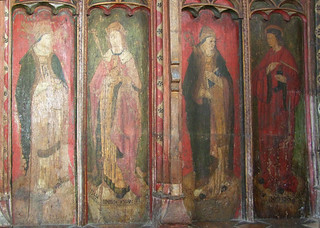
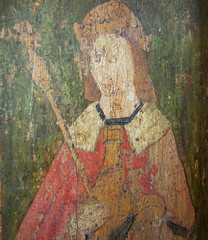
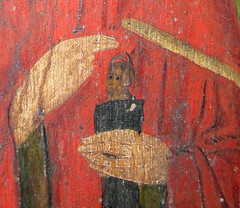
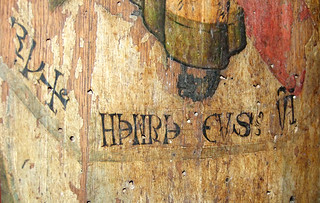
Turning to the south side of the screen, the first figure from the left is St Louis of France. Beside him, Henry VI is labelled in Latin as 'the Blessed Martyr Henry VI', and then St Augustine and finally Sir John Schorne, conjuring the devil into a boot - although the late Tom Muckley argued that the legend had become corrupted, for devotion to Sir John was considered efficacious against gout, and so surely he is conjuring the devil out of the boot (Tom was a sufferer from gout himself)..
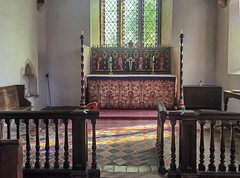
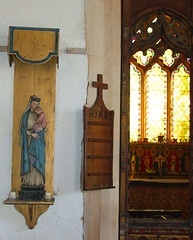
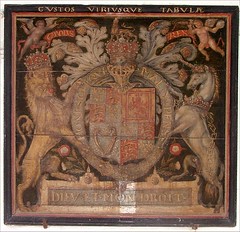
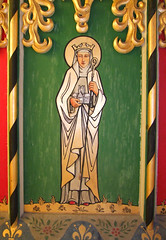
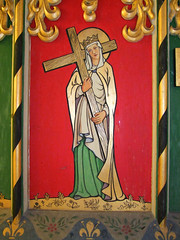
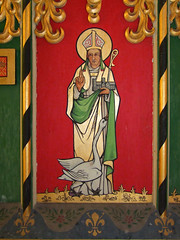
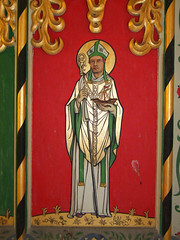
There are memories of 20th Century Anglo-catholic piety at Gateley. The statue of the Blessed Virgin had candles in front when I first came here in April 2005, although we were here in Holy Week but it was not veiled, so perhaps this is an enthusiasm whose time has gone. A gilded 20th Century reredos set in a Sarum screen depicts six saints. As on screen they are female on the north side and male on the south side, with the St Withburga, St Etheldreda and St Helen to the north and St Hugh, St Walstan and St Felix to the north. There are traces of decorative wall painting at the north-west corner of the nave that probably predate the Perpendicular of the windows, and a really good Charles I set of royal arms. Rather than initials it gives his name as Carolus Rex. This is in itself an unusual thing to find, but is made even more interesting by the inscription painted on the frame, Custos Utruisque Tabulae, which means something like 'he guards both tables' which Mortlock suggests means that the arms were at one time associated with a set of decalogue boards. It may also hint at his being king over two Kingdoms. Presumably it was painted by royalist parishioners, a reminder to anyone who was tempted to support the parliamentarians that the King was God's representative on Earth, or at least in England, and that any attempt to subvert his authority was to turn the natural order upside down. But it did no good, because he was beheaded anyway. Simon Knott, December 2021 Follow these journeys as they happen at Last Of England Twitter. |




|
|||||||||||||||||||||||||||||||||||||||||||||||||||||||
home I index I latest I introductions I e-mail I about
this site I glossary
Norwich I ruined churches I desktop backgrounds I round tower churches
links I small
print I www.simonknott.co.uk I www.suffolkchurches.co.uk