home I index I latest I glossary I introductions I e-mail I about this site
St Swithin, Frettenham

Follow these journeys as they happen at Last Of England Twitter.
| St
Swithin, Frettenham Frettenham
is another large village in the otherwise intensely rural
rolling fields between Norwich and the Broads. Someone I
met in one of the Sprowston churches once told me that
locals there thought of themselves as living in 'suburban
Broadland', but I thought this was a better description
of Frettenham. Arthur Mee noted in the 1930s that every
cottage was given half an acre of land by the late Lord
Suffield, although there appears to have been
considerable building since then, perhaps on some of
those half acres. I was disappointed to find that Post
Office Road no longer had a post office, but School Lane
still has a school, and heading out of the village to the
north is Church Lane. You can see the tower of St Swithin
from a fair distance, because it is a tall tower of a big
church, quite a contrast with nearby Spixworth on the
road to Norwich. But here, the church sits on its own,
away from the village and out in the fields. The
sprawling graveyard is lined with old trees, and there is
perhaps a sense of loneliness and abandonment after the
crisp suburban streets of the village. This is an
illusion of course, because Frettenham church is still
very much in use. But the churchyard is perhaps not an
unreasonable suggestion of what we will find inside.
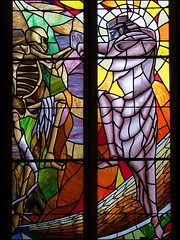
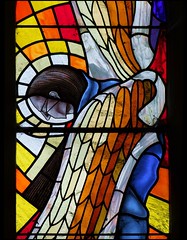
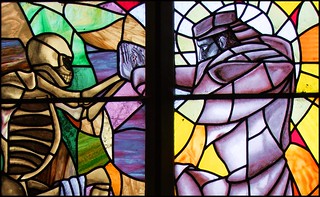
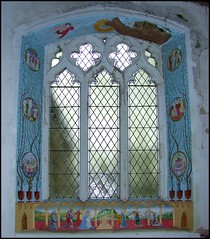
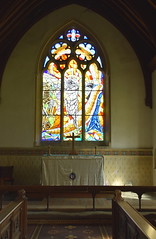
In fact, it is quite true. The designer was Paul Greener, a young man of 24 who joined the Youth Opportunities Programme after being unemployed for six months. The working party were engaged on building and decoration repairs in the church, and being given a fairly free hand they decided to go a step further. The chargehand of the working party, Michael Lane and the young Paul Greener painted the decorative mural work that you see around the east window of the south aisle. It depicts the life of St Swithin in roundels connected by vines, although unfortunately it has more recently suffered badly from water soaking through at the top. However, at the time it was received very well by the parish, so the two suggested they might have a go at some stained glass. As Paul told me later, 'none of us had had any training at all, but we went on a simple course and I did some designs for the little chancel windows. I think I did two and Mike did two. Well. they seemed to be received well, despite the fact that neither of us knew what we were doing. I realised at the time that I was involved in some thing pretty unique!'
These first pieces are set into the
upper lights of the chancel north windows. One depicts
the keys of St Peter, another two fish. Another
sympathetic mind, Richard Seaman, joined the project.
Buoyed up by their success so far, the three suggested
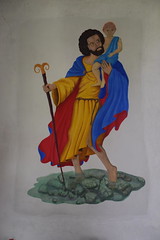
what would be their biggest legacies, the St Christopher
in the north aisle, and the east window. The parish
wanted a Resurrection scene, and so Paul made the design
in the evening at home. He continues: 'I worked this up
in to a first cartoon which got sent to Canterbury for
perusal. Much to my surprise, it was accepted. The window
itself was made in two places, in Frettenham church
itself, and in a room at the Broadland District Council's
waste disposal depot in Frettenham. We had to buy a kiln
for the firing of the painted segments of glass. We knew
virtually nothing of the technique of manufacture, and I
remember we were allowed to buy a book on it. It was
absolutely invaluable, and we would have struggled even
more than we did without it. There were three of us
working on it in the initial stages: me, Michael Lane and
Richard Seaman. Then Mike left the MSC project for a job
with Broadland Council. That left me and Richard to
soldier on. However, Richard had a degree in painting,
and between the two of us I think you will agree, we
seemed to manage. I did most of the cutting of the glass,
while Richard did most of the lead-work. We shared the
glass painting and the firing, and all the soldering and
cementing and the messy stuff. The making of the east
window took about six to eight months, including the
fitting of it, which I believe was about three weeks all
told. During this time Richard was also working on the
St. Christopher, of which I did but a small part. The
window was unveiled at the Easter Sunday service in
1988.'
Nearby, the inscription to Richard
Woodes, a rector here who died in 1620, tells us that he
had been a paynefull and profitable minister of God
for 48 years. This hardly sounds like a compliment
to modern ears, but presumably means that he was
painstaking in his work, and was able in teaching his
flock the meaning of scripture, which was no less than
any heartily protestant congregation of the early 17th
Century would expect from their minister. Such Puritan
sentiments would resound down the following half century,
as hundreds of more sacramentally-minded ministers in
East Anglia were hounded out by outraged parishioners and
lost their parishes and homes to the sequestration courts
of the Commonwealth period. They would be described in
the witness accounts as 'scandalous ministers', and the
charges laid against them would include drinking in
alehouses and consorting with common whores, but their
only real crime was that their theology and churchmanship
disagreed with that laid down by the government, and they
refused to collude with the Puritans' plan to recast the
minds of the common people in their own mould.
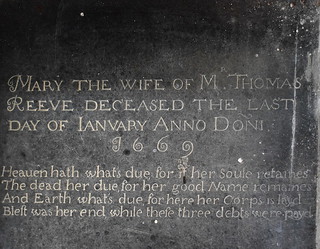
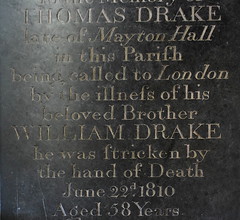
Equally memorable with the 1980s
work and the brasses are the inscriptions on some of the
ledger stones. Of Mary Reeve, who died in 1669, it was
recorded that Simon Knott, August 2019 Follow these journeys as they happen at Last Of England Twitter. |




|
|||||||||||||||||||||||||||||||||||||||||||||||||||||||
|
|||||||||||||||||||||||||||||||||||||||||||||||||||||||
home I index I latest I introductions I e-mail I about
this site I glossary
Norwich I ruined churches I desktop backgrounds I round tower churches
links I small
print I www.simonknott.co.uk I www.suffolkchurches.co.uk