home I index I latest I glossary I introductions I e-mail I about this site
All Saints, Foulden


Follow these journeys as they happen at Last Of England Twitter.
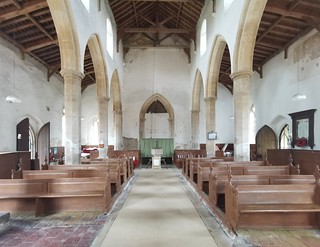
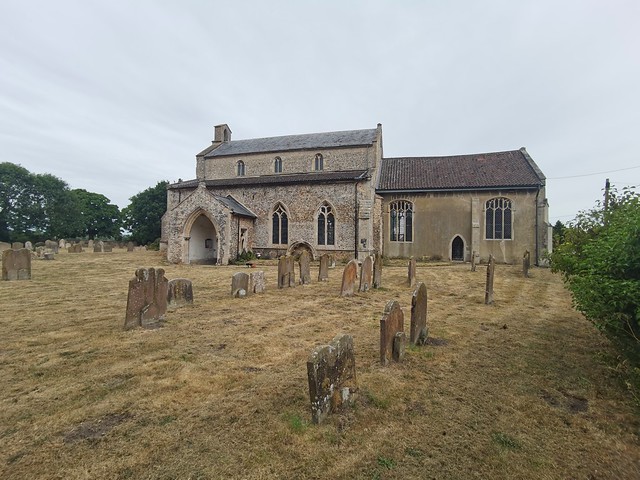
All Saints, Foulden All Saints is a rough
and ready church, set in the main street with bungalows
and a garage for company. I liked it a lot for this. It
made it seem real, and more vital. It reminded me of
villages in western France. It must have been a big
church once, but the tower collapsed in the 18th Century.
Enough survived for Ladbroke to draw in the 1820s, and in
1855 White's Directory could report that the tower is
an ivy-mantled ruin, but the rest of the fabric, after
being long in a dilapidated state, has recently been
thoroughly repaired. This tells us that the 19th
Century restoration of All Saints was an early one, and
probably explains the patched up feel to the west end -
twenty years later, it would probably have been rebuilt.
No remains of the fallen tower survive today. A curiosity
on the outside south wall of the nave is a cusped tomb
recess, said to be variously that of Roger Weyland or Sir
John de Crake, supposed founder of the church.
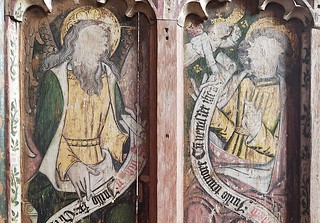
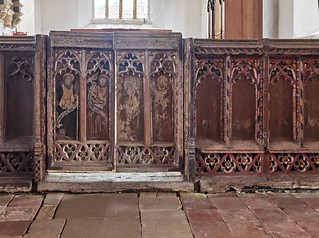
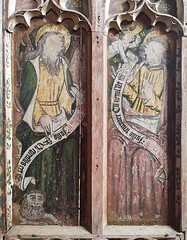
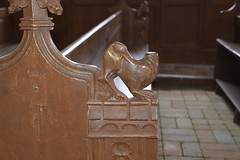
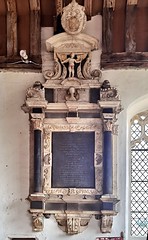
The most striking figures on the Foulden screen are the four Evangelists on the gates. St Matthew and St Mark on the northern gate have been restored. St John and St Luke on the other have not, but are still discernible. St Matthew looks up in apparent surprise as an angel delivers to him the opening words of his Gospel on a scroll, and St Mark's lion sprawls lazily at the Evangelist's feet. As is common in the iconography of the time, the four are given wings, but they are not angels as is recorded in some sources. The north side range is completely blank, but the six figures on the south side include St Jerome (his cardinal's hat vivid through the paint) and at least one other is a Bishop, and thus probably one of the other Latin Doctors, perhaps St Augustine. Hauntingly, a crowned Saint peers through the iconoclastic gloom with piercing blue eyes. Several of the benches in the nave are 15th Century, and so are contemporary with the screen. They have some intriguing figures on their bench ends, the most unusual of which is a collared creature with wings and spikes on its back. So far, so strange, but at the other end of the creature its backside has the head of a fish, and as if that was not curious enough, the fish has just consumed another creature with a long bushy tail. I've not seen the like anywhere else in an East Anglian church, and I can only assume that it was the product of the imagination of a late medieval citizen of Foulden. Interestingly, one of the other bench ends is built into the structure of a 17th Century box pew in the north aisle. We know that this was a common occurence, and it was often how medieval bench ends survived to be restored to their former status by the Victorian restorers. At Hardley on the other side of Norfolk you can still see them encased in box pews. Spectacular 17th and 18th Century monuments, which would overwhelm a smaller church, are left to sulk in silence on the chancel and nave walls. Sam Mortlock thought the 1656 memorial to Robert Longe was pompous, and it is hard to disagree. They seem peculiarly out of sorts with the mystery of the screen, as if symptomatic of the change in emphasis after the Reformation. White's 1844 Directory reminds us that this was a particularly charitable parish in years gone by. At the time of the great Enclosure Act, three hundred acres were left open for supplying occupiers of the ancient cottages with pastorage and fuel. Rents derived from land in the parish of Old Buckenham supplied £22 worth of kersey, duffle and flannel for distribution among the poor every fifth year. And every Easter, £18 15s from money left in trust by Elizabeth Longe, the first wife of the 'pompous' Robert, along with bequests made by Robert Fuller and an unknown donor at Stoke Ferry were distributed among the most industrious parishioners of Foulden, which all three taken together must have provided support for just about all the poorer citizens of the place. Simon Knott, August 2022 Follow these journeys as they happen at Last Of England Twitter.
|
|
|||||||||||||||||||||||||||||||||||||||||||||||||||||||
home I index I latest I introductions I e-mail I about
this site I glossary
Norwich I ruined churches I desktop backgrounds I round tower churches
links I small
print I www.simonknott.co.uk I www.suffolkchurches.co.uk