home I index I latest I glossary I introductions I e-mail I about this site
All Saints, Filby
Follow these journeys as they happen at Last Of England Twitter.
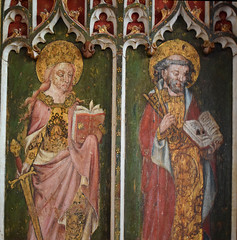
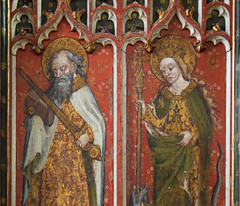
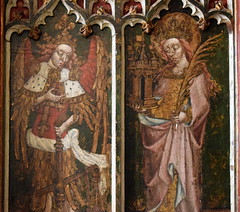
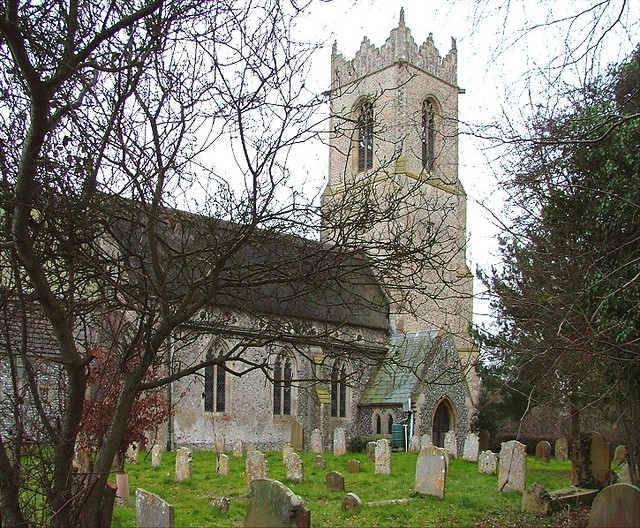
All Saints, Filby Filby is a large, lively village, virtually a suburb of Caister, and its church is a big one, out in the fields to the south of the main street. This area is known as the Flegg. It was a Viking occupied island long before the Conquest, and this is reflected in its Old Norse placenames which almost all end with the suffix -by, usually referring to a farmstead. This was a big 14th Century church which was enhanced with a grand tower during the following couple of centuries, and possibly the arcades were rebuilt too. There were some enthusiastic restorations of the churches in this area during the 19th Century and the one at Filby was no exception, renewing all the window tracery although Pevsner was sure the clerestory is original. Any crispness is softened by the thatched roof of the nave. More than a hundred Norfolk churches have thatched roofs, but it is unusually to see one on a church as big as this. You enter the church from the west. The space beneath the tower is vast, the tower arch as high as the nave roof. It is reminiscent of stepping into Salle. I first came here late in the afternoon of a gloomy March day in 2006, and the darkness inside was near-complete, only the glass gently glimmering jewel-like in the distance. I came back ten years later with John Vigar thanks to a little difficulty at Ormesby St Michael nearby which I have described on the page for that church, and even on a brighter day it was still to enter a hushed, dimmed space. The font is a bit lost at the west end of the nave despite its prominent pedestal, which wreathed in health and safety tape at the time of my second visit. It is a 13th Century Purbeck marble font, typical of dozens in this part of Norfolk, but it has been so restored and buffed up that you have to look carefully to see that it really is old. Few of the churches in the Flegg have medieval survivals of any significance, but Filby does, for its 15th Century roodscreen dado, painted with eight figures, is in excellent condition, the style strongly reminiscent of the paintings on the screen not so very far off at Ranworth. From north to south, the figures are St Cecilia with her floral wreath, St George killing a dragon, St Catherine with her sword and wheel, St Peter with his keys, St Paul with his sword and book, St Margaret killing a dragon, St Michael weighing souls, and St Barbara holding a tower. This is a textbook example of the way in which saints are set in pairs across the screen. Working from the outside in, thus Barbara and Cecilia, Michael and George, Margaret and Catherine, Paul and Peter.
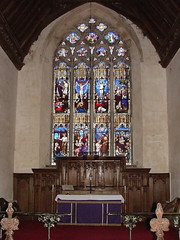
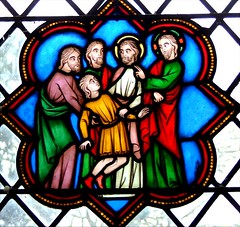
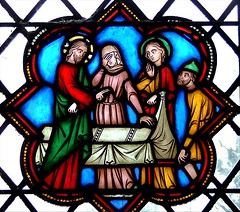
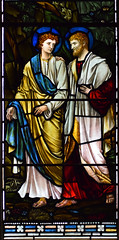
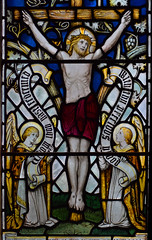
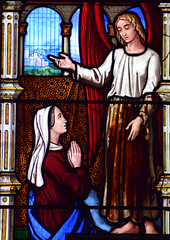
Not surprisingly for a large church with an enthusiastic 19th Century restoration, Filby has a good collection of that century's glass. Some of the earliest dates from the 1850s and is in a French cathedral style. Birkin Haward thought it was likely the work of Alfred Gerente of Paris, found elsewhere in Norfolk right across the county at Feltwell. Contemporary with it is the glass in the east and west windows by Ward & Nixon, but the best of the glass is later, with ER Frampton's glass in the great east window at the end of the south aisle in its painterly style, and Henry Holiday, on a somewhat different scale to his beautifully intimate glass at nearby Ormesby St Michael, for Powell & Son in the corresponding window in the north aisle. There are surprisingly few memorials for such a large church, but two are very impressive. They are to members of the Lucas family. The first, of 1790 to Gibson Lucas, depicts a slightly disproportionate figure wreathing two urns, but the other, to Charles Lucas of 1831, is spectacular, a sturdy, confident figure with an urn and a broken column. At the time of the 1851 Census of Religious Worship, just 100 of Filby's population of 531 attended morning service here, and 55 of those were scholars who would have had no choice. It wasn't the attractions of non-conformism that kept the others away, for none of the parish's three chapels had services that morning, and their afternoon attendances were barely into double figures. Perhaps the great majority of the people of Filby simply didn't go to church. Simon Knott, November 2020 Follow these journeys as they happen at Last Of England Twitter. |









|
|||||||||||||||||||||||||||||||||||||||||||||||||||||||
home I index I latest I introductions I e-mail I about
this site I glossary
Norwich I ruined churches I desktop backgrounds I round tower churches
links I small
print I www.simonknott.co.uk I www.suffolkchurches.co.uk