home I index I latest I glossary I introductions I e-mail I about this site
St Nicholas, Feltwell
Read
the captions by hovering over the images, and click on them to
see them enlarged.
St
Nicholas, Feltwell
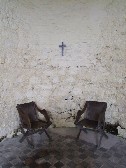
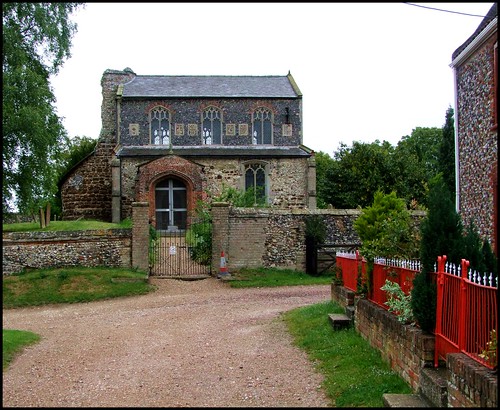
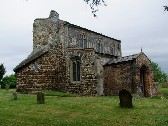
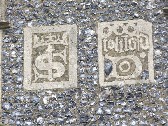
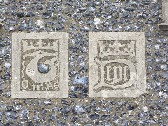
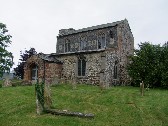
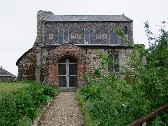
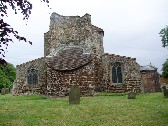
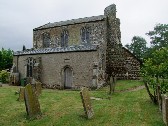
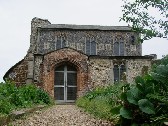
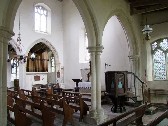
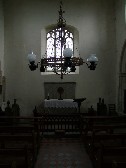
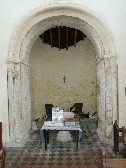
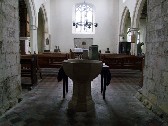
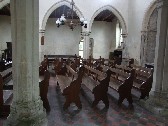
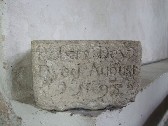
The chancel was demolished in the 1860s, not a common way of preparing a church for the Victorian Anglican revival, but also not unknown elsewhere in Norfolk. The demolition was apparently carried out by Frederick Preedy, who was working on the restoration of St Mary at the time. I wonder if he was looking for building materials. The carstone round tower was still standing then. It must have been similar to the one at Bexwell, not far off. But it collapsed one night in 1898. Perhaps the most striking feature of the building is the set of six flushwork panels, four with monograms, picked out in stone on the south side of the clerestory. Presumably, the monograms refer to 15th Century donors - those to the east appear to read Tomas Deye. Inside the church is a fragment of a memorial bearing an inscription to a Robert Dey, who died in 1698, and might possibly be a descendant. The other two are more mysterious: one is probably a crowned ST for St Thomas, but what is the one with smaller letters above a large capital D? The churchyard is strangely long and narrow, the church set at the extreme west end of it. This was never a big church, and the mixture of flint, freestone, carstone, red brick and (on the north side) yellow brick gives it a character quite unlike that of any other church in Norfolk. You step into a large, square space, as wide as it is long. There is little coloured glass, but there is only one window in each of the aisle walls. This gives a curious effect, with light shed into the building from small windows to east and west, but mostly from above, in the delicious clerestory. This creates a luminosity in the upper white walls, almost a theatrical effect, and a sense that this really is a place apart. The atmosphere is utterly charming: this is a church which has not changed much at all since the nineteenth century. It is a memory of our Victorian rural ancestors, who would not be out of place here even now in this dusty silence filled with slanting light.
|
Simon Knott, July 2009

|
||||||||||||||||||||||||||||||||||||||||||||||||||||||
home I index I latest I introductions I e-mail I about
this site I glossary
Norwich I ruined churches I desktop backgrounds I round tower churches
links I small
print I www.simonknott.co.uk I www.suffolkchurches.co.uk