home I index I latest I glossary I introductions I e-mail I about this site
St Mary, Elsing

| St Mary,
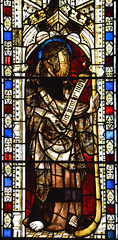
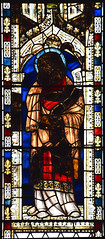
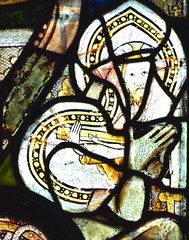
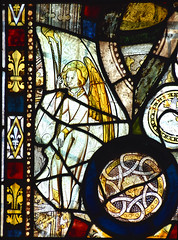
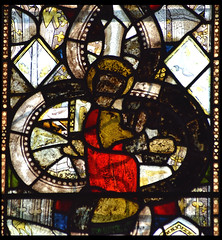
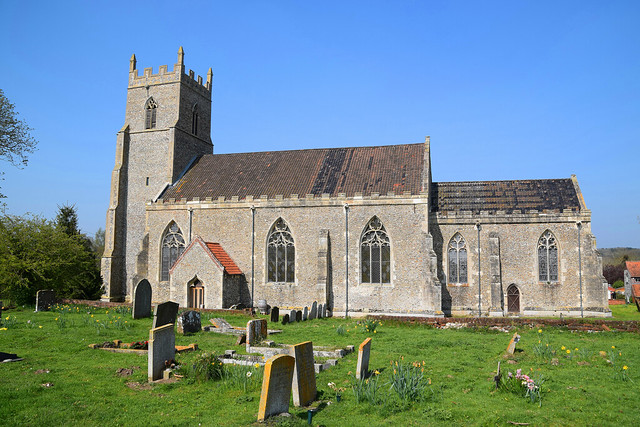
Elsing Here we are, almost exactly in the middle of Norfolk, with St Mary on a hill as if surveying its estates. In almost any other county, this splendid church would be far better known. As it is, there is one particular feature of it which is renowned above all others, which is a pity, because this is a building full of interest, with lots of medieval details, and not difficult to read and understand. St Mary is unusual in that it was pretty much all built in one go. Even more unusually, this happened early in the 14th Century, just before the Black Death made us all serious, and as such it is not at all typical in style for East Anglia. This is a Decorated building with hardly a single Perpendicular modification. As far as the architecture goes, it is almost as if the 15th Century had never happened here. Inevitably, such a forceful statement is a result of the ruthlessness and ambition of a single family, a single man. This building is pretty much a mausoleum to Sir Hugh Hastings, as though it was a pyramid commissioned by a Pharoah. He died in 1347, and this church was probably begun in earnest about 1330 at his behest. It's a wide church, but there are no aisles, and the nave lies under a single span roof of just over 12 metres, the biggest in East Anglia and one of the biggest in England. It may well have caused the masons a few problems, because the current roof dates from the end of the 18th Century, its kingposts resting on arched ties. Beneath it, you step into a huge space which swallows sound, a sense of awe enhanced by the clearing of the 19th Century pews from the west end of the nave. This serves as a perfect foil to one of the few Perpendicular features here, Elsing's magnificent font cover, a riot of pinnacles and niches that climbs into the roof. It's mid-15th century, and sits on a font a century older, commissioned and placed in the rebuilt church of the 1340s, and as such also not at all typical of the fonts of Norfolk and Suffolk. The glass in the east window is clear, as it is also in the huge Decorated windows of the nave. A space so wide and high-pitched as this is full of light, as if the building were the air itself, not merely the walls containing it. This is an achievement of the architecture, but these windows were once filled with coloured 14th Century glass, of which only fragments remain. Perhaps there are enough to comprehend what it must once have been like. There was a range of large images of the twelve disciples holding scrolls with clauses from the Apostles Creed. Of these, three survive, reset in the chancel. St Jude holds his ship, St James the Less his fuller's club, while the third has lost his inscription, but may well be St Simon. They are reset among fragments of other medieval glass, which provide some interesting details, including a Blessed Virgin and Child that is clearly pre-1350 and so probably dates from the opening of the building.
At the time of the 1851 Census of Religious Worship the parish of Elsing had a population of four hundred, but only fifteen of them made their way into this great space for the morning service. As you'd expect in East Anglia, there were far more here to listen to the afternoon sermon, but even so, the Reverend William Browne who was curate of Elsing felt moved add a footnote to the return. I beg to remark, he wrote, with respect to the number of attendants, that the returns I have made consist (with very few exceptions) entirely of the lower orders. Whether this was a point of pride or despair it is hard to say. Probably many of the parishioners attended the nearby Methodist and Wesleyan chapels in Elsing, Lyng and North Tuddenham, all of which had much higher attendances that Sunday. But it is Sir Henry Hastings that we have come to see. His brass lies on a pedestal in the chancel under locked doors, but a full-size replica leans at the west end of the nave. Pevsner thought it the most sumptuous of all English church brasses. Hastings stands piously under an elaborate canopy, his pillow held by angels. Above his head, a figure arises from winding sheets carried by angels, presumably his soul being carried up to heaven, and above that is a proud St George. Hastings is flanked by other figures, less apocryphal but equally martial, including Edward III. Surmounting everything is the Coronation of the Queen of Heaven.
Yes, the
brass is magnificent, the font cover is impressive, and
the glass is very interesting. But another medieval
survival here that is less well-known is the set of
painted panels on the rood screen dado. It is only a
recent restoration that has allowed all the subjects to
be tentatively identified. There are eight panels, and
the first two on the north side appear to be St Margaret
and St Dorothy. But it is the next two subjects that are
of most interest, because the third is the Visitation,
with the Blessed Virgin meeting a very pregnant St
Elizabeth and touching her tenderly. The fourth panel
depicts an earlier incident in Mary's life, St Anne
showing the young Blessed Virgin the passages in
scripture that predict her role in the Christ story. On
the south side are four men. The first two panels show St
Michael weighing souls and St George killing a dragon.
The last two are harder to decipher, but may be St John
the Baptist and St John the Evangelist. Simon Knott, January 2024 |


|
|||||||||||||||||||||||||||||||||||||||||||||||||||||||
home I index I latest I glossary I introductions I e-mail I about this site