| |
|
St Peter
and St Paul, Edgefield Canon
Walter Marcon, who was Rector of Edgefield for more than
sixty years from the 1870s to the 1930s, is remembered in
this part of Norfolk as the cycling parson, and for
moving his church half a mile, stone by stone. If you
stop to think about it, this is rather curious, for few
and far between must have been the ministers of the time
who did not cycle about their parish, and the rebuilding
of their medieval churches was also a common thing. Even
the moving of a church building was not so unusual, for
the same thing happened only a few miles off at
Hindolveston, and also at Fulmodeston and Croxton.
Perhaps the reason for Marcon's fame is his long
incumbency. It is as if a Rector of a Norfolk parish
today had comforted the same flock at the time of the
Suez Crisis. And perhaps there is another reason, for
Marcon's new church is very successful, a template for
what a successful small-scale village church should be
like for the new century.
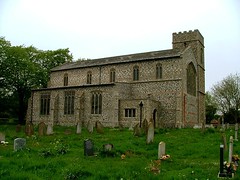
In 1882, the old church out
in the fields was dismantled, and the materials put
towards the new one nearer the middle of the village. The
architect was JD Sedding. The plan is familiar, in the
style of a typical East Anglian Perpendicular church of
the 15th century, with aisles and a clerestory. The cool
lines and use of flint and brick are at once confident
and organic, fitting the setting perfectly.The coy tower,
in the north-east corner, is in the spirit of its age but
perhaps unfortunate. It was added thirty years later, and
has the appearance of a scaled-down unbuttressed west
tower of the early Perpendicular period. It is
functional, with a vestry at the bottom, but even so has
a kitschy air that detracts from the gravitas of the rest
of the building.
You step into a cool, clean, wide interior that still has
the feeling of the early 20th century. The arrangement is
traditional, with benches facing a wooden screen. The
chancel space beyond is wide and open, the altar dressed
and backed in restrained embroidered fabrics. Perhaps the
best memorable feature of the church is the scheme of
glass by John Hayward from the 1980s and the year 2000
set to north and south of the nave. In contrast, the east
and west windows are clear, flooding the building with
light as Sedding and Marcon obviously intended. Perhaps
because of this, Hayward's glass has a kind of water
colour effect, at their strongest in the centre of the
design with the outer edges diluting into nothing.
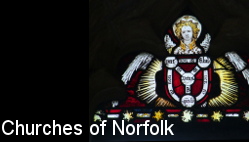
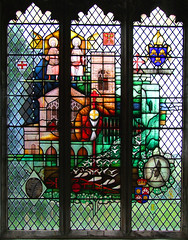
The 1980s window remembers the building of the church.
Canon Marcon is depicted riding his bike in a roundel at
the bottom, and the church's twin patrons sit enthroned
at the top. TA plough followed by seagulls at the bottom,
which is reminiscent of the work of Escher, the
ploughshares apparently turning to birds as they move.
The greater part of the design is taken up with the new
church appearing to rise out of the ghost of the old one,
with the symbols of the eucharist at the heart of it all.
The Millennium window is simpler, with Christ at the
centre calling Peter and Andrew in the left hand side to
come and be fishers of men. To the right, St Paul,
undergoing his Damascene conversion, looks on.
  
  
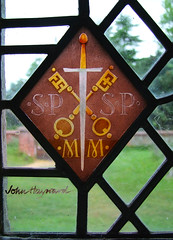
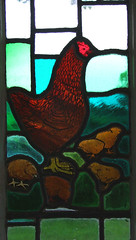
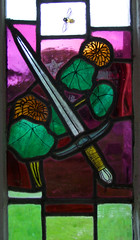
There is more recent glass in the
porch. Paul Quail is not an artist I consistently admire,
but here his work is very fitting for a rural parish
church, the symbols of Peter and Paul, the breaking of
bread and a hen with her chicks.
As at Hindolveston, fixtures of the old church were
rescued and installed in the new one. They don't make the
same impression here, possibly because St Peter and St
Paul is a much bigger church than the new one at
Hindolveston, but they are of great interest,
particularly the part of the rood screen that now divides
off the south aisle chapel. This depicts William Harstong
and his family, donors, and is dated at 1526. Presumably
there were once Saints on other panels. The dedicatory
inscription along the top has been vandalised by
iconoclasts, the opening clause orate pro anima
('pray for the soul of') scratched out.
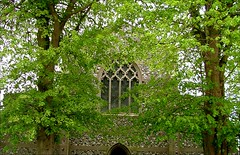
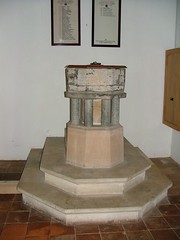
The font is a typical arcaded
Purbeck marble job of the 13th Century, reset on a
polished marble collonade and a triple-deck pedestal. The
west window is also said to come from the old church. It
is set very high, as is the east window, an echo of the
early 16th Century and another idea to re-emerge in the
early 20th Century.
Simon Knott, October 2020
Follow these journeys as they happen at Last Of England
Twitter.
|
|
|