| |
|
St Mary,
Eccles The Latin word Ecclesia means church, and
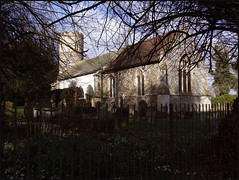
that is entirely appropriate, because St Mary is pretty
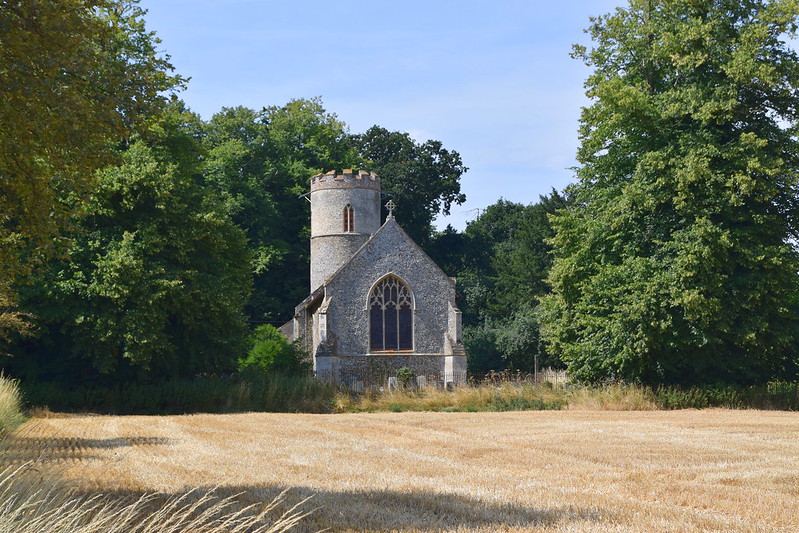
much all there is to Eccles these days. The church sits
tree-surrounded in the fields, a long track leading up to
it lined by trees that Mortlock tells us were planted to
celebrate the Festival of Britain.A greater curiosity are
the iron railings which completely surround the
graveyard. These must have been so common before they
were grubbed up in a well-meaning but misplaced fit of
patriotism during World War II. Intended for melting down
and conversion into Spitfires, most of them ended up
dumped in the North Sea. Those at Eccles are a rare
survival.
St Mary's round tower has been recently restored, and the
whiteness of it forms a beacon for miles around. Here we
are in the rolling fields of south Norfolk, but I am
afraid any chance of rural peace is rather spoilt by the
noise from the Snetterton race track, barely a mile off.
However, the trees that shroud the graveyard are
beautiful, and St Mary is a real haven for the visitor
and pilgrim, making itself open every day to receive the
stranger within the gate, as the Gospel demands.
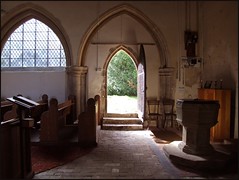
Rather oddly, there is a doorway on the outside of the
south wall giving access to the roodloft stairway. The
reason for this is that there was once a south aisle, and
this entrance was then at the east end of the arcade. The
filled arcade is apparent from the outside, but the 14th
century doorway was moved back into a new position when
the aisle and porch were demolished. This becomes obvious
as you step inside. You turn to see that you are actually
entering through the most westerly bay of the arcade. The
frosted glass that fills the upper part of the arches
isn't entirely successful, but it is nice to be able to
see the pillars and arches standing proud of the wall.
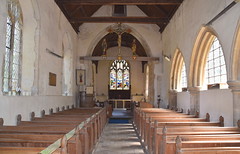
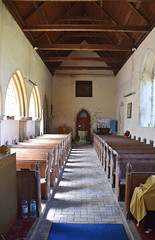
The interior of the church fits exactly the setting, for
this is an intensely rustic space. Even the old patterned
carpet seems to speak of days now gone. In the little
vestry are photographs of the church choir here in the
early 1960s. Dressed in their cassocks and
surplices,accompanied by their priest in full eucharistic
vestments, they are shown processing up the narrow nave
behind the crucifer and the acolytes with their candles,
and are a reminder that nothing appears as ancient as the
recent past. St Mary must have been very High Church. I
couldn't help thinking, with a slight twinge of nostalgia
for my own childhood, how beautiful those full choral
services out here in the fields must have been.
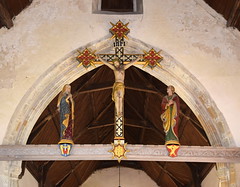
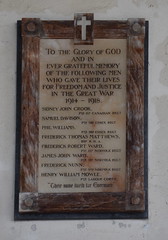
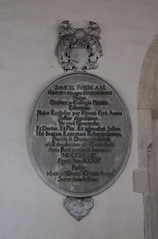
Up on the wall, a memorial has fine lines of moss growing
in its lettering where damp has collected. Around the
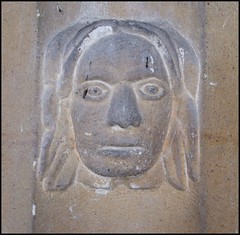
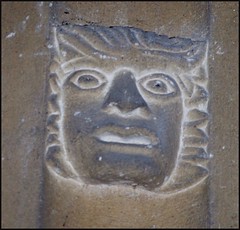
chancel arch are gorgeous little faces of animals and
people, similar to those you see around the doorways of
some of our great cathedrals.
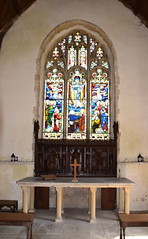
Up in the sanctuary is one of those elegant double
piscinas, and a plain, stone-legged table to serve as the
altar. Its simplicity lends a gravitas to the medieval
mensa stone recovered from the graveyard in the 1940s,
and now reinstated in its original place. It is still
considered slightly papist for an Anglican church to have
a stone altar, but I don't suppose anyone bothered about
that in the excitement of recovering the past.
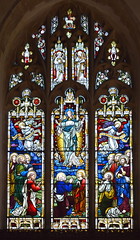
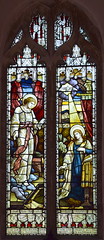
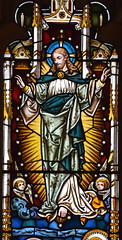
Another saving remnant is on the north side of the
chancel. This is a 19th century window moved here from St
Michael's church in Southwark in the 1960s. What a
contrast! From the urban heart of what was then the
biggest city in the world, to this little church alone in
the fields. If it had ears, perhaps the glass would take
comfort from the sound of the racing cars on the other
side of the woods.
|
|
|