| |
|
All Saints, East Tuddenham
Anyone who has seen
the cover of Richard Tilbrook's lovely book Norfolk's
Churches Great and Small will remember the evocative
image of a country church seen from across a field of
poppies. The church is All Saints, East Tuddenham, and it
is a mark of the keenness of Tilbrook's eye that East
Tuddenham is actually a rather suburban place, its church
out at one end of the long, straight high street.
Tilbrook left a remarkable legacy in the form of hundreds
of photographs of Norfolk and Suffolk churches. The
Norfolk book and its Suffolk companion barely scratch the
surface, and anyone who has been to one of the
exhibitions where the large scale prints (often a metre
wide) are exhibited will know that he was probably one of
the best photographers of churches that England has seen.
However, on the dull winter's day that I first visited
East Tuddenham I fear that even Richard Tilbrook would
have struggled to make All Saints graveyard an attractive
place. The icy wind sent clouds scudding across a washed
out sky, and even the naked trees seemed to shiver. It
was a pleasure to come back on a sunny day in the spring
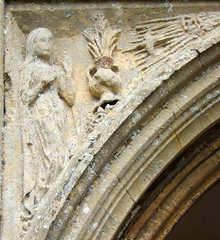
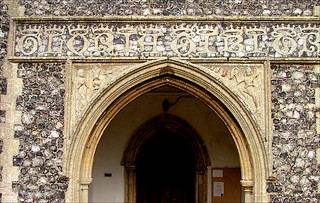
of 2016. The sun shone on the face of the south porch,
and the spandrels with their Annunciation scene. The
Archangel Gabriel seems to have sprung to earth in glory,
his words to her on an unfurling banner, his head as
proud and erect as the lily in his hand. Gloria Tibi
Tr(initas) it reads in crowned letters in the
flushwork across the top of the entrance between them.
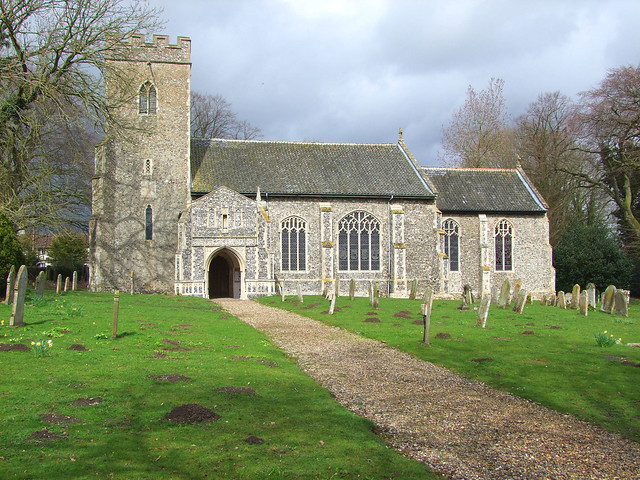
The 13th Century tower rises beside a nave and chancel
that seem wholly Perpendicular, but there are no aisles
or clerestory. Did the 15th Century just add big windows
and new roofs to an already existing building? But that
can't be right, because the tower sits in the south-west
corner, so at some point the church has obviously been
extended northwards. The chancel sits in the middle of
the east wall, so it must be later than the south side of
the nave. We may surmise that the south wall is in its
original place because the main doorway on this side is
late Norman, perhaps early Early English.
On the north side of the church is the remains of an
archway that must have led into a transept. There is even
a little piscina beside it, now outside the church. It is
all a bit of a puzzle, but interesting enough for you to
make up your own idea of what happened here. You step in,
as you'd guess, that All Saints feels wide inside. The
absence of arcades means that this is a square, light
space. Bold white walls throw into relief colourful
details. The off-centre tower arch is matched across the
church by a two-light window, and the barrel-roofing of
the chancel is a counterpoint to the woodwork of the
nave.
The font is unusual for East Anglia, in that it is
circular. Vines and foliage twist around it. Pevsner
thought it late 12th Century, which means it is probably
contemporary with the doorway. Perhaps they were even
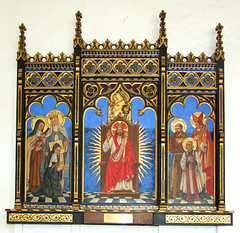
crafted by the same hands. Ahead of you there is a
startling early 20th Century triptych in the very highest
possible Anglo-Catholic taste. Christ is seated in
majesty in the middle, and three figures adore him on
each side. To the left are St Therese of Lisieux, Mother
Julian of Norwich and the Blessed Virgin Mary. On the
right are St Francis, St Felix and St John Vianney. A
curious assortment, and one you'd be unlikely to find
often in the same piece. If it seems quite out of place
at East Tuddenham, which is hardly High Church, it is
only here because it was presented as a gift. It
originally came from Norwich All Saints, one of the
Anglo-Catholic hotspots of that city, and which was
declared redundant in 1973.
The white walls and the open spaces accentuate the colour
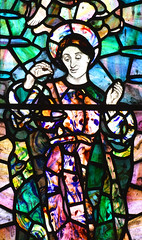
of the triptych, and there is another intense blast of
colour at the east end, in the form of glass by Leonard
Walker. Walker worked in an expressionist style in the
first half of the 20th Centurym and there is another of
his lovely windows nearby at Southburgh. Here, Christ as
Charity is flanked by the figures of Faith and Hope. They
move in a flowing, sinuous manner, but it is the colours
that are remarkable. It really looks as if the glass has
been tie-dyed.
There's more
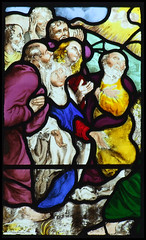
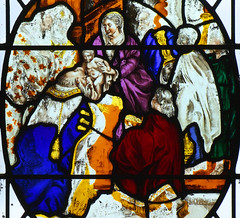
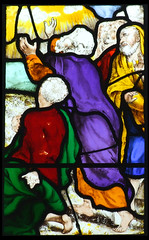
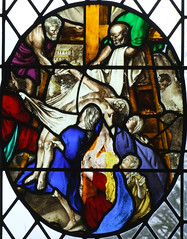
interesting glass in the south side of the nave. Four
Flemish panels, two of them roundels and the other two
rectangular, depict scenes from the life and Passion of
Christ. The roundels show the Presentation in the Temple
and the Deposition from the Cross, while the two
rectangular panels are part of a much larger scene
depicting the Ascension.
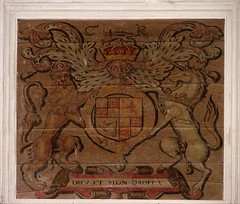
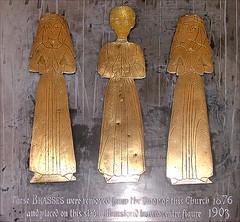
Back at the west end, three curiosities. High up on the
west wall is a rare surviving Royal Arms for Charles I.
Below it, three brass figures, showing a civilian and his
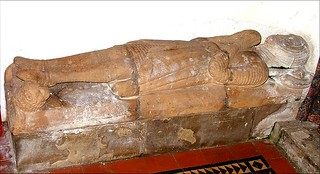
two wives of about 1500. And even older, down in the
north-west corner, a knight reclines, his heart in his
hands. His feet are on a heraldic lion, and yet it seems
more lifelike than him. If you doubt the weight of his
armour, look at the pained expression on that little
lion's face.
Simon Knott, November 2020
Follow these journeys as they happen at Last Of England
Twitter.
|
|
|