home I index I introductions I e-mail I about this site
St Mary, East Ruston


Follow these journeys as they happen at Last Of England Twitter.
| St Mary,
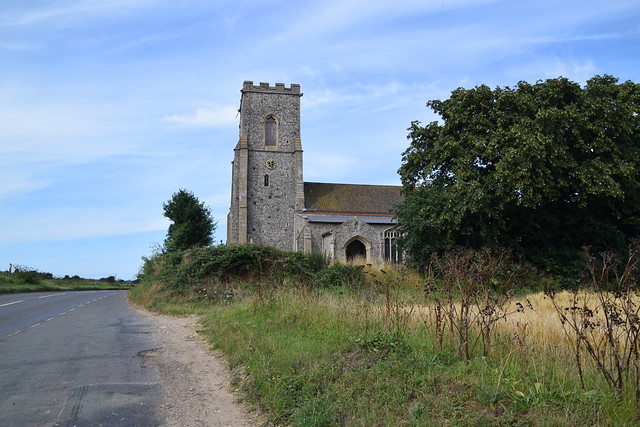
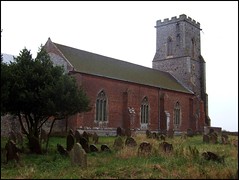
East Ruston If you came to East Ruston to visit the
church without a map, you'd probably never find it. it
sits a couple of miles from the village centre on the
main road between Stalham and Bacton, a rough and mighty
tower rising above the fields. From the south, it is the
tower which dominates. Approaching from the north, you
see the curiosity of what is apparently an entirely red
brick church, in fact an 18th Century rebuilding of the
north wall after an aisle was demolished. The cars rush
past, and it is easy to see why this sprawling church, so
far from its nominal village and with no parking, was
declared redundant.
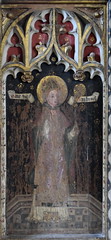
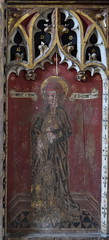
The great survival here is the rood screen. I wonder how many times I have written that sentence on this site, but the screen here really is quite extraordinary. Its oddness is first apparent in that, although it survives to loft floor level, all the tracery above the dado has been removed. But what makes it strangest of all is the width of the opening - in proportion to the size of the screen, the widest in East Anglia, and the two lions on pillars which flank the entrance. I do not think there is another screen at all like it anywhere in Norfolk or Suffolk. There are just eight figures - the four Evangelists, with an angel representing St Matthew, and the four Latin Doctors. The arrangement is similar to that at Morston. The painting is not good, though perhaps not as bad as that at Eye, the style of which it much resembles, so presumably it was the work of a local artist.
The
lightness and simplicity of the interior are perfect
foils to font and screen, although there is a relatively
unexciting Presentation of the Temple by AL Moore in the
south aisle east window. The five light east window of
the chancel is surprisingly wide for what is a relatively
small chancel, the tracery seeming impossibly slight. The
nave roof is hidden by a ceiling, presumably constructed
in the 18th century when the north aisle was removed, but
the south aisle and chancel are exposed, simple 19th
century work with medieval elements, beautiful and
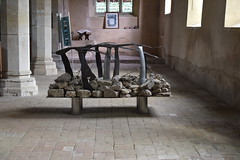
rustic. On my most recent visit in August 2019 the aisle
was home to a very large sculpture, For the Love of
Rose by Bill Cordaroy, a local sculptor. Simon Knott, December 2019 Follow these journeys as they happen at Last Of England Twitter. |




|
|||||||||||||||||||||||||||||||||||||||||||||||||||||||
home I index I latest I introductions I e-mail I about
this site I glossary
Norwich I ruined churches I desktop backgrounds I round tower churches
links I small
print I www.simonknott.co.uk I www.suffolkchurches.co.uk