| |
|
St Mary, East Raynham
The gently rolling
landscape south of Fakenham is a patchwork of fields and
copses, and set among them, enveloped in its rich
parkland, is Raynham Hall. The Hall was, and is, the home
of the Townshend family, the most famous member of which
was probably Charles 'Turnip' Townshend, second Viscount.
At the start of the 18th Century he helped to turn
English agriculture upside-down with his vigorous
promotion of four-field crop rotation. This led to a
remarkable increase in food production and consequently
of the English population, putting in place at least some
of the preconditions for the Industrial Revolution, as
well as leaving him with a memorable nickname.
The church sits beside the Hall. Here on the Raynham
estate there were three churches, but the one serving the
parish of West Raynham, set in the main village on the
estate, had fallen into disuse by the early years of the
18th Century. Few people attended the established church
for religious reasons in those days, and the very meaning
of the Church of England had come to be little more than
as an arm of the state, registering births, marriages and
deaths and marking national events and occasions. This
would not really change until the rise of Evangelicalism
in the later years of the same century, and so it was of
little consequence that West Raynham church was
abandoned, and East Raynham church beside the Hall became
the church for a new joint parish, carrying out the
functions for both.
However, the religious landscape had altered
significantly by the middle years of the 19th Century. At
the time of the National Census of Religious Worship in
1851, perhaps as many as 30% of the population were
attending their Anglican parish church on a Sunday, and
the rise to prominence of the Oxford Movement had created
a new understanding of the meaning of Anglican church
buildings. In short, there was a renewed enthusiasm for
the Church of England, and most of England's parish
churches were restored and even rebuilt at this time. In
the 1860s the old East Raynham church was demolished, and
rebuilt on a grand scale.
The architects were Clark and Holland. Pevsner calls them
rather obscure architects from Newmarket. The
construction took two years, at a cost of £7,000, about
a million and a half in today's money which feels about
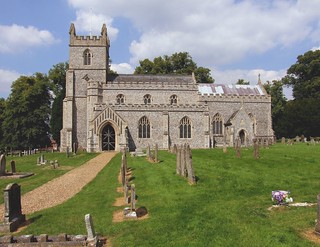
right. The church is broadly similar in outside
appearance to its predecessor on the site, although the
overall effect is of something grander. A plaque under
the tower records the dedication on April 17th 1868,
the Friday of Easter Week.
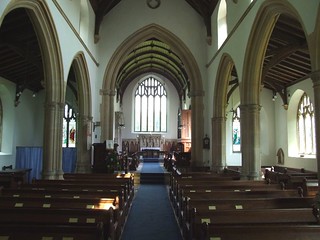
If the exterior promises an anonymous, urban interior,
you step into a pleasant surprise. This is a quiet, calm,
seemly building, with none of the fireworks of the
broadly contemporary rebuilding at Blickling, with which
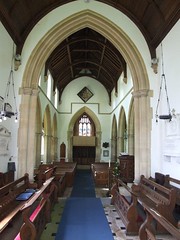
it bears some similarities. The nave is wide and open,
well-lit and neatly-furnished. The glass in the aisle
east windows is of the 1950s, depicting the Risen Christ
on the Road to Emmaus with Saints who appear to be
intended as James and John in the north aisle, and Christ
flanked by St Margaret and the Blessed Virgin in the
other.
The overwhelming presence in the chancel though is of the
Townshend family, their memorials going back more than
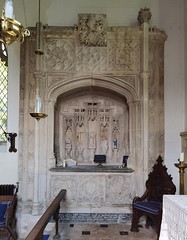
half a millennium. The Easter Sepulchre is a surprise,
elegant and full of eve-of-the-Reformation detail. It was
built by the bequest of Sir Roger Townshend who was a
lawyer, with among his clients the famous Paston family.
A near contemporary brass figure remembers George
Townshend, his son, who is depicted as a boy. Another
brass is to a tonsured priest, Master Robert Godfrey. The
inscription asking for prayers for his soul tells us that
he died in 1522.
 
The two angels praying
over a cross on the memorial to Charles Townshend and his
wife Charlotte appear to be a sentimental version in
slight relief of Richard Westmacott Junior's
near-contemporary monument to Henry Villebois at nearby
Marham, a design which was also used at Shimpling in
Suffolk for members of the Hallifax family. Could this
one actually also be by Westmacott, albeit a cheaper
edition of the same?
Perhaps the most
interesting memorial to modern eyes is that to Townshend
of Kut. A little-known name now perhaps, but a
century ago he was a national celebrity. Kut-al-Amara in
modern Iraq was the scene of one of the more infamous
events of the First World War. In the winter of 1915,
about 30,000 British soldiers led by General Charles
Townshend holed up in the city to defend it against
Ottoman forces led by the German high command. Fed on
stories of the siege of Khartoum thirty years earlier,
the British public avidly followed the course of the
event in the new popular tabloid newspapers.
It was a military disaster. Empire forces tried to break
the siege, at the loss of some 33,000 lives. Townshend
finally surrendered to the Germans in April, by which
time some 17,000 of those in the city had died. The
writer Jan Morris called it the most abject capitulation
in Britain’s military history. Poignantly, his
memorial records that his widow erected it to the one
whose memory will always live.
Big estates like
Raynham defined a rural patronage which would last until
the First World War changed the English countryside
forever. Here, the Hall with the church beside it are a
reminder of a time that was in the living memory of our
grandparents, a key to understanding the popular
experience of the world before ours.
Simon Knott, October 2021
Follow these journeys as they happen at Last Of England
Twitter.
|
|
|