home I index I latest I glossary I introductions I e-mail I about this site
St Mary, East Carleton

Follow these journeys as they happen at Last Of England Twitter.
St Mary, East Carleton East Carleton is a
straggle of houses among fields and copses on the road to
nowhere, as if a narrow skein of Norwich suburbia had
separated itself to drift remotely along the edge of the
Ketteringham Hall estate some eight miles from the City
Hall. Its church of St Mary is neat and trim in its small
churchyard. As at neighbouring Bracon Ash this is at
heart an Early English building with some late medieval
remodelling, but what you see today is overwhelmingly the
work of a decent 19th Century restoration, the nave and
chancel redone in the 1880s and the tower rebuilt in the
1890s. It is a good example of what could be done on a
small scale by a rural parish where the pennies had to be
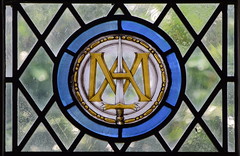
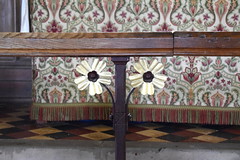
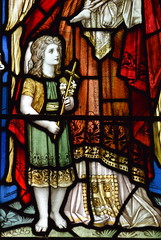
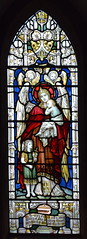
counted. The altar rails which front the small sanctuary are sweetly decorated with flowers in an Art Nouveau style. There is a small amount of coloured glass, and you feel that any more would overwhelm this little building. The most interesting panel is a roundel in the east window which contains a medieval head, perhaps 14th Century and probably of Christ. A modern roundel beside it depicts the monogram AM with a sword, and presumably both were set at the same time, perhaps in the early 20th Century which also brought Powell & Son's Angel of Charity. He holds one child, whilst the elder child at his feet holds a cross and represents Faith. The small glass of Mary at the feet of Christ at Bethany is a bit earlier, and I think it may be by Heaton, Butler & Bayne. As you leave the church, you might notice a low ivy-covered wall to the east of the church. This is all that is left of the second East Carleton church of St Peter, and Pevsner thought it would have been the lower part of the western side of the tower. Having seen it without ivy about fifteen years ago I wondered if it was actually the east end of the chancel, in which case the two churches were very close together. Beyond the ruin in the churchyard is an elaborate family memorial, presumably of the 19th Century, which must have had its ironwork removed during WWII. Its pillars now sinking into the soft earth, it seemed like a metaphor for the change and decay in all around, while beside it, the little church abides. Simon Knott, September 2021 Follow these journeys as they happen at Last Of England Twitter. |








|
|||||||||||||||||||||||||||||||||||||||||||||||||||||||
home I index I latest I introductions I e-mail I about
this site I glossary
Norwich I ruined churches I desktop backgrounds I round tower churches
links I small
print I www.simonknott.co.uk I www.suffolkchurches.co.uk