home I index I latest I glossary I introductions I e-mail I about this site
St Mary, East Bilney


Follow these journeys as they happen at Last Of England Twitter.
| St Mary,
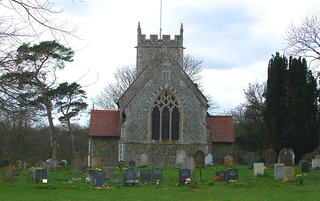
East Bilney This fine
Victorian church sits away from its village in the gentle
hills between Dereham and Fakenham. It was built to
replace the ramshackle church that Ladbroke drew here in
the 1820s. It is hard to see that any part of it survives
from the medieval structure, but it was all done well and
broadly on the plan of the original, including the
replacement of a south transept. There are two earlier roundels, continental glass of the 17th century each set in a ring of English medieval fragments, both with intriguing inscriptions. One declares itself to be from Monasterium Leodiense Duodecim Apostolorum, the Monastery of the Twelve Apostles at Leyden. Another roundel has a Latin inscription from I Samuel 17 beginning Cumque gladium non haberet David, 'and there was no sword in the hand of David when he defeated the Philistines'.
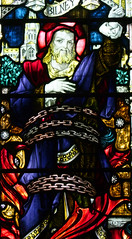
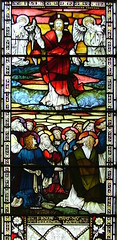
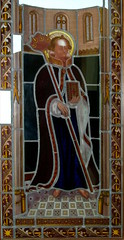
One significant local figure remembered in the Shrigley and Hunt glass at East Bilney is the 16th Century Catholic priest Thomas Bilney. I'm sure that Bilney would have been quite at home with much of the teaching of the modern Catholic Church, but his doubts about some medieval practices drew the attention of Cardinal Wolsey and Henry VIII's thought police. They cautioned him, but released him to preach again because he was so articulate in his arguments against Lutheranism and the protestant reformers. Eventually, as battle-lines hardened, he was arrested under the authority of the Bishop of Norwich, and burned at the stake as a heretic. A window in the chancel shows Bilney in two scenes, firstly preaching, and then in chains outside Norwich Cathedral awaiting his execution. I must say that he looks remarkably cheerful under the circumstances. . It would have taken a lawyer with a
fine eye for the small print to find Bilney guilty of
heresy, but what was more to the point was that the
Bishop of Norwich had acted without authorisation from
above. In turn, he was arrested, and he forfeited his
possessions as a punishment for his treatment of Bilney.
This, of course, could not bring Thomas Bilney back. His
influence over his pupils at Cambridge University meant
that there were articulate and ardent advocates of his
cause, among them the increasingly protestant Hugh
Latimer. In martyring Bilney, the Church authorities set
in motion a chain of events that would lead directly to
the horrific conflicts of the middle years of the 16th
century, and several centuries of sectarian prejudice and
conflict. Simon Knott, August 2020 Follow these journeys as they happen at Last Of England Twitter. |





|
|||||||||||||||||||||||||||||||||||||||||||||||||||||||
|
|||||||||||||||||||||||||||||||||||||||||||||||||||||||
home I index I latest I introductions I e-mail I about
this site I glossary
Norwich I ruined churches I desktop backgrounds I round tower churches
links I small
print I www.simonknott.co.uk I www.suffolkchurches.co.uk