home I index I latest I glossary I introductions I e-mail I about this site
St Peter, Dunton



Follow these journeys as they happen at Last Of England Twitter.
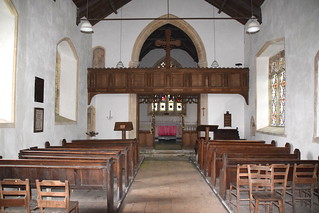
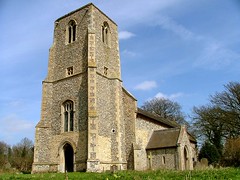
St Peter, Dunton I still remember visiting this church for the very first time about fifteen years ago. It was a bright, unseasonably warm day in early spring when we came to this idyllic spot lost in the country lanes beyond Fakenham. The Earth was coming alive again, burgeoning with new growth and the tremor of bird song. Coming back in late November 2022 it was very different, but still lovely. The church sits above the road, and although there's evidence of an earlier church it seems to have been pretty much completely rebuilt in the 15th Century. St Peter is redundant, and this is no surprise. We are in an area with one of the largest concentrations of medieval churches in England, and there are more ruined churches around here than anywhere else in Norfolk. When Monro Cautley came this way in the 1940s in the course of his magnificent survey of Norfolk Churches and their Treasures, he found the church in a terrible state, disused and completely overgrown with ivy. The fate might have befallen it that befell nearby Oxwick. But St Peter is lucky in that it came into the saintly hands of the Norfolk Churches Trust, and is not only in a good state of repair, it is open every day. The church you step into is neat and tidy, clean and cleared of clutter. The nave is dominated by an early 20th Century rood loft in front of the chancel arch, accessed through the medieval rood loft stairs. You step through it into a similarly neat and tidy chancel, dominated by an east window which is the work of Heaton, Butler & Bayne at the very height of their powers, just after Robert Bayne joined the firm in the early 1860s. They would later become a victim of their own success, needing to revert to a more mass-produced style as their other window here on the north side of the nave will show, but here is Robert Bayne at his best. The glass is interesting for two reasons. Firstly, it was given by the Guardians and Rate Payers of the Walsingham Union, which is to say of the workhouse, in memory of their chairman. Secondly, as you might expect it depicts two scenes from the Works of Mercy, I was an hungered and ye gave me meat and I was naked and ye clothed me. However, the panels for each have been set above the wrong inscription in each case, probably to make the symmetry of the window more dynamic, and likely as long ago as the 1860s.
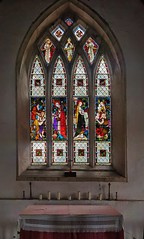
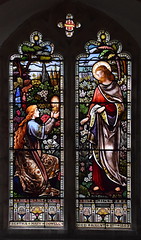
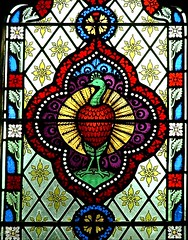
The Ward & Hughes glass on the north side of the sanctuary also appears to have the wrong inscription,although it dates from a good quarter of a century later. It depicts the Risen Christ appearing to Mary Magdalene in the garden, but the inscription reads she is not dead but sleepeth which you would more often expect to be beneath a scene of the rising of Jairus's daughter. In 2019 this glass was badly damaged by a group of children throwing stones at it, but it has been pieced back together with glue like a jigsaw puzzle. In front of the screen is a curiosity. The two lecterns are set on medieval stone bases, and it is not clear exactly what they are. My first impression was that they might be font bases, or the bases of preaching crosses, but the are rectangular rather than square. Could they have once supported an arcade? But there has never been an arcade here. The best glass in the church is probably the decorative glass on the south side of the nave, especially that with a pattern of peacocks in it. It would be interesting to know who the workshop was. Birkin Haward didn't hazard a guess, which surely he would have done if he suspected it was by a local workshop. Given that it was installed in the 1860s, is it possible that it is also by Heaton, Butler & Bayne? At the time of the 1851 Census of Religious Worship Henry Goggs, the vicar of South Creake, was also the curate in charge of Dunton church. Unusually he included in his return what he believed to be the dedication of Dunton church, St Mary, perhaps a sign of South Creake's early-for-Norfolk Tractarian enthusiasm. In this strongly non-conformist area he claimed a remarkable church attendance at Dunton on the day of the Census of almost half the population of the parish. It is unlikely that he was present at Dunton himself that day, so perhaps like the dedication it was a wishful but inaccurate guess. Simon Knott, November 2022 Follow these journeys as they happen at Last Of England Twitter.
|
|
|||||||||||||||||||||||||||||||||||||||||||||||||||||||
home I index I latest I introductions I e-mail I about
this site I glossary
Norwich I ruined churches I desktop backgrounds I round tower churches
links I small
print I www.simonknott.co.uk I www.suffolkchurches.co.uk