home I index I latest I glossary I introductions I e-mail I about this site
St Mary, Ditchingham



Follow these journeys as they happen at Last Of England Twitter.
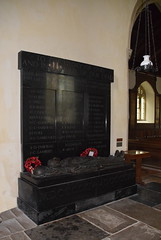
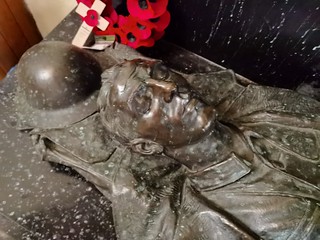
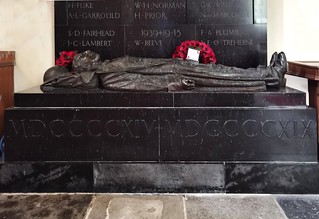
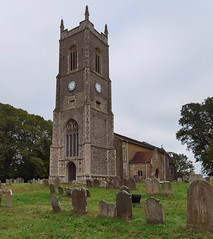
St Mary, Ditchingham Bungay is one of Suffolk's loveliest little towns, and the River Waveney runs right through it, forming the county border. Cross the bridge and you're in Norfolk, in the parish of Ditchingham and Pirnow. Pirnow's 19th Century chapel of ease was sold off for domestic use years ago, and to reach the parish church you have to travel through a mile or so of suburbia before reaching the open fields. You turn off onto a narrow lane, and at once you are in quintessential East Anglia, intensely rural and with a story or two to tell, as we will see. You might see the tower of Ditchingham church from a distance, because it is one of the tallest and most impressive in this part of Norfolk, but as you get nearer the hedgerows close in, and it is with some surprise that you reach the churchyard to see it lifting high above you, for you enter the churchyard from the west into rising ground. Pevsner thought it unusually opulent... galletted flint with ashlar dressings. It is of the 15th Century, and although the church beneath it is also relatively large for this part of Norfolk, the tower dwarfs it in proportion. It was built largely at the expense of the Bosard family, who we will meet inside. The nave and chancel were earlier, but have undergone several fairly rigorous restorations including that in 1846 by Anthony Salvin who redid the chancel (though Pevsner thought the Decorated east window was retained), and then Frederick Preedy in the 1870s, who replaced the chancel arch and nave roof as well as building a wide aisle on the north side. There is no south aisle and there are no clerestories, but in any case the height of the tower prevents any sense of starkness below. You enter through the south porch into a church which is dark without feeling gloomy, the sheer width of the interior creating an impression of numinous space. Straight ahead of you is one of Norfolk's most memorable war memorials, by Derwent Wood, 1920. A large black marble tablet inscribed with the names of the dead rises to a height of about eight feet, and lying in front of it, almost life-size, is a First World War soldier as if he were a knight lost at Agincourt.
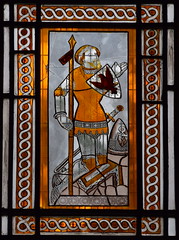
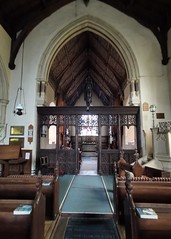
Turning east, the view narrows to the screen and beyond it the long chancel. It is hard to say quite how much of the screen is medieval. It goes with the furnishings which were Preedy's, and Preedy also rebuilt the chancel arch, so I think we might credit at least the refurbishment of the screen to him as well. Beyond it you step into the chancel, and the first sight is of the glass on the south and north sides. It is of national significance, but very little is known about where it came from. It was placed here in 1822 at the behest of John Newling, the rector of Ditchingham. The early 19th Century was a time when there was a renewed enthusiasm for beautifying churches, but as yet the stained glass and church furnishings industries which would follow in the footsteps of the Oxford Movement and the Camden Society were still very much in their infancy. Some churches solved this problem by buying discarded continental glass from monasteries laid waste by the French Revolution and the Napoleonic Wars - indeed, this was the main business of the Norwich glass dealer JC Hampp. However, here at Ditchingham the glass for the three windows was commissioned from a glass manufacturer. One window depicts in panels Edmund Tudor, Earl of Richmond and his wife Lady Margaret Beaufort. They were the parents of Henry VII. Another has two more knights, and the third is a listing of the Reverend Newling's predecessors. As Birkin Haward observed, there was not a single workshop in Norfolk, Suffolk or Cambridgeshire that would have been capable of producing this glass - it is of a far higher quality than that made by locals Samuel Yarrington and Robert Allen, for example, or any other East Anglian workshop. And yet there is no record of its origins. Intriguingly, Birkin Haward spotted in one corner the tiny trademark of the workshop, mostly hidden by the window jamb, but still visible is the very end of an inscription which reads rs and Painters. The first part is obviously the end of the word Manufacturers or Makers, but the name of the firm itself is hidden, and as far as I know the mystery has not been solved.
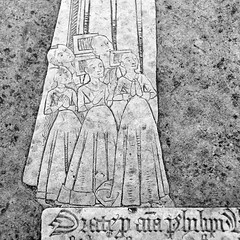
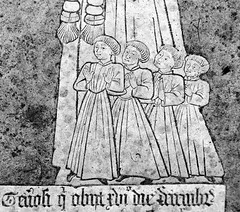
Ditchingham has two brasses to the Bosard family, who bankrolled the tower. The most impressive of these is to Philip and Margery Bosard. It shows them standing with nine children, five girls on her side and four boys on his. Their inscription reads Orate pro anima Philipi Bosard Generosi qui obijt xvi die mensis decembris anno domini m CCCCxC et pro anima Margerie uxoris sue qui obijt _____ anno domini die _____ quorum animabus propicietur deus amen, which translates as 'Pray for the soul of Philip Bosard gentleman who died on the 16th day of the month of December in the year of our Lord 1490, and for the soul of Margery his wife who died on the _____ day in the year of our Lord one thousand _____ upon whose souls may God be merciful Amen'. The inscription was obviously made when he died but before she did. Her death dates have not been filled in, which isn't terribly unusual, and it doesn't mean that she isn't buried with him. It might simply be that they didn't get around to filling them in before the Reformation intervened, although forty-odd years seems a very long time for her to have survived him. Or perhaps she had moved away, and they simply didn't know if and when she had died. Or simply, there was never anyone with the will to get it done.
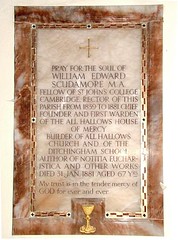
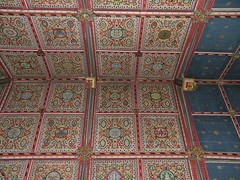
As we have seen, the development of this church as we see it today is largely that of its 19th Century restorations, but there is more to it than that. The chancel roof with its canopy of honour was decorated in the 1860s by Mrs Frances Scudamore, the wife of the rector of the time, after Salvin's restoration but before Preedy's. Her husband William Scudamore was rector of Ditchingham from the 1840s to the 1880s. In general, Anglo-Catholicism did not reach much of East Anglia until the early 20th Century, but there were hotspots several decades earlier, and Ditchingham was one of them. Scudamore would leave his mark not just on the church, but on the countryside around it. This was a militantly non-conformist part of England, and at the time of the 1851 census of religious worship some East Anglian parishes had fewer than a tenth of the parish population attending the parish church on a Sunday. The Oxford Movement aimed to turn this around. But one of the features of Anglo-Catholicism which the stout-hearted protestant peasants of Norfolk and Suffolk found hardest to stomach was the establishment of religious communities. These groups of Anglican men and women set apart and living consecrated lives were frowned upon not only by the press of the day, but by the Diocese of Norwich itself. In fact, similar religious communities were, by the 1850s, a familiar feature of the English landscape, but these were Catholic communities, not Anglican ones. They had usually been established by groups fleeing France during the terror of the Revolution half a century earlier. The Catholic Sisters and Brothers were generally received with sympathy, since the people of England warmed to revolution even less than they did to Catholicism. But Anglican religious communities were considered a step too far. When Father George Drury established an Anglican convent in the 1850s at Claydon on the outskirts of Ipswich, he was accused by the Ipswich newspapers at the time of keeping a harem, an outrageous slur in mid-Victorian England. Similarly, when the Suckling and Crosse families helped establish an Anglican Community of the Sisters of Mercy at Shipmeadow in the 1850s, there was outrage. However, the community benefited from the sheltering support of the two main local landed families, something poor George Drury never had. Indeed, the founder of the community was one of the Crosse daughters, Lavinia Crosse, and in 1858 the community found a home in the adjacent parish of Ditchingham, across the Waveney on the Norfolk side of the border, thanks to the energy of William Scudamore. They called themselves the Community of All Hallows, and their first achievement was to open a home for fallen women, which usually meant young girls who'd had children outside of marriage. A convent and an orphanage followed. Scudamore died in 1881, but two years later Kelly's Directory for Norfolk could note that the House of Mercy, opened in 1859, in conjunction with the Church Penitentiary Association, is under the care of the sisterhood of All Hallows, and has for its object the reception of women of unchaste lives, from all parts of England; the house is a large cruciform building with a beautiful chapel in the head of the cross; it can receive 30 penitents; warden, Rev. E. P. Williams; treasurer, Sister Catherine Rotch; Miss Lavinia Cross, lady superior. All Hallows Home, founded in 1867, is an orphanage for girls of the better classes who have fallen into reduced circumstances; they are admitted at any age above 3 and under 10, with the understanding that they remain in the Home until after confirmation; the house will hold 30 orphans; respectable girls of the lower classes are also received into the Home for industrial training as domestic servants. All Hallows Country Hospital is capable of holding 20 patients, who may be admitted without restriction from any practicable distance, at a small weekly payment; incurables, convalescents and lady patients are also received at an increased charge. These institutions are under the care of the same Sisters. Scudamore's memorial is on the north side of the chancel, and near it is a real period piece, a reredos hung on the north wall that depicts Christ in Majesty with saints and angels. It appears to date from the last years of the 19th Century, and the two figures kneeling at top right are shown with portrait faces of real people. I assume that one of them is WIlliam Scudamore.
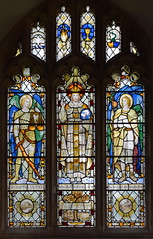
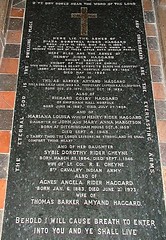
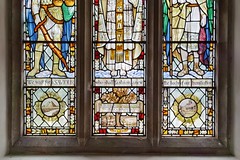
The most famous name associated with Ditchingham, however, is that of the writer Henry Rider Haggard. Haggard, author of the adventure novels King Solomon's Mines and She which were bought and read in their hundreds of thousands in those heady days of Empire, was from a local wealthy farming family which provided Ditchingham church with a succession of churchwardens. Haggard was one of those eccentric radical conservatives that the late 19th and early 20th Century Big Houses often turned out. He advocated a system of National Insurance thirty years before it was introduced and was a vociferous debater. It was said that the committee of the East Norfolk Conservative Association were much relieved when he failed to win the constituency for them. Rider Haggard's father was notorious when he was a churchwarden for standing at the south door and writing down the names of latecomers, brandishing a big fob watch as he did so. The Rider Haggards have a large ledger stone in the passageway of the chancel, and the most easterly window on the north side of the aisle remembers their best-known member. It is by Powell & Sons, and the inscription tells us that it was placed to the Glory of God and the memory of a beloved father Henry Rider Haggard. This window is dedicated by his youngest daughter Lilias, 1925. Lilias too would be a well-known writer, producing seven collected volumes of the countryside column she wrote for the Eastern Daily Press. Either side of her inscription are vignettes of the Pyramids and of her father's South African home. Above, Christ in Majesty is flanked by St Michael and St Raphael, the inscription under their feet from St Paul's Letter to the Philippians telling us that we wait for a Saviour who shall fashion anew the body of our humiliation. Simon Knott, October 2021 Follow these journeys as they happen at Last Of England Twitter. |



|
|||||||||||||||||||||||||||||||||||||||||||||||||||||||
home I index I latest I introductions I e-mail I about
this site I glossary
Norwich I ruined churches I desktop backgrounds I round tower churches
links I small
print I www.simonknott.co.uk I www.suffolkchurches.co.uk