home I index I latest I glossary I introductions I e-mail I about this site
St Andrew, Deopham


Follow these journeys as they happen at Last Of England Twitter.
St Andrew, Deopham The great tower of St Andrew faces across the valley to the even more imposing tower of Hingham a couple of miles off. Though clearly a work of the Perpendicular period, there is a jauntiness, dare I say a friendliness, about the Deopham tower that belies the austerity of the almost exactly contemporary tower at Cawston. Does this mean that the assumed date of 1450 is a wrong one? Pevsner thought not, imagining rather that the modernising enthusiasms of late medieval architects cut no ice with the masons here, who preferred to stick with what they knew, the detailing of the previous century. The corner buttresses are at angles to each other, and rise in no less than six stages. This tapering makes the whole tower appear as if it would eventually come to a point somewhere in the far distance. The most singular and spectacular part of the detailing is the triangular motif containing a flushwork wheel and flanked by flushwork shields on each side of the parapet. Also memorable are the flushwork blind windows facing east and west, with their elaborate tracery. Deopham, pronounced Dee-f'm,
is a scattered parish in the deceptively remote rolling
landscape to the south-west of Norwich. The great church
is visible from miles around. However, since I was last
here in 2006 the building has fallen on hard times. The
clerestory windows are boarded up from the outside, and
the lead stolen from the south aisle roof in 2016 has
never been replaced, the roof still covered with a
tarpaulin in what was presumably intended to be a
temporary arrangement. As you can imagine the church is
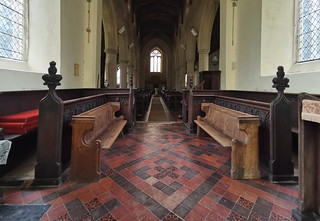
dim and dusty inside, and a notice tells us that Heritage
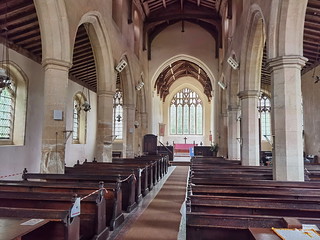
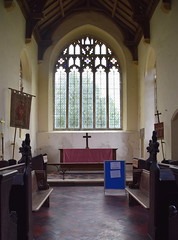
England have declared Deopham to be a church at risk. The soaring tower arch echoes the south doorway, and above it in the nave there is a bit of a puzzle. There is a lovely late medieval tie-beam roof, but on the south side of the arcade only there is a row of stone corbels doing nothing, about two metres below the wooden angel corbels of the roof. What are they there for? Did they support the roof before the clerestory was added? Or was there a more ambitious plan for a double hammerbeam roof that was later abandoned for the cheaper option of the tie beams? Whatever, it is odd that they are only on the south side. Early 20th Century processional banners include one for the Sunday School, and the Mothers Union banner has Ave Maria embroidered on it. These, and a contemporary statue set in a 14th Century image niche suggest that there was once an Anglo-Catholic tradition here, perhaps even into living memory. However, half a century earlier at the time of the 1851 Census of Religious Worship, the recently appointed vicar George Henry Turner had commented that this has been a long neglected parish, without either Day or Sunday School. The congregation is now increasing and schools (National) are to be erected immediately. Perhaps it was a result of this neglect that the parish boasted at the time two Primitive Methodist churches, which bizarrely claimed a total attendance between them of five hundred and fifteen congregants on the day of the census at a time when the parish had a population of just four hundred and ninety-four. Of course, some of these people would have come from further afield, and some probably attended more than one service. The parish church on the other hand was host to just forty people for morning service that day. There was obviously a lot of work for the Reverend Turner to do at Deopham. Simon Knott, August 2021 Follow these journeys as they happen at Last Of England Twitter.
|
|
|||||||||||||||||||||||||||||||||||||||||||||||||||||||
home I index I latest I introductions I e-mail I about
this site I glossary
Norwich I ruined churches I desktop backgrounds I round tower churches
links I small
print I www.simonknott.co.uk I www.suffolkchurches.co.uk