| |
|
St Mary,
Denton Norfolk is so huge that it swallows big
churches like St Mary. Unless you knew to look for it,
you would not even notice that it was there. Here, on a
low ridge in a folding landscape, is one of the county's
more interesting churches. And yet it does not even front
on to a public road.
You come down the narrow lane from Alburgh and across the
old pack bridge, and there it is on the high ground above
you. But to get to it, you carry on, and then through the
yard of the Hall. Beyond the converted stable block the
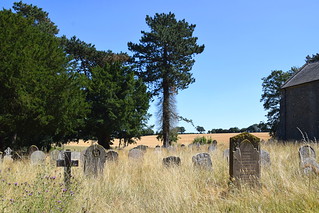
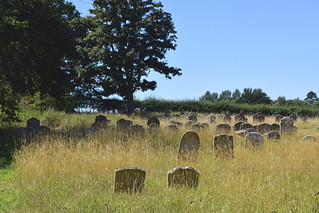
lane opens up, and steps lead up into the walled
graveyard. A sign reminds you that the building is now in
the joint stewardship of the Church of England parish and
the local United Reformed Church community.
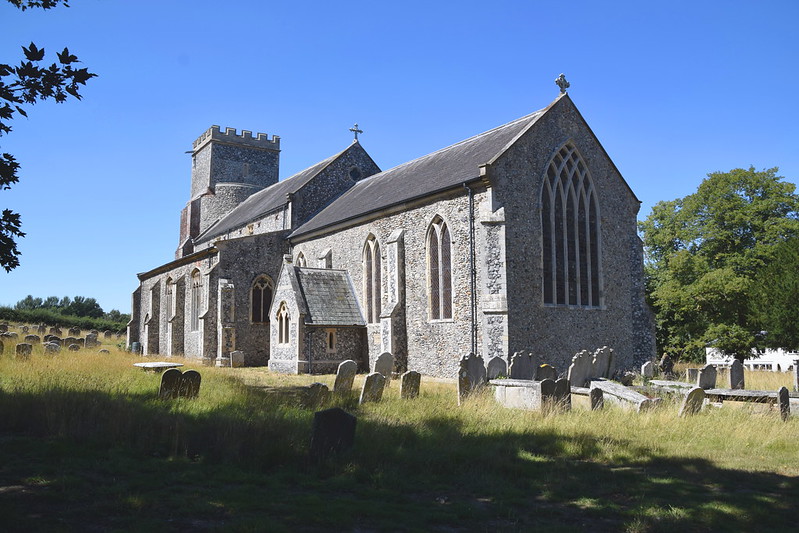
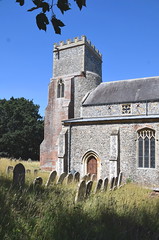
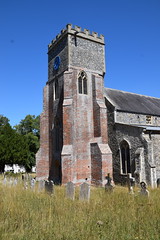
Denton has one of the most curious church towers I know,
with evidence of three rebuildings, all of them quite
different to each other. The earliest was a flint round
tower, and the curved eastern face of this survives,
abutting the nave. This round tower fell in the 18th
century, and it was rebuilt in the late Tudor style, a
beautiful red-brick square tower. Finally, the Victorians
added the unusual west windows in the Decorated style,
and a top stage was added in flint and freestone. There's
nothing else quite like it. Across the valley to the
west, the tall, stern tower of Alburgh stands, a
sentinel.
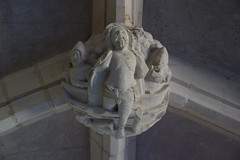
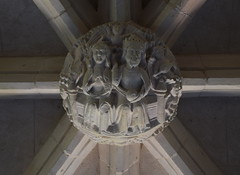
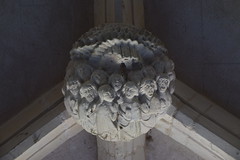
St Mary has a number of features that would be famous in
almost any other county, and the first of these is the
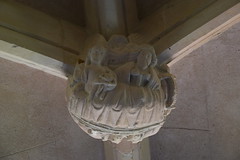
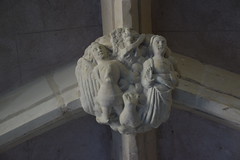
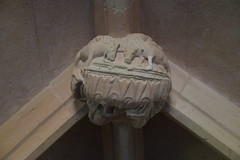
extraordinarily good series of bosses in the fine 15th
century north porch. They are obviously by the same
workshop as those at Hethersett and Wymondham. They are
intricately carved, at once delicate and bold. They have
been sympathetically restored, and depict the
Annunciation, the Nativity, the Resurrection, the
Ascension of Christ and the Coronation of the Queen of
Heaven. This is effectively a rosary sequence, and it is
easy to imagine 15th century Dentonians standing in this
porch telling their beads as they looked up in wonder.
You step
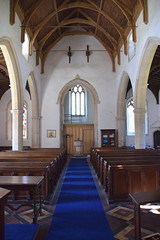
inside to what at first seems a large, anonymous,
Victorianised interior. It was difficult for the
Victorians to resist giving such a big church as this an
urban feel, but there are still local, rustic survivals
that provide a link with the lost generations. The most
famous of these is the Denton chest, a large, solid
object made up of panels painted with Saints. The panels
are very small, and there is some debate about whether
they came from a rood screen, a rood loft, or something
else altogether; but in fact they are no narrower than
the panels of the screen at neighbouring Alburgh.
The chest is probably a 19th century construction. It
features two Saints on each end, with two groups of four
Saints on the front - twelve altogether. This is barely
sufficient to stretch across the chancel arch here even
if set in divisions, and with a doorway in the middle,
but the odd mix of Saints suggests that some are missing.
I'd have liked to have moved the chest to see if there
are any others on the back, but for security reasons it
is bolted firmly to the stone floor.
Anyway, on the east end of the chest are St Agnes, with a
dagger and a little lamb, and St Dorothy, with a basket
of flowers. The eastern range on the front consists of St
Jude with a boat, St Peter with a bunch of keys, a Bishop
who appears to be wearing a papal tiara and is therefore
St Gregory, and St Clement with an anchor. The western
range on the front is St Zita with her household keys, St
Barbara with a tower, St Edmund in royal robes and
carrying an arrow, and St Edward the Confessor in royal
robes carrying a ring. The west end of the chest contains
probably the most interesting figure, St Walstan of
Bawburgh with his scythe, and St Paul with a sword.
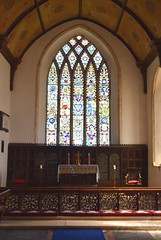
Perhaps the most spectacular feature of St Mary is the
east window. This is an elegant four light window, with
interlocking tracery, and it is crammed full of English
and continental glass, mostly from the 16th and 17th
centuries, but with a small amount of very good English
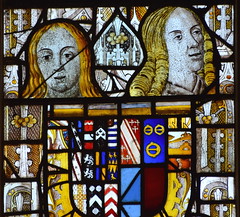
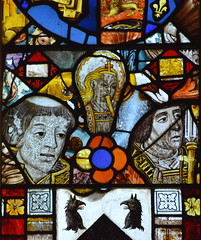
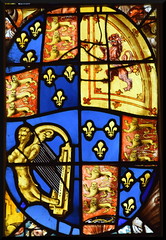
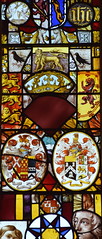
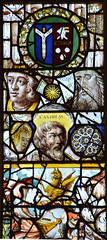
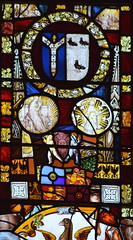
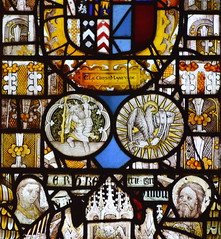
medieval glass set in it. Two roundels in the centre,
depict St Christopher and the eagle of St John. Just
above, the Flemish glass is signed C Le Grys Manfylde,
1567. There are at least two sets of Royal Arms, one
fragmentary, but the Stuart set is complete and
particularly vivid, and some of this glass probably came
from secular buildings originally.
Windows of
this kind are not unusual in Norfolk, and are of two
kinds. Either, as here, the collection of some
antiquarian local Squire or Rector that was bequeathed to
the church, or sometimes a collection bought as a job
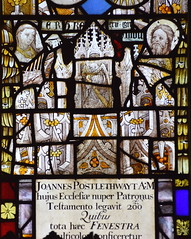
lot, often from the Norwich dealer JC Hamp. A small pane
records that the glass here was collected by the Rector,
John Postlethwaite, and it was left to the church along
with an astonishingly large amount of money, £200, to
have it installed. This is about £40,000 in today's
money. No wonder they did a good job. The most
interesting thing is quite how early this was, for while
many of the collections of this kind made their way into
churches in the late 18th and early 19th century, but
this dates from 1716. It was reset by Ward & Nixon in
the 1850s.
There is a grand piscina and a single seat of the former
sedilia up in the chancel, which must date from its early
14th century construction. At the other end of the
church, the entrance to the stairway that leads to the
parvise, the upper storey of the porch, is in the
north-west corner of the nave. It is a grand entrance
with a fleuroned doorway set under a triangular pitched
roof. This upper storey was obviously open to the
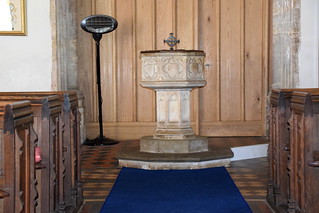
elements for many years. The font, with its shields in
quatrefoils, is set in a sea of minton tiles, but at
least the Victorians didn't replace it.
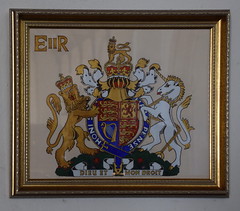
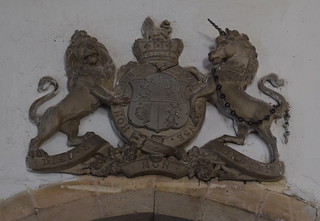
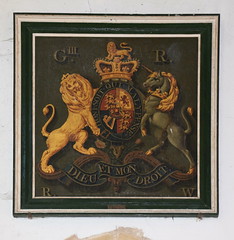
There seems to have been a particular loyalist sympathy
in this parish over the centuries. There are sets of
royal arms to both Victoria (in stone) and George III (on
boards) at the back of the church, set above the south
and north doors, and on the west wall a set for the
current queen. Along with the Stuart set in the east
window, this means the church has four complete sets of
royal arms, more than any other church in East Anglia.
Simon Knott, October 2018
|
|
|