| |
|
St Peter,
Crostwick How things can
change in ten years! For this is a story about what
seemed to me to be decline and loss, a pivotal moment in
the safeguarding of a part of Norfolk's priceless
history. Crostwick is a tiny village, just a pub, a big
house and a few cottages on the busy Norwich to North
Walsham road. And this has always been a small, poor
parish, its soil sandy and of little use for agriculture.
Even in the middle of the 19th Century, when the
population of rural Norfolk reached its post-medieval
peak, there were barely 150 people here, and there must
be many fewer today.
I first visited this church 10 years ago in February
2009. I picked up the key from a cottage near the pub,
and cycled on up the main road towards where I knew the
church to be. I had been through Crostwick so many times,
but it had never occured to me before that there might be
a church here. It isn't signposted from the main road,
and I relied on the Ordnance Survey map to direct me
along a muddy track which went into the woods. Even here,
I almost came unstuck, for the track splits, and I ended
up heading into the local Scout HQ. I should have taken
the left fork, because after a few hundred metres this
leads through the trees to a hidden gem, St Peter, with
the rolling fields stretched out beyond.
I stepped from the wooded path into the enclosed
churchyard, its hummocky graves contributing to an air of
sadness and loss that was not easily dispelled by the
sound of children's voices, surreal from the gardens of
the houses by the road. A small churchyard, and this is a
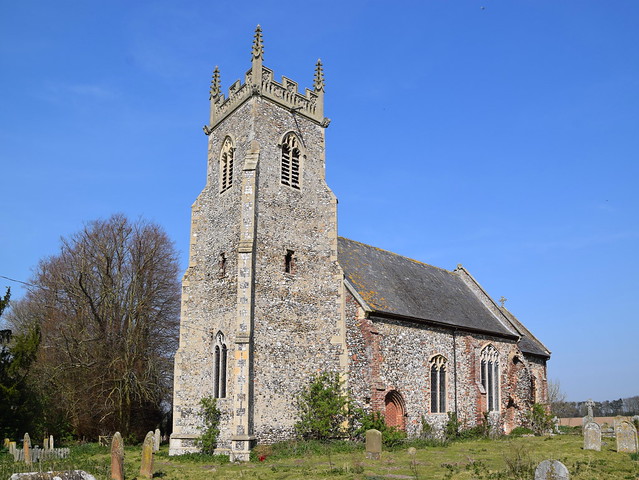
small church, not surprisingly, but its most striking
feature is the magnificence of the top of the tower. The
tracery is pierced rather than picked out in flushwork,
as if this was some great city church rather than a shy
local one hidden away in the woods. The rest of the
building is perhaps more reassuringly familiar, a
slightly ramshackle, rough and ready structure with
plenty of red brick among the flint. The result is
pleasing. A striking feature is the open roodloft
stairway on the south side, like looking into the bones
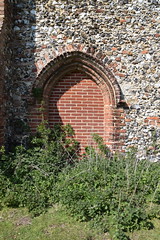
of a large animal. Further west, the red brick south
doorway has itself been bricked up.
I wandered around the tower and back to the north side. I
had already been told what to expect. A few weeks
previously, someone had driven up with a van, taken up
the tiles in the north porch, and driven away with them.
I am afraid that the sheer arrogance and selfishness of
people who could do such a thing is completely beyond my
understanding. I haven't come across many incidents of
deliberate damage during my visits to 2,000-odd East
Anglian churches, but the stealing of building materials
from a church to sell them for a profit seems to me one
of the worst forms of vandalism, not least for the
vulnerability which it leaves behind. I suppose that, if
I tried hard, I could just about make a case for
understanding bored teenagers carving their initials into
doors, or militant atheists throwing stones through
windows, or even the violent schizophrenic who put out
all of the stained glass windows in one of Suffolk's
churches about twenty years ago. But the theft of slabs,
and lead, and copper and the like, these irrevocable
attacks on our priceless heritage by thugs who want
nothing more than a few fivers in their back pockets,
should be a cause for great shame. I was only grateful
that the kind people of Crostwick still allowed the key
to the inner door to be given out.
I stepped into a church which is all of its 19th Century
restoration, but with an endearing rustic feel which
tells us more about Crostwick than it does about the
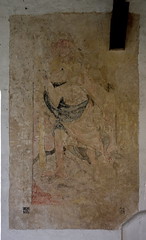
Victorians. There is one significant medieval survival, a
St Christopher wall painting on the south side of the
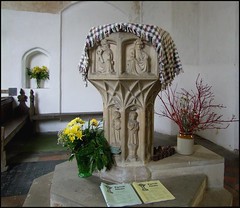
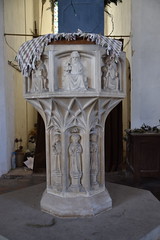
nave facing the north doorway. The 19th Century font is a
good one, with seated Saints in each panel and standing
ones in the shaft, much in the style of some of the15th
century fonts to the south-east of here in the Yare
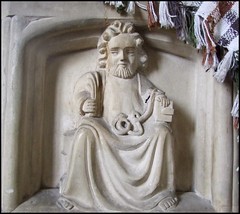
Valley. My favourite feature, which I have not come
across elsewhere, is the figure of St John, seated with
his poisoned chalice. But the serpent here is a long
snake rather than a serpent, and unwinds itself into his
lap.
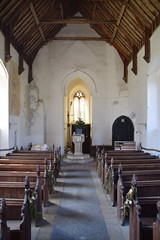
I looked up at a roof which was
pleasingly rural in character. Was it 17th Century, or a
Victorian copy? Under the tower, an angel who had once
sat at the top gazed sadly out from behind a lawn mower.
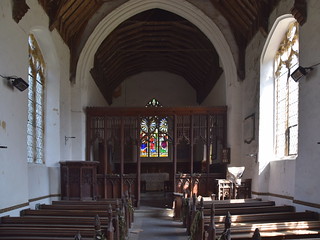
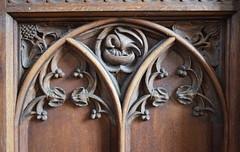
The screen is a good reproduction of the early style of
some Norfolk screens, featuring the double wheel above
the entrance. You can see medieval versions of the same
thing at several churches, including Merton. Up in the
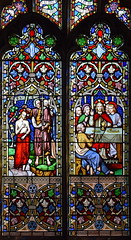
chancel, the 19th Century glass is very good. That on the
south side bears the signature of William Wailes and the
date 1853, while the adjacent panel has the signature of
the restorers, the King workshop, and the date 1989.
Up on the wall nearby is remembered Eliza Willett, relict
of Joshua Kirby Trimmer, eldest son of the authoress.
This is a roundabout way of saying that Eliza was the
widowed daughter-in-law of Sarah Trimmer. Mrs Trimmer is
not well-known today, but her influence lives on, for of
not many people can it be said that they created a genre.
Born in Ipswich, she was an 18th Century writer and a
collector of children's literature. She published a
periodical, The Guardian of Education, which was
the first to review children's literature in a serious
way. She defined the parameters of what children's
literature might include, and compiled the first history
of the subject, thus establishing the canon, and
recording its early landmarks. Sarah Trimmer's work has
been built on considerably since, but it formed the basis
for what we still understand children's literature to be
today.
Ten years passed. Ten summers and winters, and Crostwick
church sat huddled in the woods, and then we came back.
It was April, and the trees were coming into leaf
like something almost being said, the path through
the woods already beginning to feel overgrown after the
mild, wet winter. The air of sadness that I had felt
coming this way ten years ago was alleviated somewhat by
the sunshine filtering through the branches. The porch,
though repaired, was full of dry leaves. We let ourselves
into the church into a scene of dirt and decay. The first
sight, absurd on top of the font, was the Christmas tree,
still in place at the end of the April. Bunches of spruce
tied to the ends of the benches were also covered in
dust, making it clear that the church had not been used
since last Christmas. But was it last Christmas, or an
earlier one? For the most striking thing about the
interior was the mess caused by the jackdaws' nests built
in the eaves on the south side of the nave. Branches and
bird droppings littered the benches, and as if to make
the point a lone jackdaw flew glumly from one end of the
church to the other all the time we were inside.
It would, of course, not be a difficult matter to set all
this right if there was a will to do so. But it was not
hard in all this to see a metaphor. For so many of our
rural medieval churches rely not on large congregations
for their survival, something they will never see again,
but on the stalwart work of two or three enthusiastic
parishioners whose sleeves seem to be permanently rolled
up in the war on decline and loss. They are usually old,
and there are not often very many of them. They will not
be with us forever, and unless other people step up in
their place their efforts will have been in vain. Does
this matter? Do our medieval parish churches exist only
for the benefit of their congregations, or is their
existence a matter of concern for all of us? Crostwick
church seemed to me to be a lesson for the future, a
place where all roads end if we are not careful,
and let them.
Simon Knott, August 2019
Follow these journeys as they happen at Last Of England
Twitter.
    
|
|
|