| |
|
All
Saints, Crostwight I spent many happy days in the
summer of 2019 cycling around the churches between
Norwich and Cromer, and of all that part of the county I
think it is the area to the east of North Walsham that I
like best. I was visiting churches, but chasing memories
too, and when I came to Crostwight my mind was cast back
fourteen years to the time of my first visit with the
late Tom Muckley.
It was one of those balmy spring days in early April,
2005. It was getting on towards late afternoon, and Tom
and I were nearing the end of a successful day's church
exploring. Virtually every church in this area was open
every day, and those which aren't were willingly opened
by their caring churchwardens.Indeed, in years to come I
would find that even these churches were now open. There
is a real impression in this part of Norfolk of churches
held by the communities to be more than mere worship
spaces, but sacramental structures, folk museums and
touchstones down the long generations. I like them all a
lot.
We had visited everywhere we'd planned, but there was
still an hour or so of daylight left. Suddenly, off in
the fields to the left, I saw a long, low structure with
a truncated roof. I looked on the map to see that it was
the parish church of Crostwight, although there appeared
to be no village, hardly any houses even. From the map I
could see that there was an old rectory about a quarter a
mile from the church, beside the lane, but even in early
Spring it was so tree-surrounded as to be barely visible
until we actually reached it.
"Five pounds says it's locked", warned Tom,
risking his exhaust by driving up to the graveyard along
an old track. And he was right, but the key was back at
the old rectory, where the keyholder was very friendly
and welcoming. We unlocked the door, and stepped inside.
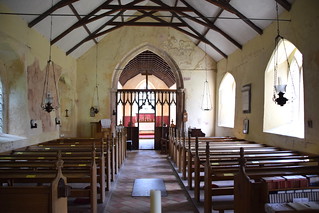
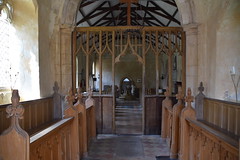
An ancient space. A wide nave, pale, rustic, full of
creamy light. A medieval screen, golden in the afternoon
shadows. And then, treasure. This is the best kind of
discovery - late in the day, unexpected, unsought. For
All Saints has one of the most extensive schemes of late
medieval wall-paintings in East Anglia.
From time to time I called in when I was cycling in the
area, but when I tipped up on a hazy summer day in 2013,
bumping my bike along the track, I found two very loud
and energetic characters in possession. They were moving
furniture, hunting for inscriptions, graffiti and the
like. They made it quite clear by their expressions and
shortness with me that they really didn't want me there,
so I wandered around for a bit until I felt I had
irritated them enough by my presence, and then I headed
on. Perhaps the experience had left a nasty taste in my
mouth, because I didn't come back for six years.
And when I did it was on one of those warm, hazy mornings
that seemed to fill the early summer of 2019, so
different to the heavy oppressive heat of the previous
year. This was my first church of the day, cycling out
from North Walsham station and reaching here about half
past eight in the morning. The church was still locked,
though this time the keyholder asked me to leave the
church open, so perhaps I was just too early. I came back
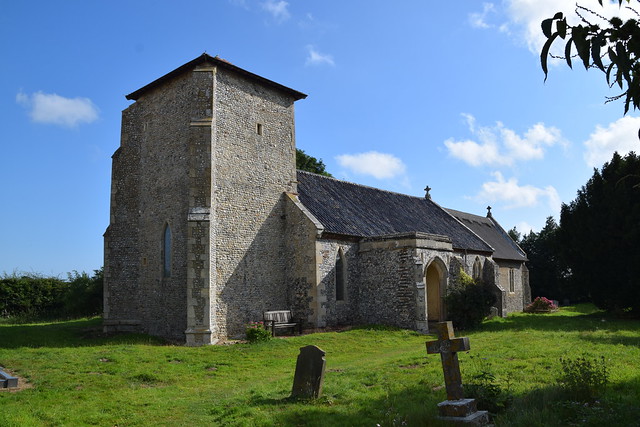
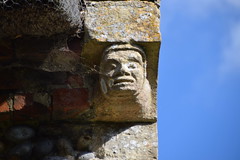
past the low, stumpy tower which was taken down as unsafe
in 1910 as part of a general restoration, the bells
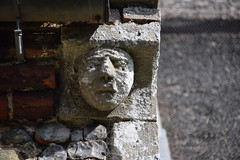
rehung lower, looking up at the curious little heads I'd
remembered on the sides of the gables, and stepped
inside.
The first impression is of cool, damp stone and wood, an
organic place. But I was already looking across the
church to see again the wall paintings stretching along
the north side of the nave. The sequence probably dates
from the later part of the 14th century, perhaps the
early 15th. The scheme is essentially doctrinal in
nature, part of the enforcement of Catholic orthodoxy at
that time in the face of local superstitions, perhaps as
a response to the effects of the Black Death.
The Passion sequence of wall-paintings is the most
remarkable. It runs at three levels on the north wall of
the nave between the two windows. The arrangement is
rather complex, and several of the panels are hard to
decipher. The sequence starts in the middle level, works
towards the centre, goes up to the top level and then the
bottom level. In order, they are:
 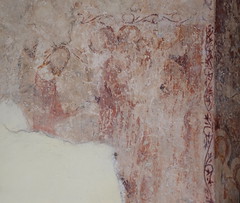 
1: The entrance of Christ into Jerusalem.
2: Christ washes the feet of his disciples.
3: The Last Supper - Christ in the centre, John on the
left
  
4: Christ prays in the Garden of Gethsemane.
5: Christ is arraigned before Pilate.
6: Christ before Herod.
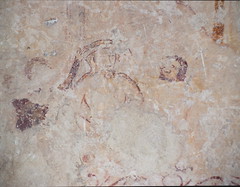 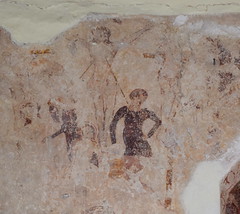 
7: The crown of thorns is placed on Christ's
head.
8: The Crucifixion. Christ is crucified, a thief on each
side of him.
Below, Mary weeps, Longinus pierces his side, another
soldier offers him vinegar on a reed.
9: The Ascension of Christ.
A blank
area of wall between subjects 9 and 10 must once have
depicted the Resurrection, but this is now completely
lost. A further blank piece of wall to the east of the
Ascension image suggests a space for one more panel,
which may have been Christ sitting at the right hand of
the Father, or possibly the day of Pentecost.
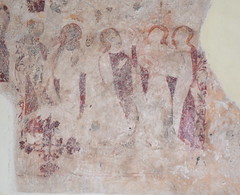
There are more wall-paintings to the west of the window.
These are also fascinating. At the extreme west is a
depiction of the Seven Deadly Sins - a tree grows out of
the jaws of hell (represented by the mouth of a giant
fish) and the sins grow on it as fruit. The jaws are full
of sinners, being pushed down into hell by a devil. To
the right of this is a very curious painting. It appears
to show two women being welcomed by an angel at the gates
of Heaven, with what may be a devil low down looking on.
Pevsner thought it was a warning against gossip as at Seething, but I don't think
this can be right. Anne Marshall suggested that it is
similar to a painting at Swanbourne in Buckinghamshire,
which depicts the allegory of the penitent and unpenitent
souls. Immediately to the right of this is a much more
familiar image, St Christopher. Finally, an unidentified
Saint, a scroll above his head.
  
The screen
is nicely-proportioned and a gorgeous chestnut brown, but
close examination suggests that it has been substantially
restored . The carving in the spandrels in particular,
while fascinating, depicting dragons, wild men, flying
hearts and the like, does appear to be modern, at best
recut. And, curiously, while the chancel arch itself
retains extensive painted decoration, there is none on
the screen at all. Is it possible that the screen was
brought here from elsewhere as part of one of the 19th or
early 20th Century restorations?
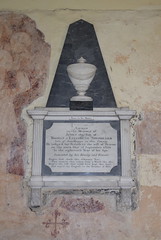
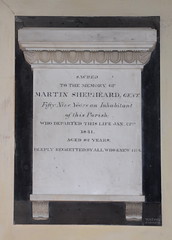
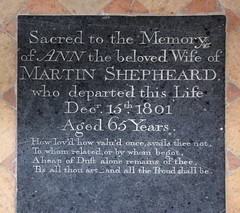
A number
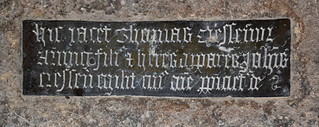
of memorials of interest survive. A brass to Henry
Lessingham, rector of Banningham who died in 1497 asks us
in Latin to pray for his soul. We are told that 18 year
old James Shepheard resign'd his breath to the will
of heaven in 1810, and equally memorable is the
inscription on the ledger stone of his grandmother, Ann
Shepheard who, dying in 1801 at the age of 65 assures us
that How lov'd, how valu'd once avails thee not, To
whom related, or by whom begot, A heap of Dust alone
remains of thee, Tis all thou art - and all the Proud
shall be.
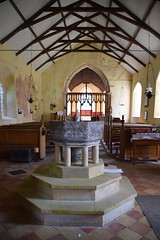
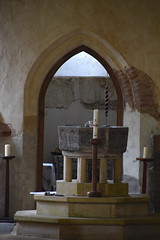
As with
many churches around here, All Saints has an octagonal
Purbeck font reset on collonaded pillars. This one is in
very poor condition, and must have spent a long period
out of doors at some point. But its worn and fractured
sides somehow add to the atmosphere of a simple, rural
church in a tiny parish - barely 700 acres, and certainly
no more than a hundred people. It sits a quarter of a
mile from the nearest road and from the nearest house.
There is no electricity. It has, in modern eyes, no real
reason for existing any more. But it is well-kept, used
regularly, and obviously much loved.
Hubert Arthur Francis was the only man from the parish to
die in World War Two, aboard HMS Royal oak at Scapa Flow.
Today, he has a memorial as grand as any you'd find for
Lords of the Manor in other country churches. And beneath
it, his photograph in a simple frame. Still remembered.
That, for me, made it all the more special.
Simon Knott, December 2019
Follow these journeys as they happen at Last Of England
Twitter.
|
|
|