home I index I latest I glossary I introductions I e-mail I about this site
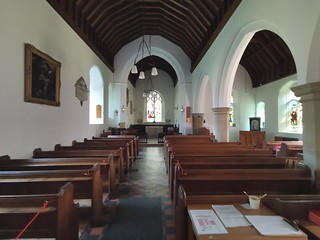
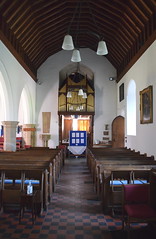
St Peter, Cringleford, Norwich

Follow these journeys as they happen at Last Of England Twitter.
St Peter, Cringleford, Norwich Heading south-west out
of Norwich, you come to the pleasant old village of
Cringleford, now part of the urban area and within the
southern bypass, but by the slip of a bureaucrat's pen
still outside the city boundary. It was once a much
busier place, because the street was once the the main
road from London to Norwich. What a welcome sight this
little church must have been in centuries gone by for
people who had made that long journey! I wonder how many
medieval merchants and travellers had stopped off at St
Peter to offer a prayer of thanks. There are still old
houses around the church, giving this part of Cringleford
a villagey feel, especially now that the traffic has
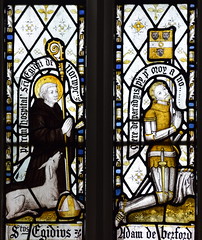
gone. Lavers & Westlake provided glass for the 1898 restoration, but there was a further and more dramatic scheme of glass installed in the early 1920s depicting faux-medieval figures of St Giles and Sir Adam de Berford, owner of the manor of Cringleford. This, and the figure of St Andrew, look to be the work of Herbert Bryans who had once worked for Kempe & Co, although his work outshines their typical style. In fact it is possible to make the contrast here at Cringleford, for Kempe & Co were here in the late 1920s with glass of Christ summoning the Disciples and of the Crucifixion. The font is late, with the foliage patterns typical of the early 16th Century, and it may well be contemporary with the tower. Above it is something much earlier, for set in the wall is what appears to be a coffin lid with a pattern of late Saxon interlace. It does look rather as if it might open downwards like an ironing board. Simon Knott, August 2021 Follow these journeys as they happen at Last Of England Twitter. |





|
|||||||||||||||||||||||||||||||||||||||||||||||||||||||
home I index I latest I introductions I e-mail I about
this site I glossary
Norwich I ruined churches I desktop backgrounds I round tower churches
links I small
print I www.simonknott.co.uk I www.suffolkchurches.co.uk