home I index I latest I glossary I introductions I e-mail I about this site
St Michael, Coston

Follow these journeys as they happen at Last Of England Twitter.
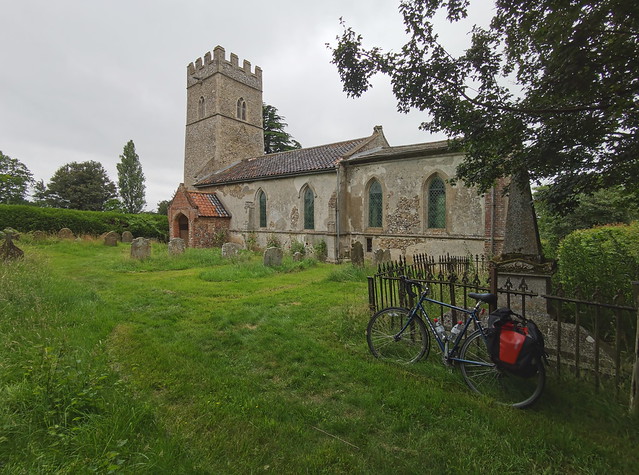
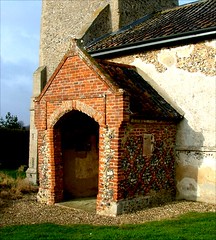
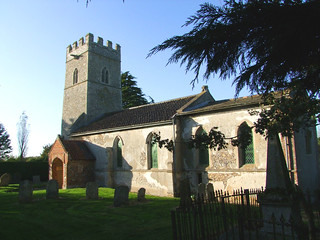
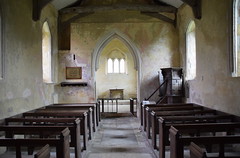
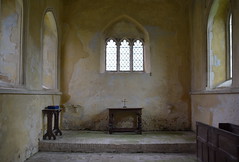
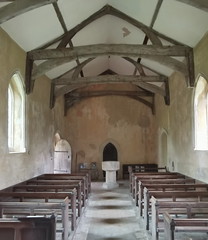
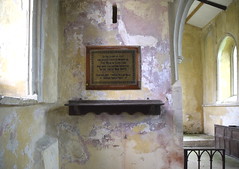
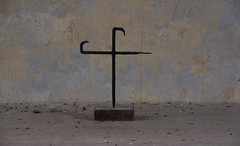
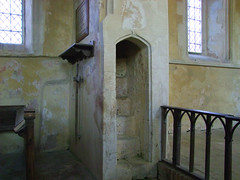
St Michael, Coston Norfolk is almost twice the size of neighbouring Cambridgeshire, and has more than twice as many settlements. But with roughly the same population, Norfolk inevitably has some villages which feel more remote than they appear on a map, and which are tiny when you get there. Coston is one such place, and no doubt this contributed to the redundancy of its church. St Michael is fortunate now to be in the tender care of the Churches Conservation Trust, though I'm not sure it would be considered significant enough to be taken into the CCT fold if it was declared redundant nowadays. It was fortunate to have met its end in the days when the old Redundant Churches Fund still had an evangelical zeal about preserving old buildings just for the sake of it. But despite its lack of excitements, Coston's church is a little jewel of Early English, an unusual thing to find in Norfolk on such a small scale. It was probably built all in one go in the mid-13th Century, with the charming brick porch added four centuries later. The church is easily missed, for the tiny churchyard is accessible only through a gap in the hedge on the road from Wicklewood. There are just a handful of headstones and one grand railed memorial. You step into what is effectively a shell, for Coston church had fallen into disuse long before its redundancy. By the 1970s it was roofless and the tower was close to collapse, but in fact this was of a piece with its story over the centuries, for a visitor in 1763 had found it ruinous and decayed. The chancel had fallen into such a bad state that it was foreshortened to a stump at the pre-ecclesiological date of 1809 and a small early 16th Century window was reset in the east wall, which is surprisingly effective. Under the circumstances the building has done well to survive so long. Light falls through clear glass onto the old wood of the simple furnishings shoehorned into the narrow nave and onto the damp-stained walls and bare stone floors, contributing to an atmosphere which is at once quiet and memorable. A cross made of two rusty hooks sits on the bare altar table. Charmingly, the rood loft stairs run up within the chancel arch, coming out on the north side of the nave just above head height, although the size of the stairway suggests it must have been far above head height for 13th Century Costoners. The top of the masonry stage of the east wall of the nave might perhaps have been used in lieu of a candlebeam. Below the exit, a bat-bespattered plaque remembers the three men of Coston who made the supreme sacrifice in the Great War. Back outside, one of the headstones to the south-west of the tower remembers Charles Capp, who died at the age of 15 in 1883, from an injury received by a stroke from a sail of the Runhall Mill. The inscription continues, telling us that this stone was erected by his friends and parishioners to perpetuate his untimely loss. He was one of the choir of Runhall church. How awful. On another nearby headstone, words from the Book of Job sum it up pretty neatly: Man that is born of a woman is of few days and full of trouble. He cometh forth like a flower, and is cut down: he fleeth also as a shadow, and continueth not... Simon Knott, July 2021 Follow these journeys as they happen at Last Of England Twitter. |




|
|||||||||||||||||||||||||||||||||||||||||||||||||||||||
home I index I latest I introductions I e-mail I about
this site I glossary
Norwich I ruined churches I desktop backgrounds I round tower churches
links I small
print I www.simonknott.co.uk I www.suffolkchurches.co.uk