home I index I latest I glossary I introductions I e-mail I about this site
St Andrew, Colton
Follow these journeys as they happen at Last Of England Twitter.
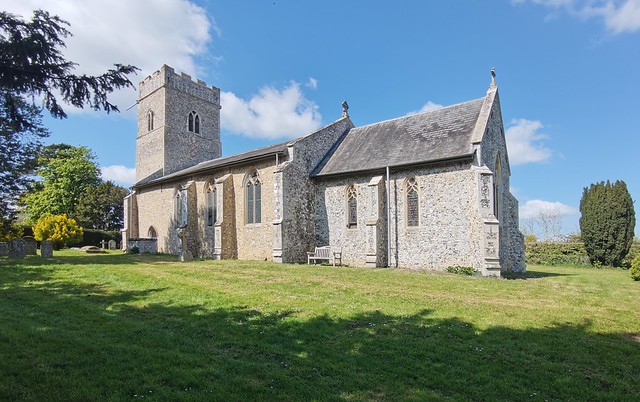
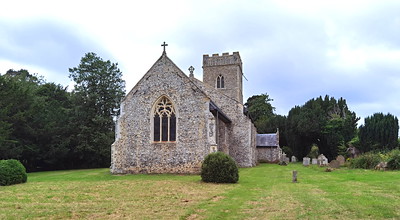
St Andrew, Colton Norfolk is a big place. After North Yorkshire, Lincolnshire, Cumbria and Devon it is the fifth largest county in England, and inevitably there are parts of it which are less well-known than others. In that triangle of quietly agricultural countryside between Attleborough, Dereham and Norwich, for instance, there are perhaps eighty medieval churches, but only a handful of them - Ketteringham, the two Tuddenhams, Ringland - ever make it into the guidebooks. And yet, in any other county, Colton church would surely be better known. The church sits away from its village along the rolling back lane to Barnham Broom in a delightful churchyard carved out of the fields around, with just the old rectory for company. Externally, this
church is still what most early 14th Century East Anglian
churches would have looked like when the Black Death
arrived. A bequest at the very end of the 15th Century
probably topped out the tower and provided a new bell,
and most of the window tracery was replaced in the 19th
Century, although probably along fairly authentic lines.
And yet, all may not be as it seems. Curiously, Pevsner
says that the church originally had aisles but the
arcades were removed at some time to widen the nave.
Certainly, inside we will see a blocked opening to the
south of the chancel arch which is curtailed by the south
wall of the nave. If an aisle was removed on this side
then the south wall must have been rebuilt further north,
but it seems just as likely that Pevsner has
misinterpreted what happened here. He points to the 17th
Century roof as a likely time that the changes were made,
whatever they were.
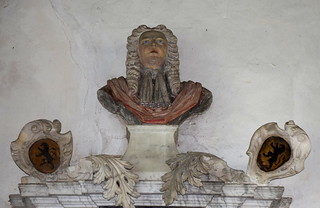
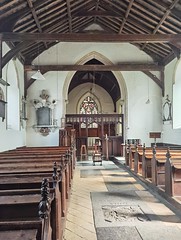
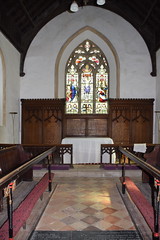
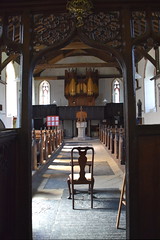
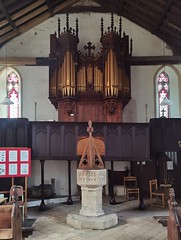
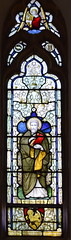
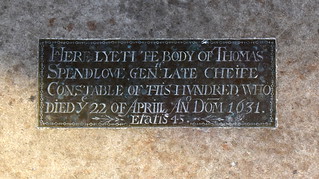
The gallery was paid for by the Daveney family, whose ledger stones pave the nave and chancel. You walk eastwards across them through a church of light and shadow, the interplay of air, stone, wood and metal. In front of the delicate screen, with its wheels in the ogee arch above the entrance, hangs a brass lamp. Above, an Art Nouveau wrought iron rood completes the piece perfectly. Some of the benches appear to be old, and on one a pair of two-headed goats butt each other in symmetry either side of a poppyhead. Lavers, Barraud & Westlake produced the glass in the chancel, the date of 1900 perhaps being an attempt to bring the church back into the latest fashion. A brass floor memorial to Thomas Spendlove tells us that he was late cheife constable of this hundred. He died at the age of 45 in 1631. The money of the Daveney family may have left its mark on the church, but it is a Pooley that dominates the nave. He is Philip Pooley, who died in 1715, and his memorial in the north-east corner of the nave is surmounted by his painted bewigged bust life-size in effigy, a somewhat pious expression on his face. You can't help thinking that his memorial was deliberately positioned so that he is looking over the shoulder of the minister preaching from the pulpit. His inscription tells us that he was an affectionate Husband, a good Father, a kind Master, a devout Frequenter of the Publick Worship, a true lover of the Clergy, a charitable Benefactor to the Poor, an obliging Neighbour, a generous friend, a Pious Christian, whose exalted Soul through the infinite Merits of Jesus Christ, enjoys a blessed Immortality. The more restrained memorial beside it is to his wife.
At the time of the 1851 Census of Religious Worship, Henry Daveney was curate here, serving in place of the rector Henry Girdlestone who was also rector of Landford in Wiltshire. This was not uncommon in the first half of the 19th Century before the Anglican revival got going and more or less did away with plurality and absentee incumbents. Henry Daveney was the major landowner in the parish of Colton and presumably did not rely on the church for any of his income. It is interesting to note that out of Colton's population of two hundred and forty one, just seventeen people chose to make it along the lane to attend morning service that day. However, there were nearly a hundred people in attendance for the afternoon sermon. It was quite usual in East Anglia for the sermon to attract more people than the service, but the size of the difference in attendance here is suggestive of a Low Church parish who would certainly have been more comfortable with Daveney's west gallery than they would with the new fashion for altars, candlesticks and crosses. Eventually, afternoon sermons would die out and the familiar pattern of matins, evensong and communion services become the norm, but for now it was the sermon that most attracted people. Interestingly, Daveney recorded the rector's income from farm, rent charge and glebe at Colton as being £350 a year, roughly £70,000 in today's money, but, as he added in a footnote, in the absence of the rector I am unable to state how much is derived from each source. Simon Knott, June 2022 Follow these journeys as they happen at Last Of England Twitter.
|
|
|||||||||||||||||||||||||||||||||||||||||||||||||||||||
home I index I latest I introductions I e-mail I about
this site I glossary
Norwich I ruined churches I desktop backgrounds I round tower churches
links I small
print I www.simonknott.co.uk I www.suffolkchurches.co.uk