home I index I latest I glossary I introductions I e-mail I about this site
St Andrew, Colney

Follow these journeys as they happen at Last Of England Twitter.
| I passed
this church for years before I ever went inside. It sits
within the urban area of Norwich, on the busy Earlham
Road just before it disgorges its heavy load of traffic
onto the A47, and I had always thought it rather a poor,
beleaguered thing. It was only when I cycled from
Bowthorpe, that most maligned of Norwich suburbs, and
turned off the road into a little lane with cottages and
the beautiful church in its graveyard, that I got a sense
that Colney really was once a little village. Indeed, a
map inside the church shows that the greater part of the
parish is south of the Earlham Road, and is still
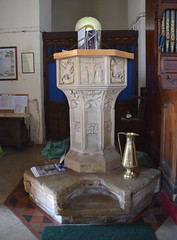
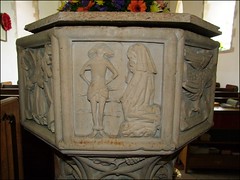
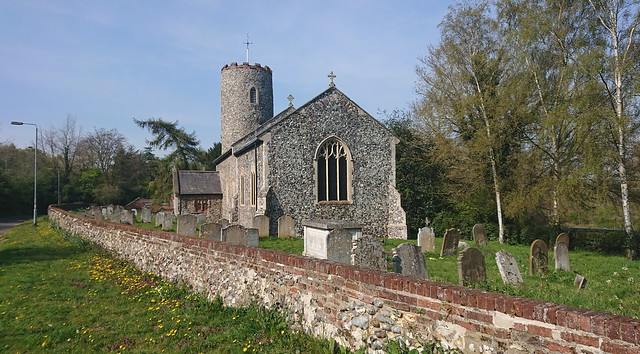
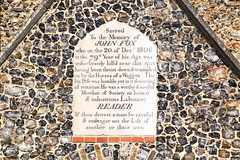
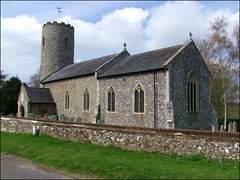
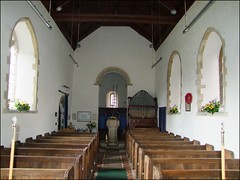
intensely rural today. This is one of half a dozen or so round-towered churches in the urban area of Norwich, and unless you are viewing it from the main road it has the most successfully rural setting of any of them. The churchyard is a narrow one, and it is easy to forget that, until a few years ago, the route of the main road ran alongside the churchyard wall, and heavy traffic thundered past within a few metres of the church. A reminder of the traffic that once passed so close, and probably the best-known feature of St Andrew, is the headstone to John Fox recut and reset above the south porch entrance. It reads Sacred to the memory of John Fox who on the 20th December 1806 in the 79th year of his age was unfortunately killed near this spot having been thrust down and trampled on by the horses of a wagon. READER if thou drivest a team be careful and endanger not the life of another or thine own. The tower above is heavily restored, but there are double-splayed window holes, and there are also carstone quoins below in the west wall of the nave, both suggestive that this dates back to Saxon times. Otherwise, the church is generally 14th Century in character, albeit with the crispness of its 19th Century restoration. You step into a church which feels entirely Victorian, although very much with a fitting sense of its rural past. The great treasure of the church is the late medieval font. It is an exotic species - I do not think there is another like it in East Anglia. It features the signs of the four Evangelists carved characterfully, the winged lion, bull and eagle taking off with their scrolls in their mouths, the angel of St Matthew holding his in front of him. Facing east is a very good Crucifixion scene, but the most extraordinary panel is that which faces west. It shows a hooded figure kneeling, a donor perhaps, next to what appears to be a man tied to a post with arrows sticking out of his body. Now, this being East Anglia, your first instinct might be that it is intended to represent St Edmund, but the imagery is so close to that of St Sebastian that I think that is who it is meant to be. And, given that this is such an unusual font, it raises the suggestion that this font did not come from Colney originally, and possibly not even from elsewhere in East Anglia.
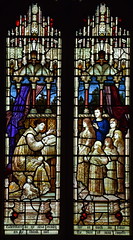
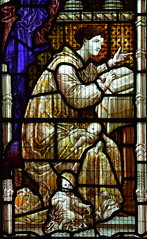
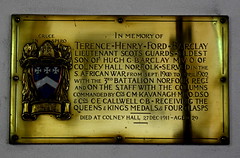
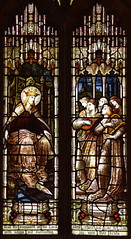
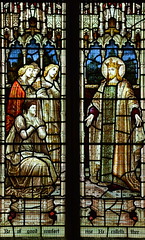
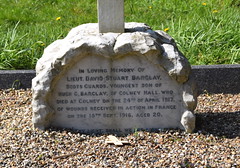
Norwich has contributed more than its fair share of familiar 18th and 19th century family business names, and perhaps the most prominent in the modern age is that of the Barclay banking family of Colney Hall. This was their parish church, and when Evelyn Louisa Barclay died at the age of 37 in 1899, the windows in the chancel by Edward Frampton were placed in her honour. They are worth more than a glance, because they feature Mrs Barclay and her eight children. The most charming window shows her at her reading desk, a baby on her lap and an infant on the floor, the six older Barclay children standing and listening attentively. They are in the height of late Victorian gravitas before it transmuted into the triumphalism of the years before and after the First World War. The oldest boy, Terence, standing in blue, met a tragic and curious end, for in 1911, when he was 29, he was mauled and killed by a lion kept in the menagerie at Colney Hall. His little brother David, the infant sitting at his mother's feet, died just five years later, mortally wounded on the Western Front during the First World War. Both of them are buried in the churchyard.
In the
decades immediately before the Reformation, there was a
great flowering in East Anglia of brasses for Priests,
and there is one here, to Henry Alikok, who was Rector,
and died in 1502. It is a chalice brass, depicting a
chalice and host, to denote that the commemorated person
was a Priest. It sits on the edge of a great expanse of
orange tiles, which appear to have been painted. I assume
that they are actually late Victorian, perhaps
contemporary with the Barclay windows, and I couldn't
help wondering what had been obscured. |
Simon Knott, May 2019
Follow these journeys as they happen at Last Of England Twitter.









|
|||||||||||||||||||||||||||||||||||||||||||||||||||||||
home I index I latest I introductions I e-mail I about
this site I glossary
Norwich I ruined churches I desktop backgrounds I round tower churches
links I small
print I www.simonknott.co.uk I www.suffolkchurches.co.uk