| |
|
St Giles,
Colby
 |
|
If
you take the great swathe of Norfolk that runs
from Fakenham to the east coast, taking the gap
between Cromer and Aylsham, you pass through no
towns. There are no medieval churches that Simon
Jenkins saw fit to put in his premiership in England's
Thousand Best Churches; and yet you will
find as many medieval churches in this narrow
band as most English counties have in total. Given that
Norfolk has so many churches, certainly more per
square mile than anywhere else in western Europe,
it might be thought that to visit even all those
in this swathe would be a hard slog. But this is
not the case. Most of these churches are kept
open, or are at least accessible; many of them
are lovely, and some have wonderful things to
see. And just a few are of great interest, but
little known, perhaps because there are
so many churches here.
|
St Giles,
Colby, is a great case in point. Set awkwardly north of
its village along a lane going nowhere in particular, an
indeterminate number of miles south of Sheringham, it is
interesting to look at, it is beautiful inside, and it
has several extremely interesting features. I doubt that
it will be found in many people's top fifty Norfolk
churches - it is certainly in mine.
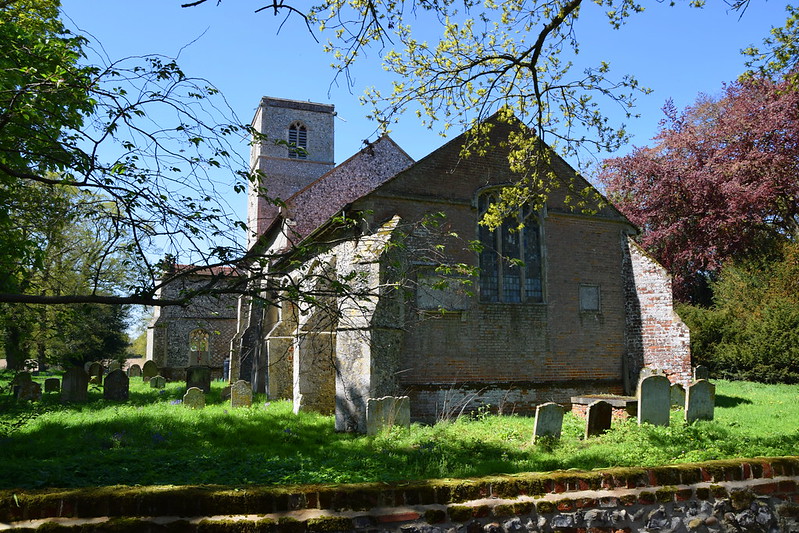
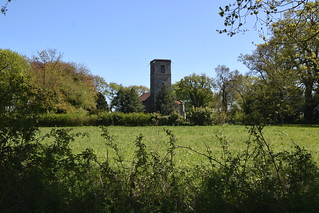
Externally,
it is rather odd. The tower is pencil thin, which in East
Anglia always starts you humming and hawing about the
Normans, but that is not the case here, I think, for it
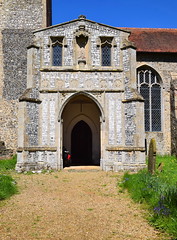
looks all of its late 13th century origins. Then, there
is a massive late 15th century south porch, with image
niches and wonderfully carved spandrels.
 |
|
That
on the east side is clearly St Michael
dispatching a dragon. Another dragon is being
dispatched on the west side, and this is claimed
by the guide books as St George. I wonder. He
carries no shield - St George usually carries a
shield. He is on foot - St George is usually
shown on horse back. There is something very
similar on the porch at St Michael at Plea in the
centre of Norwich. Perhaps he is a wild man,
albeit a civilised one. Perhaps, more likely, he
is the donor of the porch, emulating his Saintly
hero in the other spandrel by dispatching evil. |
|
 |
Unusually,
the porch lets straight into the nave - there is no
aisle, no clerestory. You wonder if there is one around
the north side. You set out around the church, and are
met with a bit of a surprise, for the whole northern side
of the church has been rebuilt in 18th century brick.
Perhaps they did remove an aisle, but as you head east
you see that they also rebuilt the chancel in its
entirety.
This,
then, is the skin. Perhaps it suggests what we might find
inside. 13th century origins that have not been
overwhelmed. A late medieval donor, pious and rich enough
to provide the porch, but not to add clerestories or
aisles - or, at least, not aisles that would last. An
18th century enthusiasm that was strong enough to rebuild
in confidence. Perhaps, also, there is a further
impression, that this is a parish that has had to
maintain and beautify its church by the graft of its own
hands - the key, for instance, the idiosyncratic work of
some early 19th century blacksmith.
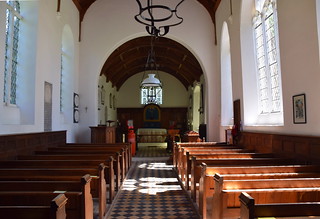
Your first
step inside will reveal all of these at once. Light
streams into the church through a simple Y-tracery west
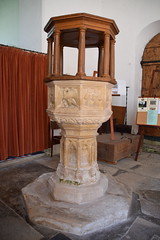
window. The font is late 15th century, and topped by the
Georgians in a rural manner. The 18th century provided
the view to the east, of which more in a moment.
In a
county of interesting fonts, Colby's is one of the most
interesting. It is set curiously; it stands so that no
panel faces east, south, west or north; rather, being
off-centre, the two easterly panels face east-south-east
and east-north-east. It may have been moved; but the
pedestal it stands on does the same thing, and appears to
be original.
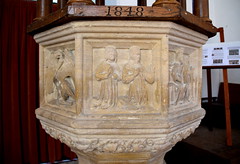
The most
significant panel, and most important, is that to the
ENE. It shows the Madonna and Child set in what I believe
is known as the Seat of Wisdom. Now, this is an
extraordinarily rare image to find on a font. It is
undamaged by Anglican or Puritan iconoclasts.
 |
|
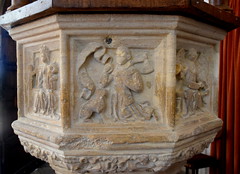
The
panels either side are also extremely unusual.
That two the south shows two kneeling figures in
15th century dress. They are paying homage, and
are almost certainly the two donors of the font.
To the north, another figure, a huntsman, kneels
with an axe. In front of him is what appears to
be a small dog. This is more problematical. It is
claimed as the figure of St Giles, who saved the
life of a hind that turned out to be Christ. The
creature, it is suggested, is the hind. The
problem is, it is unusual to find St Giles
carrying a weapon - and the creature does
look like a dog. However, we know that this
church owned a relic of St Giles before the
Reformation - his finger, in a silver reliquary.
And somebody kindly sent me a photograph of a
statue of a huntsman carrying an axe with a deer
at his feet - it stands high above the streets of
Liverpool, on top of the turret of a 19th century
pub. The name of the pub? The St Giles Tavern. |
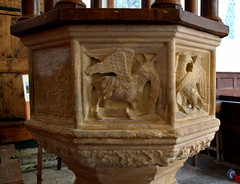
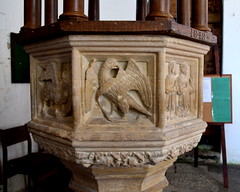
All the
panels are in super condition, and must have been
cemented over during the Anglican reformation of the
1540s. The other five panels are interesting for what isn't
there. The symbols of the four evangelists are
paired either side of the 8th panel. And this,
incredibly, is still cemented over. What on
earth could be beneath it? A crucifixion? A Holy Trinity?
I couldn't help thinking that it looked like 19th century
cement, in which case it was probably exposed by the
Victorians at the same time as the other seven panels,
and then cemented over again for being badly damaged.
Around the
base of the font are reset brass inscriptions that echo
the font's evidence of 15th century important people. And
then, the view east is simple and delicious. Not too much
money was spent by the Victorians on the nave - the walls
are still panelled, the benches seemly, the tiles
restrained. There is no coloured glass.
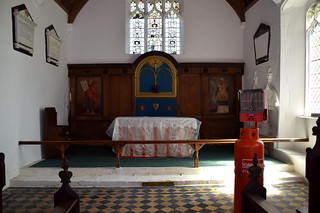
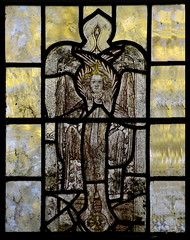
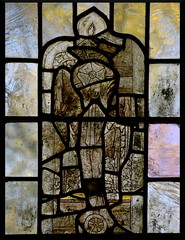
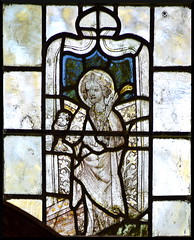
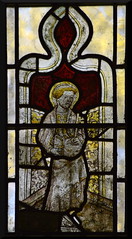
And then,
there is that gorgeous chancel - a small east window
above an 18th century sanctuary which is a rural vision
of what a City of London church might be like. Even Moses
and Aaron, flanking the now-removed decalogue boards, are
locally painted. It is claimed that this reredos came
from the church at Gunton on the occasion of its
rebuilding by Robert Adam. This may be so, but I find it
difficult to make the dates add up, and it does seem to
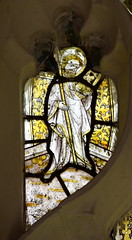
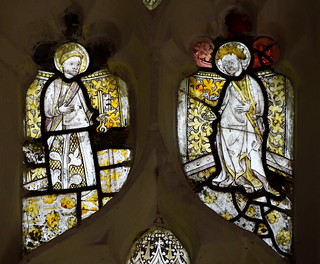
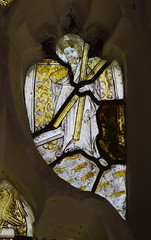
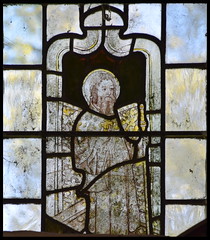
fit perfectly here. To top it all off there are some fine
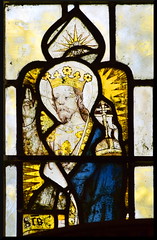
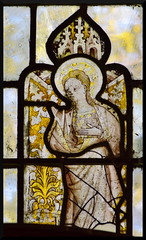
15th century glass figures reset in the otherwise clear
east window: Christ in Majesty and a Mary of the
Annunciation above the altar, two angels on their wheels
either side at the top, and other figures including St
James with his pilgrim staff and bag, St John with his
poisoned chalice and St Peter with his keys.
There is
more of interest in this immaculately well-kept church,
including the inscription to the 17th century Richard
Snelling; he left one pound to be distributed on every
Christmas Day among the aged poor of Colby, and ten
shillings on every Easter Day to cloath four poor
children of the said parish. The altar cloth in
exquisite needlework set in a frame on the east wall has
an inscription recording that it was worked by Miss
Charlotte Coleby (1797-1869), elder daughter of the
Reverend George Coleby... by some means the frontal
passed into the custody of the Royal School of
Needlework, and it lay more or less forgotten until the
School moved to new premises in 1962, when it was
returned to this church. It is a rare and poignant
reminder of the Oxford Movement-inspired revival in the
Church of England as it was actually carried out by
people on the ground - it was, perhaps, the first altar
frontal that the parishioners of Colby had seen for
several centuries, and it is still here, in the place
where it was made and fondly used.
Simon Knott, August 2005
|
|
|