home I index I latest I glossary I introductions I e-mail I about this site
St Agnes, Cawston



Follow these journeys as they happen at Last Of England Twitter.
| St Agnes,
Cawston Here we are near the
middle of Norfolk, and perhaps it is surprising that
Cawston is a large village, both because it is in this
area of narrow lanes and remote churches, and also
because it it so close to the larger village of Reepham.
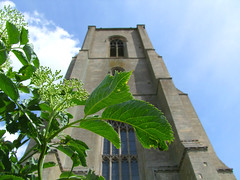
But St Agnes is not a surprise, because the great tower
is visible for miles, riding the hedgerows and rising
above the trees as you weave between the sprawling
fields. A stark monolith, both because of the austere,
unfamiliar stone in this land of flint and because the
top is without pinnacles or battlements. From many places
you can see both this tower and that of the great church
of Salle a couple of miles off, but there is never any
confusing them. The new church was wide and tall
with aisles and clerestories. The new tower is one of
East Anglia's most memorable, although it is difficult to
find it beautiful. It is certainly magnificent, and all
in all this attempt by the donors to capture the
imagination of the parishioners and to ensure prayers for
their own souls after their deaths must have been wholly
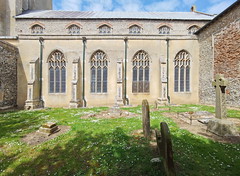
successful. The chancel survives from the earlier
building, although it had in turn been rebuilt in the
early years of the 14th Century. Otherwise, the
rebuilding reflects the full confidence of the early
years of the 15th Century. More than this, it provides a
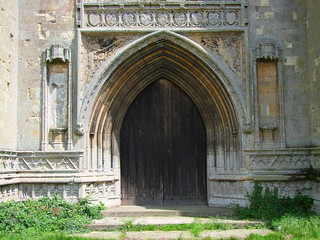
taste of things to come in the decades ahead. The west
doorway seems out of scale, as big as it is, its
compactness accentuating the vastness above. A wild man
and a dragon face up to each other in the spandrels.
We'll meet them again inside. Gargoyles and grotesques
squat below the untraceried parapets.
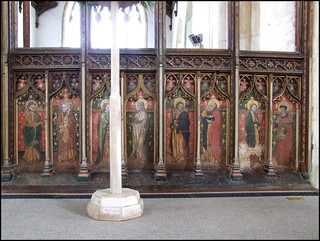
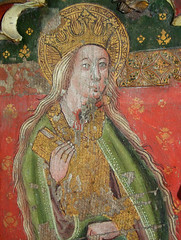
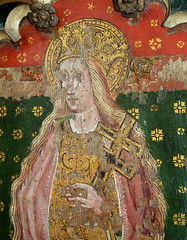
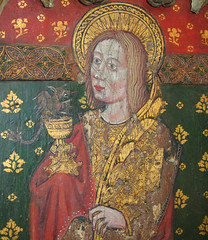
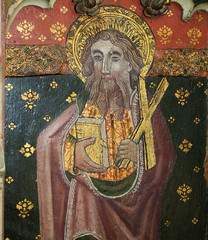
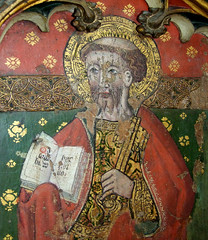
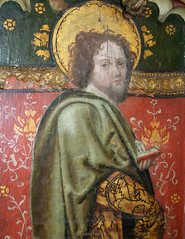
On the north side, from the left, are St Agnes with her lamb, St Helena and the true cross, St Thomas with a spear, St John with a poisoned chalice, St James with a pilgrim staff, St Andrew with a saltire cross, St Paul with a sword and and St Peter with a key and a book.
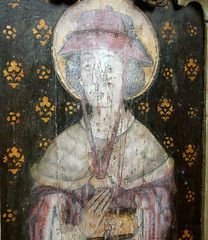
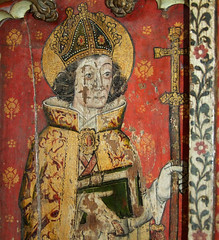
As at neighbouring Salle the figures on the gates are the four Latin Doctors, St Gregory, St Jerome, St Ambrose and St Augustine.
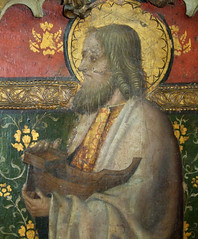
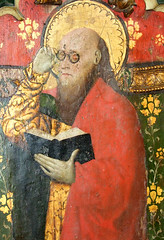
On the south side, the Saints are St James the Less with a fuller's club, St Bartholomew with a flencing knife, St Philip with a book, St Jude with a boat, St Simon with a fish, St Matthew famously in his glasses, St Matthias, who carries a large book, and the uncanonised Sir John Schorn conjuring the devil into a boot. Of these, the last and St Gregory are heavily vandalised, Sir John probably because of superstitious practices associated with him, and St Gregory because of his papal tiara.
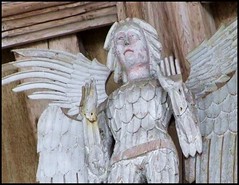
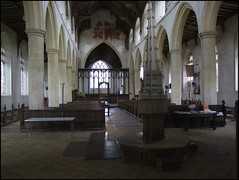
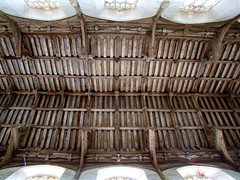
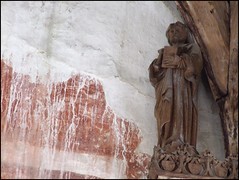
Looking up, the great nave roof is contemporary with the screen and is home to perhaps East Anglia's best group of roof angels, cleaned and restored recently to bring back to life the the exquisite detail and the vividness of the original colour. Angels take flight from the wall posts and stand within the hammer beams. At the east end are the 19th Century figures of St Agnes holding a lamb and a palm and St John holding his poisoned chalice flanking the rood tympanum above the chancel arch with its ghostly outline of the cross.
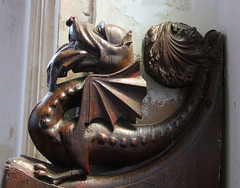
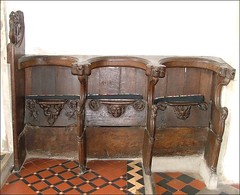
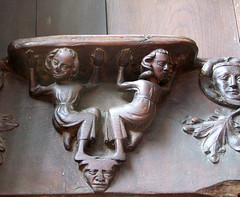
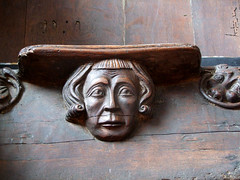
Stepping beneath the vanished rood and through the screen, the chancel is simpler and more elegant, reflecting its origins on the other side of the Black Death before we became more serious about these matters. A curious set of three misericord seats has been sandwiched into the gap where the sedilia once was, supported rather awkwardly under the right hand feet. The seats certainly weren't there originally, and may not even have come from this church, but they look very fine now. Two seated figures support the left hand seat, as if they were building a house or even a church. There is a comical face in the middle and a stag flanked by two dogs on the right. The most curious figure is on the easterly arm, which appears to show a dragon with something in its mouth, a figure perhaps, in which case it might be a rare symbol of St Martha. There is no figure on the other arm, suggesting that this set was once one of at least a pair, and stood end-on to a north wall. The traceried base courses to the
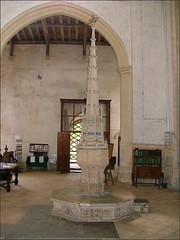
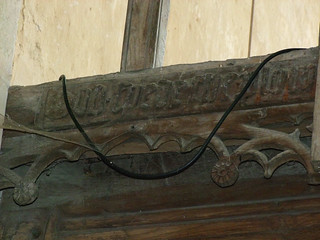
tower continue inside the building, and set in the tower
arch is a pretty little gallery which is something quite
unusual. The inscription along the front appears to read:
God spede the plow and send us ale corn enow oor
purpose for to make: At crow of cok of the plowlete of
Sygate: Be mery and glade wat good ale yis work mad. Ale
corn is barley, of course, and a goodale was a
fundraising celebration held by a guild, in this case the
Plough Guild of Sygate, a street in Cawston. There is a
suggestion of a pun in the last phrase, for the most
obvious meaning of 'what good ale this work made' might
also be interpreted as 'Wat Goodale this work made', Wat
Goodale being the name of the donor of the gallery, and
if you move the second colon on four words it becomes an
injunction to be merry and glad at the crow of the cock
(that is, sunrise) at the Sygate Plough. The Plough inn
remained in use well into the 20th Century, and when it
closed in the 1960s the sign was given to the church, and
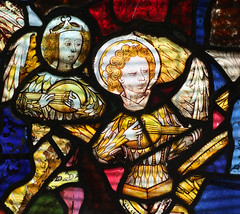
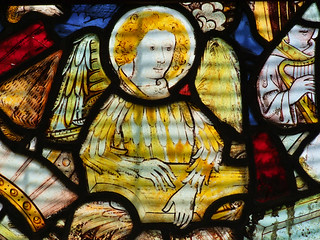
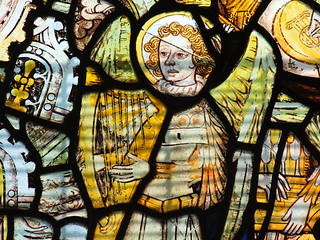
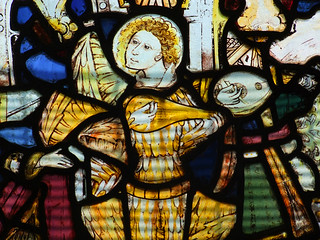
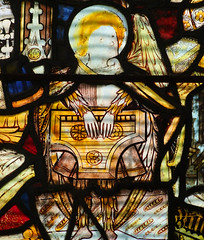
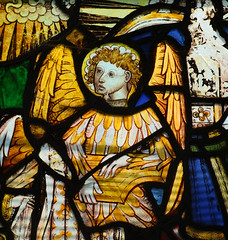
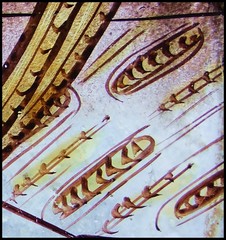
is still on display. Surviving pieces of the 15th Century glass that Wat Goodale and his mates would have seen here when it was new are mostly collected together in the nave. A number of angels playing instruments are echoes of similar work at St Peter Mancroft in Norwich and at East Harling, and are perhaps suggestive of what was lost here. You can make out the tiny details of ears of barley, the motif of the 15th Century Norwich School. Among the angels are tantalising fragments: St John the Evangelist's eagle, the head of God the father, what is probably the cloth of St Veronica, a dove descending, and so on.
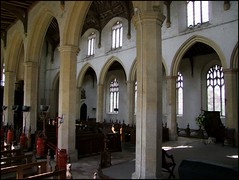
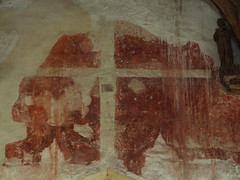
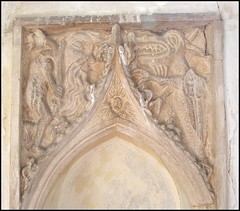
Unusually for a large church in East Anglia, but as at neighbouring Salle, Cawston church has transepts. The south transept roof is richly decorated, and punctuated by bosses of faces which may depict donors. Also probably donors are the two figures either side of the central figure in the important wall painting on the east wall of the transept. She sits between them on a throne, a book in her left hand. She lifts her other hand in the air, seemingly in benediction, but if you look closely you can see a dove pointed towards it. The guidebook suggests that it is Mary, but I do not think this can be the case, since the pose depicts none of the conventional Marian iconography. I am inclined to the other view that it is in fact St Agnes, the dove kissing her ring, and that this was probably the chapel of the guild of St Agnes. Once, an altar would have sat beneath it, lit in the afternoon by the now blocked window in the west wall opposite. She also appears on the roodscreen, of course, and as Simon Cotton points out these taken together with the known existence of a guild support the presumed dedication of the church. In the south wall of the transept is an elegant piscina, too far from the painting of St Agnes to have supported an altar there, so there must have been another one here. In the spandrels are a wild man and a dragon, echoing those above the west door. The fine 15th Century pulpit is a reminder of the emphasis that the pre-Reformation church placed on preaching. The alms box down by the south door requires, in the manner of parish chests, three separate keys turned at the same time to open it. One would be held by the rector, the others by churchwardens. The 1851 Census of Religious Worship returns for Cawston make bizarre and somewhat labyrinthine reading. The population of the village at the time was large, almost 1200 people, and thus more than double that of a typical self-sufficient Norfolk village. The Reverend AEL Bulmer, the rector of Cawston, recorded that his church had room for 800 people, but he declined to say how many people had attended church on the Sunday of the census or what the average attendance at the church was. Further, he was also unable to say what his income was, one of the questions asked of all ministers that day, noting only that it was a tithe rent charge in lieu of 12 acres of glebe, and the amount of indowment is presumed to be registered in the Tithe Commissioner's Office. Returns to the same enquiry have been made repeatedly to different public bodies. The inference is that the Reverend Bulmer had arrived in a fairly moribund parish and the parishioners of Cawston were not in a hurry to come forward with the tithes to which he felt he was entitled. This reluctance was often felt in parishes with a strong non-conformist element, and this is where things get even more interesting, for there were no less than three separate Methodist chapels registered in Cawston at the time. The main Wesleyan Methodist Chapel, established in 1816, claimed a regular average total attendance for each Sunday of more than 300, yet on the day of the census just 4 people had turned up. George Smith, the Wesleyan minister of neighbouring Reepham recorded in the return that the average numbers represent the Congregation until within the last few months. Very violent and disgraceful proceedings destroyed the congregation. Legal redress has recently been obtained and it is hoped that many will return to the chapel. What on earth could have happened? A clue might be that elsewhere in the village was a Wesleyan Methodist Reform Chapel which had been established on 5th December 1850 (that is to say, just three months before the census). Here, 270 people turned up, but John Dennis, 'steward and waggoner' noted that the cause of our Congregation being so small is our banishment from the Old Wesleyan Methodist Chapple erected about 1816 the Congregation in this Chapple nearly double wich have all left except from 4 to 6 and the room we now occupy is quite filled. Meanwhile, elsewhere in the village at the Primitive Methodist Chapel, which had been established in 1832, there were 140 in a congregation which would have had every right, had such a thing been allowable to Primitive Methodists, to be quietly smug. Simon Knott, October 2020 Follow these journeys as they happen at Last Of England Twitter. |









|
|||||||||||||||||||||||||||||||||||||||||||||||||||||||
home I index I latest I introductions I e-mail I about
this site I glossary
Norwich I ruined churches I desktop backgrounds I round tower churches
links I small
print I www.simonknott.co.uk I www.suffolkchurches.co.uk