home I index I latest I glossary I introductions I e-mail I about this site
Holy Cross, Caston


Follow these journeys as they happen at Last Of England Twitter.
| Holy
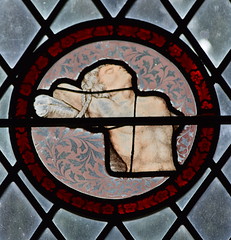
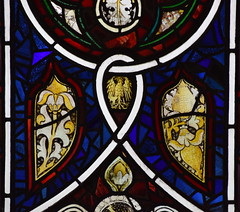
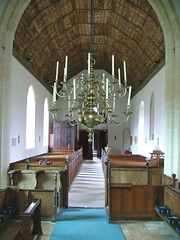
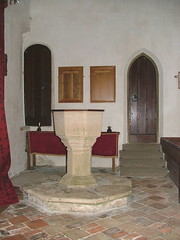
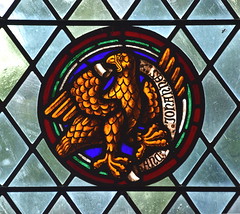
Cross, Caston Caston is one of the Wayland villages, its attractive houses clustered around a green. It is not far from the Thetford to Watton road, and also not far from the edge of the British Army's battle training area, but you would not know that these things were near. Coming here in May 2021 I remembered very little about it, for I had not been back to Caston for fourteen years. Rereading my account of my 2007 visit I was reminded that I had found the church open that day, so I was not too concerned when I found the churchyard grass neatly mowed (over the years I have found a vague correlation between churchyards that are bowling green smooth and locked churches). The church is also very crisp, the result of its fairly overwhelming 1850s restoration. In the 1990s the roof was returned to thatch, which ameliorates matters somewhat, for really this must have been an atmospheric church before its restoration. It was largely constructed in the early 14th Century like the nearby church at Thompson, with a 15th Century restoration renewing the upper part of the rather squat tower and bringing large nave windows to let in the light. The south doorway is blocked and the north porch has been converted into a vestry, and so unusually for East Anglia you enter from the west through a striking ogee-arched doorway beneath a beautiful Decorated window. The area beneath the tower serves as a porch, and then you step through into the long, narrow nave under a boarded ceiling, which, Pevsner tells us, conceals a 14th Century scissor-braced roof as at Thompson. The lower roof of the chancel beyond is also boarded, the east window giving something more of an indication of the church's true age. Caston has an interesting collection of fragmentary medieval English and early modern Continental glass, collected together on the south side of the nave. It is unlikely to come from this church originally I think, for if it did it is improbable there would be fragments of what is clearly a fair number of continental scenes. Most probably it came from one of the Norwich glass dealers and was placed here in the 1850s, although some of it had to be reset after blast damage in the Second World War, a fate suffered by a number of churches near to air bases. Some pieces are identifiable, including the wheel of St Catherine, the eagle of St John, a fragment of the Miracle of the Loaves and Fishes, and several heads including part of one wearing a crown. The most substantial surviving piece is from a Continental Crucifixion scene, the unrepentant thief bending back to avoid the gaze of Christ. There are more fragments worked into the windows on the north side of the chancel including a piece of the scene of Christ being mocked and beaten, and in an upper light the raised hand of the Risen Christ in Majesty.
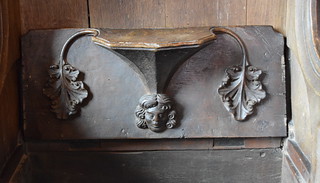
Otherwise the windows are fairly clear, a good setting for some 1850s roundels depicting the symbols of the four evangelists, and a 1950s depiction of the Instruments of the Passion. The restoration left a fair number of scattered survivals. A stall in the chancel has misericord seats and graffiti on the desk carved by some bored scholar in 1783. There are a number of 15th Century bench ends reset on 19th Century benches including the figure of a cowled animal. Perhaps most dramatic of all is the grand candelabra which dominates the chancel. Pevsner tells us that it came here in 1871 from Cheshunt church in Hertfordshire, which presumably was undergoing a restoration at the time and selling off the trappings of the past. It brought with it a story that it had been given to Cheshunt by Charles I, and had originally come from Hampton Court. On the day I visited in 2021 it was being cleaned, and had been taken apart into a remarkable number of similar-looking pieces. The man cleaning it seemed very knowledgeable about it, and so I'm sure he remembered how to put it back together again. Simon Knott, June 2021 Follow these journeys as they happen at Last Of England Twitter. |





|
|||||||||||||||||||||||||||||||||||||||||||||||||||||||
|
|||||||||||||||||||||||||||||||||||||||||||||||||||||||
home I index I latest I introductions I e-mail I about
this site I glossary
Norwich I ruined churches I desktop backgrounds I round tower churches
links I small
print I www.simonknott.co.uk I www.suffolkchurches.co.uk