home I index I latest I glossary I introductions I e-mail I about this site
St Mary, Carleton Forehoe


Follow these journeys as they happen at Last Of England Twitter.
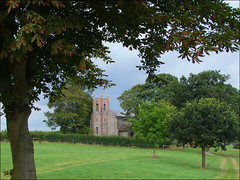
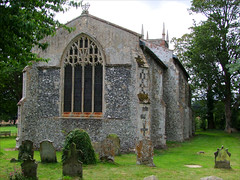
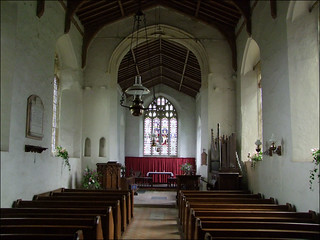
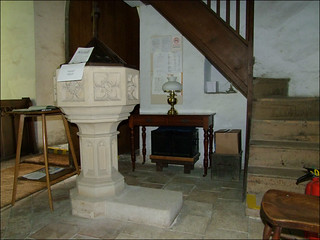
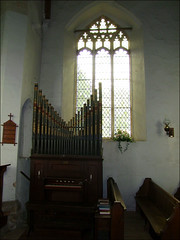
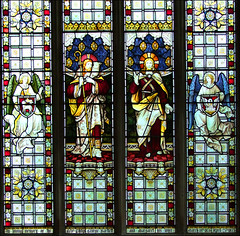
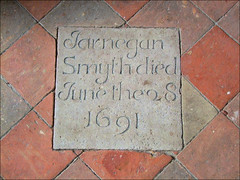
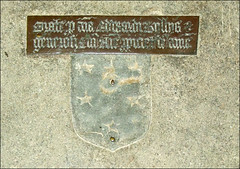
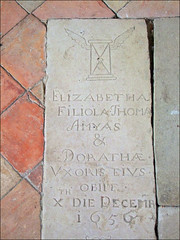
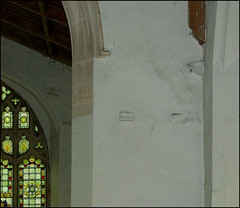
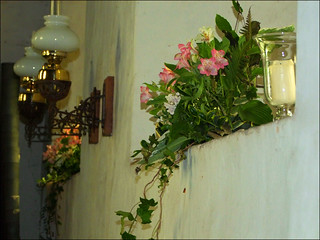
St Mary, Carleton Forehoe Not far from the lovely little town of Wymondham a path cuts off across the fields to where Carleton Forehoe's church of St Mary sits in its tree-shrouded graveyard. In summer the churchyard is a riot of leaves, and all that can be seen from the road is the pretty and idiosyncratic tower rising above the churchyard hedge. You used to be able to drive across the field to it, but they've recently put in a new fence and gate, and so now you must walk which is no bad thing. Unusually for Norfolk, the flint and red brick tower is early 18th Century with the kind of pinnacles you might expect on a tomb or memorial of the period. Perhaps uniquely, the legend on the west face reads Vivat A Regina, a hymn to Queen Anne. The trim tower and crisply restored nave and chancel disguise the church within, for you step into the surprise of a tall, open barn-like interior which is utterly lovely. There is anoverwhelming feel of the first half of the 19th Century, with an open gallery at the west end, brick floors, and oil lamps lining the walls and hanging from the roof. One earlier survival is the set of image niches either side of the chancel arch, two or one side and one on the other, showing the site of medieval nave altars. The four corbels above must have supported the rood beam. Beyond, the 1880s glass in the chancel adds a touch of gravitas. The silence of the fields all around contributes to this sense of insulated rusticity. In any rural church the most moving details are often the simple memorial inscriptions in the floor. On 10th December 1656, at the height of the Commonwealth, Thomas and Dorothy Amyas's daughter Elizabeth died. Her Latin inscription is beneath a simply cut geometric hour glass with wings. Nearby, a terser inscription recalls that Jarnegan Smyth died on 28 June 1691. In the aisle, a 15th Century brass inscription asks us to pray for the soul of Edward Tyllys and commends his soul to God. The shield associated with the inscription is now lost, only the indent surviving with the ghosts of six stars. It was lovely just to sit here, away from the 21st century, communing with the ghosts of rural Norfolk. And then, the pleasant walk back across the fields. Simon Knott, November 2020 Follow these journeys as they happen at Last Of England Twitter. |





|
|||||||||||||||||||||||||||||||||||||||||||||||||||||||
|
|||||||||||||||||||||||||||||||||||||||||||||||||||||||
home I index I latest I introductions I e-mail I about
this site I glossary
Norwich I ruined churches I desktop backgrounds I round tower churches
links I small
print I www.simonknott.co.uk I www.suffolkchurches.co.uk