home I index I latest I glossary I introductions I e-mail I about this site
St Margaret, Cantley

Follow these journeys as they happen at Last Of England Twitter.
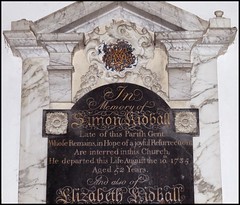
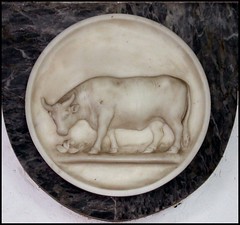
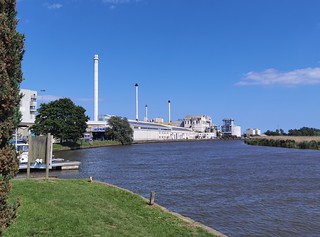
St Margaret, Cantley Cantley comes as surprise. You can see the village from miles away across the fields, but whereas in other parts of East Anglia it is the church tower which beckons you on, here it is something quite different. In the 1930s, Cantley was chosen as the site of one of a number of sugar beet processing factories that were built across East Anglia at this time, and the much-expanded British Sugar plant here today is one of three that are still in use, the others being at Bury St Edmunds and Wissington (there's a fourth at Newark in Nottinghamshire). The factory sits between the River Yare and the railway line. We are halfway between Norwich and Yarmouth here, and the river is navigable by large boats. It was possible for the raw materials to arrive here by boat, rail or road, and for the sugar to leave by any of the same means. It was the perfect solution to the problem of getting east Norfolk and north Suffolk's sugar beet harvest in as quickly as possible, although today it is mostly lorries that do the work of bringing the beet to the factory and taking the refined sugar products away again. Cantley's parish church is set on the northern side of the village. It is not a large church, there are no aisles or clerestories, but it is uncharacteristically long and narrow for a Yare Valley church, the stumpy, squared off tower accentuating this. The long chancel stretches beyond a low south transept. The whole piece seems to be largely a 14th Century rebuilding of the Norman church, but the window tracery to nave and transept is later, and I think the east window is probably a fruit of the 19th Century restoration, designed to match them. You enter through the low, wide south porch into a light and airy space with a quiet elegance. There is no coloured glass and so there isn't the gloom you might find in many narrow churches. I'd not been back to Cantley since 2007 and I have to say that alarm bells rang a little on approaching it when I saw that several of the windows had sections boarded up. Inside, paint and plaster on the north wall is peeling away, presumably water damage, and it does feel as if this pleasant little church could do with a bit of tender loving care. The entrance to the transept is low, little more than a doorway, and among the ledger stones here is a somewhat battered one one of the 18th Century to John Kidball with a fierce looking skull. It is not possible to read the year of his death because the last two digits were removed by a later repair. However, up on the wall is a spectacular memorial to Simon and Elizabeth Kidball of towering marble and flamboyant lettering. Simon Kidball died in 1735 and I assume it is the same family, but without knowing John Kidball's death date we can't know if the family had gone up or down in the world. The best memorial here is to the Layton brothers, Jonathan 'of Reedham Hall' and Charles 'of Clippesby Hall' who died in 1801 and 1791 respectively. Their memorial is topped by a large wheatsheaf, and at the bottom is a roundel depicting a handsome bull. Cantley is one of those tiny parishes which form a patchwork along the banks of the Rivers Yare, Bure and Waveney. They are ancient parishes, the first to be settled by incoming Angles and Saxons, the crowded manors surviving the Norman invasion and Domesday to form the parishes of today. Many of the Yareside parishes have hardly any people in them - neighbouring Hassingham has just nine houses - and there are few proper village centres. But Cantley is quite different to the others, because thanks to British Sugar this is an industrial village. North of the works there are streets of houses which look as if they should be in Norwich or Ipswich rather than in a remote country parish. My grandfather Joe Knott was a labourer living in Cantley in 1932 when he married my grandmother at Ely Registry Office. He gave his address as 9 Council Cottages. This was the time that the sugar beet factory was built, and construction work was Joe's trade. He later went to work on the building of the vast Fisons factory in Ipswich, and then he took his wife back to Ely were they spent the rest of their lives. There's a good view of the factory from the Reedcutter Inn beside the Yare, and which you may recognise if you have ever seen the film Yesterday. It seems unlikely that Joe ever set foot in the church, but he couldn't help but be in my mind as I sat behind a pint beside the river, because I'm sure he would have spent time here. Simon Knott, July 2022
Follow these journeys as they happen at Last Of England Twitter. |
|
|||||||||||||||||||||||||||||||||||||||||||||||||||||||
home I index I latest I introductions I e-mail I about
this site I glossary
Norwich I ruined churches I desktop backgrounds I round tower churches
links I small
print I www.simonknott.co.uk I www.suffolkchurches.co.uk