home I index I latest I glossary I introductions I e-mail I about this site
St Edmund, Caistor St Edmund




Follow these journeys as they happen at Last Of England Twitter.
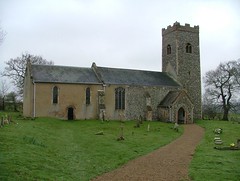
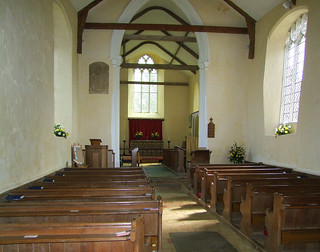
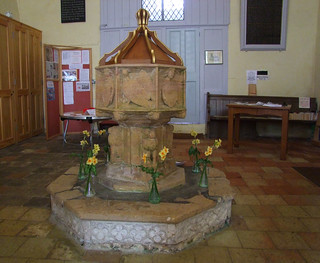
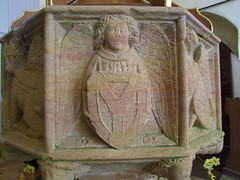
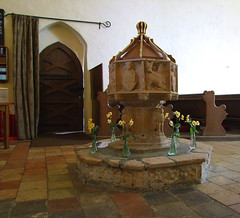
St Edmund, Caistor St Edmund The setting of this church must be one of the strangest in Norfolk, for it sits in one corner of the great outline of the Roman town of Venta Icenorum. Little remains of the ancient town apart from the ramparts, which are at their highest near to the church. There is some walling on the north side, and a tower down by the river, but otherwise this is a wild and open place, especially on a gloomy, drizzly day in winter. There is some evidence that the church sits on one of the main roads of the town, which was not much smaller than Roman Colchester, where so much has survived. Remains of a fourth century church have been found in Colchester, and so it is not unlikely that St Edmund sits on the site of a predecessor that predated its patron saint's life and death by several centuries. Not surprisingly, a fair amount of Roman brick has been used in repairs and reconstructions over the centuries, and these create delightful outlines and fillings to doorways and windows. The tower also contains a fair amount of brick, and there seems to have been a fairly late medieval restoration to the top of the tower. The former window that was set in the south doorway has recently been removed and the doorway opened up as an entrance into a discreet extension. St Edmund used to be a church that was not used very often, and in the past it has not been easy of access. However, that has changed in recent years. You step through a doorway flanked by big corbel heads at shoulder height, and then down into what is a substantially Victorianised interior, with a slightly sad feeling, as if a busy former life had now passed it by. The ceiling is odd, in the shape of, but slightly lower than, the roof, with some beams showing through the plaster, but no cross or tie beams visible. There are faint survivals of wall paintings, and opposite the north doorway is the ghost of a large St Christopher, suggesting that the north side has always been the main way in. On the north side of the chancel arch there is another figure, its haloed head just discernible. In the past, enough of the poisoned chalice he was holding survived to tell that this is St John. Perhaps he was matched on the south side by another figure, the Blessed Virgin perhaps, or St John the Baptist as at Weston Longueville. In this small space the font is imposing, a typical deep cut East Anglian design with evangelistic symbols and angels holding shields, East Anglia's familiar lions supporting the stem. Interestingly, there is a dedicatory inscription in Latin around the base asking for prayers, not for an individual, but for the Bothers and Sisters, Benefactors of the Guild of St John the Baptist at Caistor. On my most recent visit I was interested to track down again the grave of Georgiana Docking, which had been obvious to me back at the start of the century because of the large oak tree bursting through it. Perhaps she was buried with an acorn in her pocket. But the tree has recently been felled, and so Georgiana can sleep in peace. Leaving the churchyard on the south side you climb the Roman ramparts, enhancing the sense of remoteness, of an ancient and wild space. From here, you can walk clockwise around the ramparts. This is a round trip of about twenty minutes, longer if you amble and dawdle to take in the atmosphere. You can stand and look back at the church from the far west, and see how it might once indeed have been the site of a Roman temple, a Roman city sprawled around it, an awesome thought. The centuries roll away, until an express train bursts through not fifty metres behind you, hurtling on its way to London and destroying the illusion. Simon Knott, November 2020 Follow these journeys as they happen at Last Of England Twitter. |




|
|||||||||||||||||||||||||||||||||||||||||||||||||||||||
|
|||||||||||||||||||||||||||||||||||||||||||||||||||||||
home I index I latest I introductions I e-mail I about
this site I glossary
Norwich I ruined churches I desktop backgrounds I round tower churches
links I small
print I www.simonknott.co.uk I www.suffolkchurches.co.uk