home I index I latest I glossary I introductions I e-mail I about this site
Holy Trinity, Caister-on-Sea


Follow these journeys as they happen at Last Of England Twitter.
| Holy
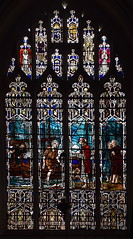
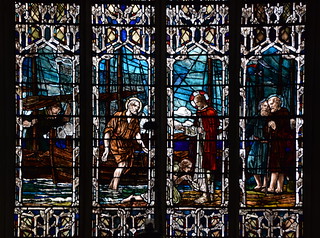
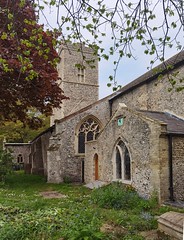
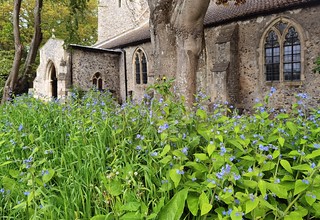
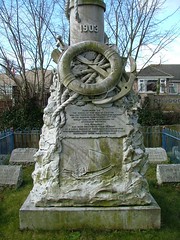
Trinity, Caister-on-Sea The long coastal strip that runs northwards from Suffolk into Norfolk is perhaps not the most enticing part of East Anglia, unless you are looking for a jolly seaside holiday, and there'd be nothing wrong with that of course. But by the time you get to the old centre of Caister-on-Sea things have calmed down a bit, and there is a sense of a more parochial way of life, of local people going about their daily business. In the middle of this is Holy Trinity, set in a gorgeous churchyard that was alive with alkanet and borage on the day I visited in late spring 2023. Caister is an ancient place. Its castle was home to Sir John Fastolf, hero of the Wars of the Roses, his character notoriously defamed by Shakespeare. But to anyone from outside of Norfolk the town might most immediately associated with its lifeboat. Few and far between can be the working class homes in the first half of the 20th Century which did not proudly display a souvenir of the Caister Lifeboat. Perhaps it was because the early years of that century saw the birth of mass circulation newspapers that it threw up popular heroes, most notably perhaps Captain Scott and Edith Cavell, but also the nine men of the Caister lifeboat Beauchamp who lost their lives answering a call on 19th November 1901, the night of what became known as the Great Storm. Five of them were from the same family, an appalling thought. Their memorial stands to the north-east of the church across the Ormesby road in the old cemetery. Instantly recognisable from a thousand early 20th Century reproductions, it consists of a broken pillar bedecked with nets, lifebuoys, chains and other equipment, all intricately carved in stone. In front, and long since vandalised, is a little pillar with a slot in the top, so that people coming to look at it might make a contribution to the RNLI, as if this was just another seaside attraction. Which, in a real and intended way, it was. The church they knew had been substantially restored and even partly rebuilt barely seven years before the disaster, a date so late in the 19th Century that it is surprising it was so unsympathetic. Bearing this in mind, this was essentially a late 13th and early 14th Century church, probably complete before the pestilences of the second half of that century reached East Anglia, carrying off half the population. Simon Cotton notes that the 1330 contract for the nave roof survives, but it has been entirely replaced since. The south aisle was there by then, but on stepping inside you see that the arcade that separates it from the nave is entirely 19th Century. In fact, the main thing you'll see as you step inside is Caister's remarkable font. It is the largest medieval font in East Anglia, and it must be one of the largest in England. It stands fully five feet high even without a pedestal, and requires a set of steps to use it. There's a story that it was found in a garden in Eye, Suffolk, and brought here as part of the 19th Century restoration. This may be so, and it may even have been originally set in the great church at Eye, where the font is now a 19th Century replacement. If so, I expect the 'found in a garden' part of the story may be a romantic fiction, and it was simply discarded during the 19th Century restoration at Eye. It is certainly impressive, wherever it came from. Also impressive is the east window. It is by Paul Woodroffe, a pupil of Christopher Whall, and depicts the fisherman disciples meeting Christ on the shore. It remembers those lost in the 1901 lifeboat disaster, and the inscription along the bottom reads to the Glory of God and in memory of nine brave men. November 14th 1901. In truth, the crew were doomed as soon as they left the shore. It was an appalling night. At the inquest into the disaster, James Haylett, who was on watch that night and lost three members of his family, said they would never give up the ship. If they had to keep at it 'til now, they would have sailed about until daylight to help her. Going back is against the rules when we see distress signals like that. The popular newspapers of the day reported this as 'Caister Men never turn back', and Never Turn Back became the slogan of the Royal National Lifeboat Institute.
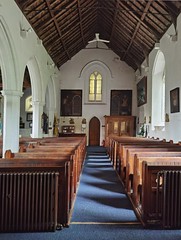
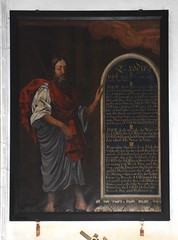
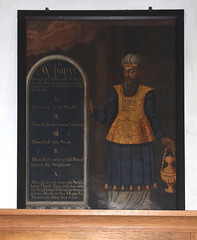
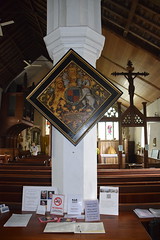
Internally the nave feels square, and the roof is low without a clerestory. The view into the chancel is dominated by two sets of organ pipes, facing each other across the chancel. It looks as if they are leaning towards each other, whispering. At the east of the south aisle is a simple and lovely Blessed Sacrament chapel, because like most churches in this area Caister was long in the Anglo-Catholic tradition, and still retains its stations of the cross around the walls. The glass above this side altar is the 1930s work of Alfred Wilkinson, depicting Christ as the Good Shepherd. Holy Trinity is not short of painted wood. there are two large 18th Century commandment boards at the west end depicting Moses and Aaron, and what appears to be a hatchment turns out to be a curiously poised set royal arms within a lozenge. they are dated 1786 and charged with the arms of the House of Hanover, but the motto reads Exurgat Deus Dissipentur Inimici, 'Rise up o God and scatter my enemies'. The G of G R is clearly a repurposed C, and so these must originally have been the arms of Charles I, and possibly even those of his father James I before him, whose motto this was. Another painted board on the north wall depicts a coat of arms and the legend these were his armes who of his store, gave to this towne to feed the poore, a charming detail. Simon Knott, July 2023 Follow these journeys as they happen at Last Of England Twitter.
|
|
|||||||||||||||||||||||||||||||||||||||||||||||||||||||
home I index I latest I introductions I e-mail I about this site I glossary
links I small
print I www.simonknott.co.uk I www.suffolkchurches.co.uk
ruined churches I desktop backgrounds I round tower churches