home I index I latest I glossary I introductions I e-mail I about this site
St Edmund, South Burlingham
Follow these journeys as they happen at Last Of England Twitter.
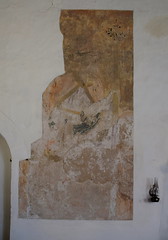
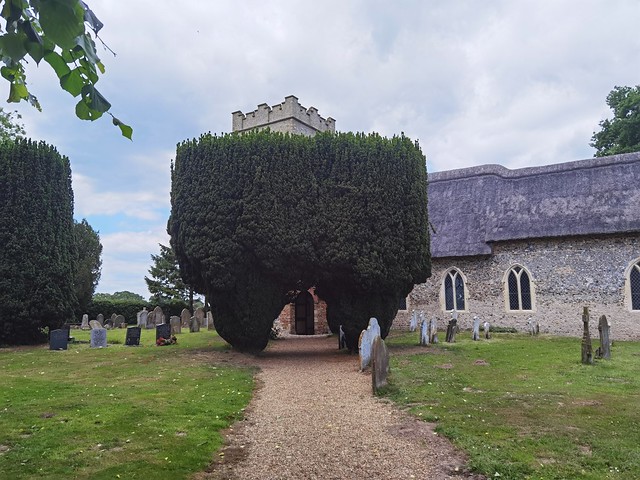
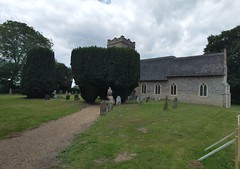
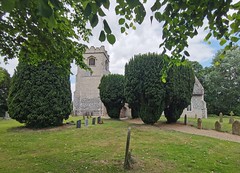
St Edmund, South Burlingham The corner of Norfolk hemmed in by the Bure and the Yare has more than its fair share of small, lovely churches, and and the church of the parish of South Burlingham, also known as Burlingham St Edmund, is one of them. If it is not as well known as its neighbouring churches at Buckenham, Wickhampton and Moulton St Mary, it is simply because unlike them this church is kept locked, but a key is available across the road. The view to it across the churchyard is memorable, because of the large yew trees that form aprocessional entrance to the south porch, and the thatched roof of the nave and chancel which seems to ooze over the rough flint walls like melted cheese. This was clearly a Norman church as you can tell by the south doorway, but it was then substantially rebuilt at the end of the 14th Century. The tower seems later, and indeed appears today pretty much all of its 19th Century restoration when the bell stage was unfortunately rebuilt. Pevsner thought this was very badly done. But fortunately the interior restoration was carried out with much more care, for you step into an interior that is harmonious and pleasing. Everything seems to come together, the medieval survivals at one with the later works of the 17th and 18th Centuries. As at neighbouring Lingwood there is no chancel arch, but the proportions of the interior allow it to escape the tunnel-like feel there. The first striking survival is beside the former north doorway, a tall St Christopher wall painting. St Christopher was an important saint in the late medieval economy of grace, for he was (and is) the patron saint of travellers. The Black Death of the mid-14th Century had taught the dangers of dying away from home, alone and unconfessed, so the protection of the saint was sought by those on journeys. Hs image was often set opposite the main entrance of a church so that passers-by could stand in the doorway and make their supplications to him. Most of the surviving St Christopher wall paintings are in this part of Norfolk, a land of small parishes where it is easy to pass several churches in a day's walk. But it is not the St Christopher wall painting for which South Burlingham church is most renowned, for up in the chancel, on the south wall, is one of England's best preserved scenes of the martyrdom of St Thomas of Canterbury.
Because Thomas symbolised so strongly the power of the Catholic Church over the Crown, his images were viciously circumscribed by the Anglicans at the time of the 16th Century Reformation. The image of him on the screen at North Burlingham, a mile or so to the north, was almost completely obliterated barely ten years after it had been painted. Here, the wall painting had probably been whitewashed half a century earlier, during the 15th Century, as fashions changed, to be revealed again during the 19th Century. It's worth noting that it is unusual to find a wall painting in the chancel rather than in the nave. The rood screen that
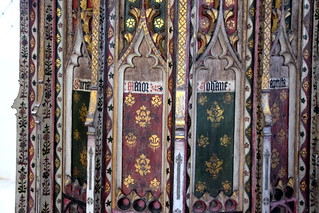
separates the nave from the chancel is of the late 15th
Century. On the west side of the screen there is a
curiosity to the north of the opening. The lower parts of
the dado panels are unpainted. Pevsner thought this
showed where altars had been, while Mortlock imagined
that pews had been built right up against the screen. It
is unlikely that furnishings would have affected the
painting of the screen, and yet the obscured area seems
too large for altars. At some point, someone kneeling at
their devotions against the screen has cut a cross-shaped
squint in the dado to get a better look at what was going
on at the altar.
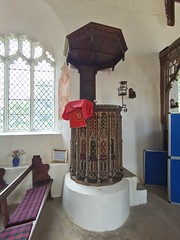
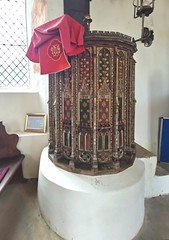
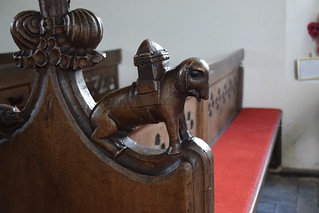
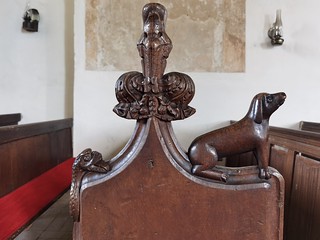
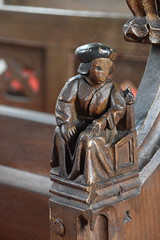
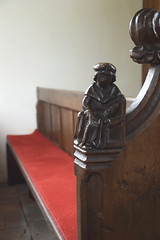
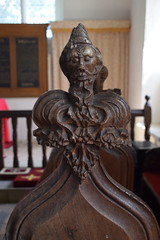
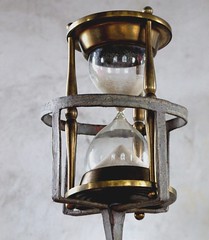
The South Burlingham pulpit is another reminder to us that sermons are not a product of the protestant Reformation, but were in our churches a full century before, as the years after the Black Death made us all serious, and preaching began to encourage a congregational act of worship rather than a diversity of personal devotions. If anything, the Reformation actually suppressed preaching, making incumbents apply for a licence to preach. At first they could only use homilies prepared by central government, an enforcement which has a curiously modern ring to it. A later generation of preachers would make the sermon their own, of course, and St Edmund retains its 18th Century preacher's hour glass, one of the loveliest in Norfolk. It was not intended to keep the preacher brief, but to ensure that he did not shortchange the congregation during the popular Sunday afternoon sermon, which was almost everywhere in Norfolk better attended than the Sunday morning service. Some of the benches on which the pre-Reformation listeners sat on have survived, their bench ends including an elephant with a castle on its back, a serpent sneaking up on a dog, another dog with a stolen duck or goose in its mouth, seated figures and, on a poppyhead in the chancel, a face peeping out.
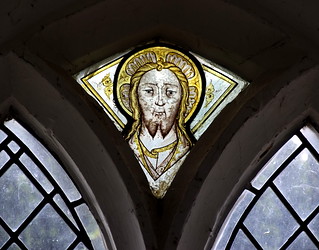
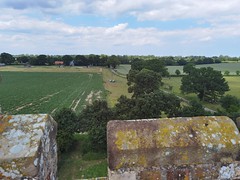
The return stalls in the chancel have 17th Century graffiti on them, probably from a time when the chancel was in use as a school. The sanctuary, with elegant 18th Century railings conceals one of those rare chalice brasses, marking the burial place of a medieval Catholic priest. High in the centre light of a window, a single piece of medieval glass shows the head of the risen Christ, still looking on after half a millennium, like a blessing. A blessing too was the kind lady who let us go up to the top of the tower, climbing up the stone staircase and then through the bell chamber and out on to the roof. The views across the south Norfolk countryside were well worth it. All in all this is a lovely church, full of interest and a text book guide to the English Church on the eve of the Reformation. Simon Knott, August 2022 Follow these journeys as they happen at Last Of England Twitter.
|
|
|||||||||||||||||||||||||||||||||||||||||||||||||||||||
home I index I latest I introductions I e-mail I about
this site I glossary
Norwich I ruined churches I desktop backgrounds I round tower churches
links I small
print I www.simonknott.co.uk I www.suffolkchurches.co.uk