home I index I latest I glossary I introductions I e-mail I about this site
St Michael, Bunwell

Follow these journeys as they happen at Last Of England Twitter.
| St
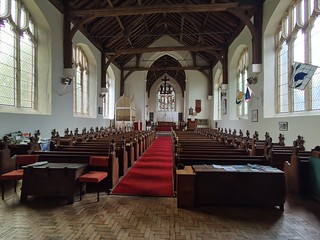
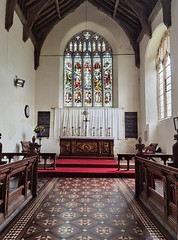
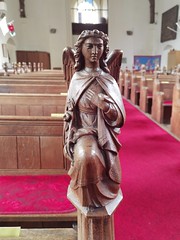
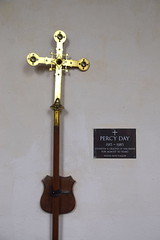
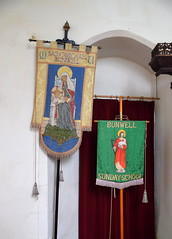
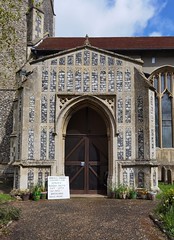
Michael, Bunwell This grand church sits a mile or more away from its village on the south side of its churchyard with the school for company, beside a turnpike section of the old Diss to Norwich road. It is in certain respects an unusual building, for although it is a large Perpendicular church of the kind you might expect in East Anglia with a flushworked tower and porch, there are no aisles and no clerestories. The rebuilding here began relatively late, for in 1499 William Smiths gift of 6s 8d to making tower is the first of a relentless series of bequests towards that project transcribed by Paul Cattermole and Simon Cotton. Year after year wills directed money towards the tower, among them John Hirnynge whose 1505 will includes item I be qwethe to the stepill of Bonewell xiiis ivd which was two nobles, and the same year William Taylor who directed toward the makyng up of the stepill of Bonewell every yere when the masons work on it 6s 8d till the sum of 33s 4d be paid, which is particularly interesting because it tells us that work was under way, and Taylor was positioning his bequest to contribute to the work for five years. For clarity, it should be noted that stepill, or steeple in this context means a tower, not a spire. There was a last bequest to the tower in 1508 suggesting that it was complete soon after, and then in 1540 Robert Lincoln left 6 marks to leading the porch, which is to say roofing it. This is interesting because, as Pevsner points out, the porch looks oddly as if it was intended to rise into a second storey. And there is a further curiosity, because James Cook's 1541 will left 6s 8d to reparation of the church when they goo about to mend the church syde. The following year William Wexe left 6s 8d to mend the church syde. What did this mean? Was an aisle planned at last? But the Reformation had arrived, and it was too late. And so we step through the early 16th Century porch under Robert Lincoln's leading and the mystery of the missing upper storey into a church which is remarkably wide. It is so wide that the arrangement of furnishings creates a sense of there being aisles despite the fact that there are no arcades. The walls are as much glass as they are stone thanks to the great Perpendicular windows. All this was under a hammerbeam roof until it was replaced by tie beams with arched braces in the early years of the 20th Century. There is an urban feel, and if St Michael was suddenly lifted and dropped into the middle of Norwich or Cambridge it would look very much at home. The font is broadly contemporary with the rebuilding of the tower, and as at nearby Old Buckenham there are shields on its panels, which would have been painted, set within quatrefoils. There is a fine set of royal arms for Queen Anne. But if the architecture here is a reflection of the power and prestige of the late 15th and early 16th Centuries, it is the late 19th and early 20th Centuries which give the interior its character Bunwell, particularly in the years preceding the First World War, was in the vanguard of the triumphalist High Church Anglo-Catholic movement. Some of this survives, perhaps most poignantly in the processional cross now set on the north side of the chancel in memory of Percy Day, chorister and crucifer of this parish for almost 50 years. Angels kneel in prayer on the front range of the nave benches, and the six candlesticks still stand on the retable behind the altar. Above them, the great east window by Hardman & Co, unveiled at Easter 1914, reflects something of the mindset of that time, a nation poised casually on the edge of its greatest trauma. Saints in glory, knights in shining armour, flames and incense and the shimmering peacock feathers of angel wings congregate about the enthroned Christ. It was the high point of something which would be jolted into rapid change over the next hundred years. Simon Knott, April 2023 Follow these journeys as they happen at Last Of England Twitter.
|
|
|||||||||||||||||||||||||||||||||||||||||||||||||||||||
home I index I latest I introductions I e-mail I about this site I glossary
links I small
print I www.simonknott.co.uk I www.suffolkchurches.co.uk
ruined churches I desktop backgrounds I round tower churches