home I index I latest I glossary I introductions I e-mail I about this site
St Nicholas, Buckenham

Follow these journeys as they happen at Last Of England Twitter.
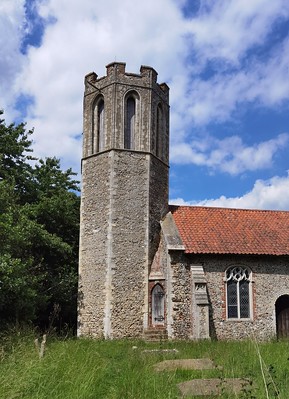
St Nicholas, Buckenham This hauntingly lovely
little church sits all on its own in the lonely, rolling
fields above the River Yare, a good quarter of a mile
from the nearest narrow lane. You have to walk across the
fields from a row of cottages to reach it, and so
tree-surrounded is the site that your first full view of
the building is as you step across the ditch into the
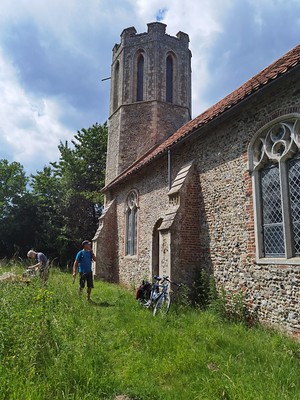
churchyard. Externally, the church is fairly typical of
those around here, with the somewhat stark buttressed
flint walls of its nave and chancel running together
under the red pantiles of the roof, a surviving Norman
doorway revealing its true origins. But the octagonal
tower is one of only half a dozen in the whole of East
Anglia, a passing fashion in the early years of the 14th
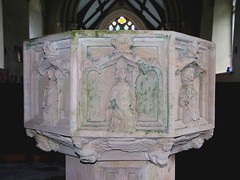
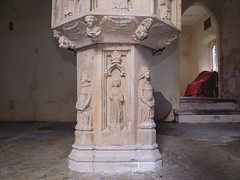
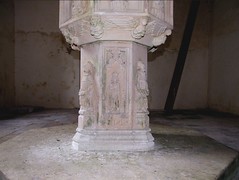
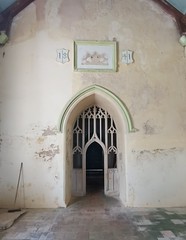
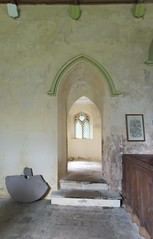
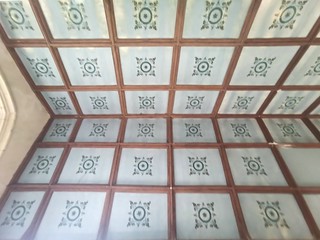
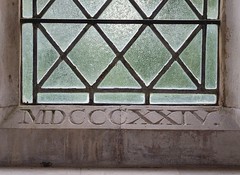
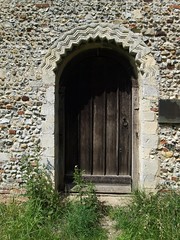
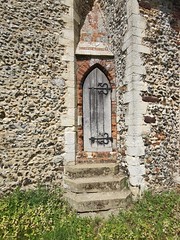
Century. The church is always open and you step into a space which feels unfamiliar at first. Pastel green walls and brick floors lend an organic feel, but your eyes are drawn to the surprise of the infilled tower arch, looking like the sugar icing of a wedding cake. Here, the Georgians used the tracery pattern of a window to create a kind of stone screen. For good measure, the arch is picked out in a darker green. The date above reads 1841, but this probably refers to the completion of the interior, while the 1845 on the porch outside most likely marked the completion of the restoration. The ghost of a royal arms is set above the tower arch, long since stolen. A small room no doubt intended as a vestry leads off through the former north doorway. The roof above the nave is panelled with square decorative designs. Although the historical importance of St Nicholas is undoubtedly its Georgian makeover - and, of course, the fact that it has survived at all to remind us of our folly - there is also one great medieval survival. This is an exceptionally fine font, one of several in this part of Norfolk which depicts saints standing around the shaft and seated on the panels. There is another nearby at Hemblington which has been carefully restored and repainted. Figures seated around the bowl, holding their symbols, include St Simon with an erect fish, St Bartholomew with a flencing knife, St Peter with a very long key which looks as if it might be used for locking a church, St Leonard with his manacles, St James with his pilgrim staff, and the dedicatee of the church, St Nicholas. Those standing around the shaft include St John, St Etheldreda and St Helen.
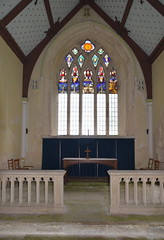
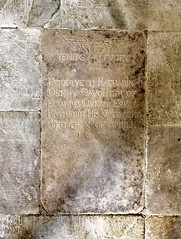
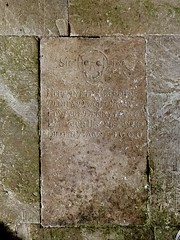
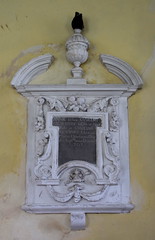
The font contrasts curiously with the gothick tower arch, as you would expect. Looking east, the most significant loss of this interior was probably the coloured glass, the work of the Norwich artist Samuel Yarrington in the 1820s. Yarrington's workshop provided imported continental glass as well as designing and making glass of their own. Their business was with country houses and public buildings, but increasingly with churches. A number of East Anglian churches have glass by Yarrington, but this must have been one of his biggest schemes. Glass of this age is fascinating, because it comes from a completely different ecclesiological and artistic mindset to that of the more familiar church glass of later in the century. During the 1970s, Yarrington's glass here was systematically smashed by stones picked up in the churchyard, or bits of wood broken off of furniture inside. When the Redundant Churches Fund took possession, the remains were removed (this was when Mortlock saw the east window) and what could be repaired has been reset in the upper part, the glass below it left clear. This is a curious sight, but a constant reminder of what happens when a building like this is left to fend for itself. A number of plaques and memorials survived the abandonment. Two are to members of the Beauchamp family, who died out in the Empire as the 19th Century began, one in Bangalore and the other in Dublin. The Reverend George Elwin, who was Rector of here and Hassingham for 44 years a century later, is also remembered. An early 18th Century wall-mounted memorial to Anne Newbury looks half a century older, but time does move slowly in these parts. Best of all is a sequence of ledger stones in the sanctuary to members of the Denny and Awcocke families, all of whom died between 1658 and 1660, presumably as a result of some pestilence. Each has a memorable design at the top with skulls and Latin mottos reading Tempas Fuget ('Time Flies'), Hodie Mihi, Cras Tibi ('Today Mine, Tomorrow Yours'), Sic Tu ('Thus You') and the curious Mors Licornibus Sceptra Aequat ('Death Makes the Unicorn and Sceptre Equal'). This appears to be a misinscription for Mors Ligonibus Sceptra Aequat ('Death Makes the Hoe and Sceptre Equal',) implying that poor men and rich men are equal after death. As lonely and remote as this church seems now, it was certainly a busy place at the time of the 1851 Census of Religious Worship. Buckenham and Hassingham parishes were consolidated, and morning worship that day was held at Buckenham. Thomas Beauchamp, rector and officiating minister, recorded that thirty-five people attended the service along with the twenty scholars who had no choice but to be there. This makes a total of fifty-five at a time when the population of Buckenham parish was fifty-six, a remarkable proportion, especially in this strongly non-conformist area of the county. It makes you wonder who the odd one out was. The scholars, explained Beauchamp proudly, attended a Dame daily School for Girls and Boys, supported by the rector. It makes you wonder what he, or they, would make of the church if they could see it now. Simon Knott, August 2022 Follow these journeys as they happen at Last Of England Twitter.
|
|
|||||||||||||||||||||||||||||||||||||||||||||||||||||||
home I index I latest I introductions I e-mail I about
this site I glossary
Norwich I ruined churches I desktop backgrounds I round tower churches
links I small
print I www.simonknott.co.uk I www.suffolkchurches.co.uk