home I index I latest I glossary I introductions I e-mail I about this site
St Bartholomew, Brisley



Follow these journeys as they happen at Last Of England Twitter.
| St
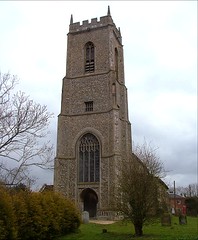
Bartholomew, Brisley Norfolk is not short of great Perpendicular churches with a village
huddled around them, and here is another. St Bartholomew
is enormous, and its village fairly remote in the winding
lanes between Dereham and Fakenham. Even so, Brisley is
fairly sizeablecompared with most in this area of
straggling hamlets, and on first seeing it there was
something about it that made it seem more urban to me
than it was. It took me a moment to put my finger on it,
and then I noticed the telephone wires lining the
graveyard, tangling and cutting across each other as they
connected to the houses on the other side of the road.
Ironically we are gradually doing away with such things
in towns, replacing them with wireless links and
underground fibre-optic cables. But here in the heart of
rural Norfolk such things can still create a kind of
visual pollution. But despite this the church completely
dominates the place, and it is hard to stand anywhere
here and either not see it or be unaware of its presence.
Think of what that must have been like in the late Middle
Ages! The sheer presence of such a building must have
been both a comfort and a terrifying reminder of last
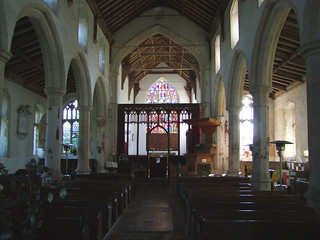
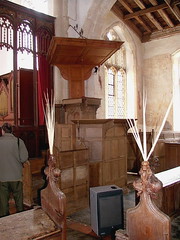
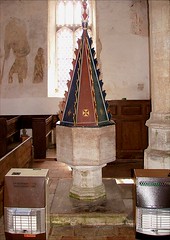
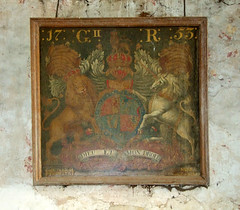
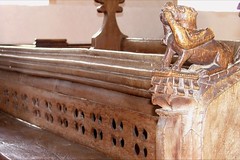
things, and the world to come. Some of East Anglia's largest 15th Century country churches were over-restored in the 19th Century, turning them into urban, anonyomous spaces inside that might as well be in the centre of busy towns. But this did not happen to St Bartholomew, and to enter it today is to find yourself in an entirely rustic, perhaps even ramshackle place. It is a delight if you enjoy rough and ready churches. The ranges of old benches with their traceried backs line the stone floors under old roofs with head bosses, and the walls around are speckled and dappled with flaking patches and hints of colour. There are some wall paintings remaining, including the haunting face of one St Christopher, the stooped body of a second and the unusual survival of St Andrew carrying his cross. Brisley's is a church of idiosyncracies, of a hundred little details that make the place memorable. These include a number of tracery-backed 15th Century benches from the time that sermons were becoming an essential part of the liturgy. Thier bench ends include an engaging dog with a duck or goose in its mouth. As at neighbouring Gateley the font is primitive and bulky, and topped off by a jaunty coloured cover. In 1753 the church put up its new George II royal arms. These are signed at the bottom by the churchwardens G Betler and F Frohawk, and also by J Brothill who cleaned and repaired them in 1854. There are a number of surviving
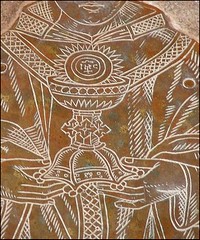
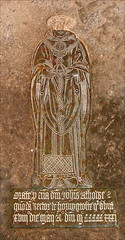
brasses from either side of the Reformation divide, the
most famous of which is up in the chancel, depicting
Priest John Athowe. It is right on the very eve of the
Reformation, 1531, and would be one of the last of its
kind in England. It shows him wearing his mass vestments
and holding an ornate chalice with the host rising from
it. At some point someone has attempted to remove it but
succeeded only in brreaking part of his head away. The
inscription records that he was the rector of
Horningtoft, a nearby parish. Athowe's inscription, which
also asks for prayers for his soul, is in Latin, but
another brass inscription in the nave has something
similar in English. This is to Robert Markayte and Rose
his wife, and dates from 1525. It is an unusual survival,
and a haunting one, because it still contains both
clauses that normally incurred the wrath of Anglican
iconoclasts; Of your Charyte pray for the sowles
of... it begins, and concludes on whose sowles
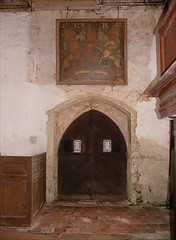
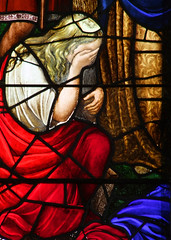
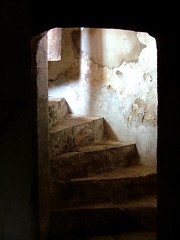
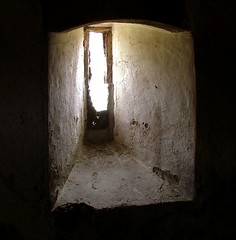
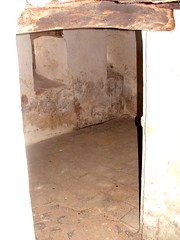
Jsu have Mcy Amen. The great east window contains the church's only coloured glass, a depiction of the crucifixion of the 1850s that Birkin Haward thought was probably the work of Charles Clutterbuck. It owes more than a nod to the 1630s depiction of the same subject at Peterhouse Chapel, Cambridge, and in turn provided the inspiration for Ward & Hughes' 1874 east window at Gressenhall. Perhaps the most memorable feature of St Bartholomew is to be found when you have stepped through the 15th Century screen into the chancel. There is a doorway to the north which leads down into the crypt below the sanctuary. You climb down a narrow flight of stairs into a space which is curiously light and clean. I could imagine it as a wine cellar of some kind, perhaps. It is less easy to populate it in your mind with piles of coffins. A notice on the wall tells you that it was once used to accommodate prisoners overnight on the long journey from Kings Lynn assizes to the gallows in Norwich. Imagine spending the night here with your execution in prospect for the day ahead! Not a happy thought. Simon Knott, December 2020 Follow these journeys as they happen at Last Of England Twitter. |








Amazon commission helps cover the running costs of this site.
home I index I latest I introductions I e-mail I about
this site I glossary
Norwich I ruined churches I desktop backgrounds I round tower churches
links I small
print I www.simonknott.co.uk I www.suffolkchurches.co.uk