home I index I latest I glossary I introductions I e-mail I about this site
St Andrew, Brinton

Follow these journeys as they happen at Last Of England Twitter.
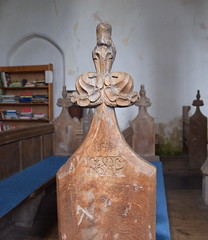
St Andrew, Brinton A pretty church in a pretty village, its churchyard hemmed by a farm and the church itself somewhat secluded by trees despite being set beside the village street. There seems to have been a general renewal towards the end of the medieval period, bequests to roofs in the 1520s suggesting a date for the completion of the work. A north aisle hides beyond the nave, but the chancel was lost long since, and the large Perpendicular windows on the south side, coupled with two small windows set above the south porch (what were they for?) make the whole piece charming and almost cottage-like. The first sight on entry is a large Elizabethan text painted on the north wall. These are not uncommon, but this must be one of the largest and best-preserved in Norfolk. It consists of sentences from St Paul's letters to the Romans and to Titus, the first letter of John and the Gospel of St Matthew. Thus reproved, you turn east, and see for the first time how lovely the interior is. There was a general tidying up and repair job in the 1860s, for a good reason, as we will see. Frederick Preedy came along a decade later and gave a quote for a major restoration of the interior. Seeing what he did at neighbouring Gunthorpe we can perhaps be thankful that he was not taken up on it. There are plenty of older survivals, and they are intriguing because, like the Elizabethan text, they are from the 16th Century. The angels in the roof came with the reroofing in the 1520s, and one of the bench ends is dated 1544, an intriguing date, right in the white heat of the Reformation. If all the benches are from this time it may explain their secular subjects, a man turning a hurdy-gurdy, another apparently churning butter, and what has been taken to be a man sitting on a lion my actually show him shearing a sheep, I think. One of the benches has a burning barrel on it, a rebus on the parish name, the adjective brint or brent being an early form of 'burnt' and a tun being another word for a barrel.
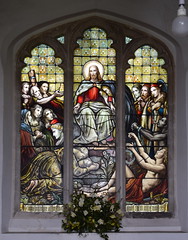
AL Moore's glass is an acquired taste, and you wouldn't want it everywhere, but his 1892 window in the south aisle is certainly striking. It depicts Christ saying ''come unto me all ye that are heavy laden and I will give you rest', and the three lights are crowded with figures converging. Christ's expression can be interpreted in different ways, I suppose. The east window is by Mayer & Co, and the curious upper lights scene on the south side of Christ with the fishermen is by Paul Quail. The north aisle opens up into the stub of a transept at its east end, and there are more figures in glass here in the upper lights of the north window. There is an intriguing snapshot into the lives of these rural parishes in 1851, when on census day a separate Census of Religious Worship was taken. In much of the country, including Norfolk, this was before the Anglican revival of the 19th Century had properly taken hold. The main outcomes of the census were quite how few people were attending their parish church on a Sunday, and quite how little work some incumbents were doing. It was common for those who filled in the form to either talk up their numbers or even to refuse to give them, but Brinton was one of half a dozen Norfolk parishes that made no return at all, and wasn't asked for one. A clue as to why that might be is that Brinton Reform Wesleyan Methodist Chapel, which was long established, had an attendance on the morning of the census of a hundred people out of the total parish population of just one hundred and ninety, as recorded by the chapel steward, a shoemaker called John Cushing. This is a remarkable proportion of the parish, and suggests that the people of Brinton were largely non-conformists. The living of Brinton was consolidated with that of Thornage, a parish three times the size, and the rector of both, one Augustus Dashwood, lived at Thornage and had been in harness since 1826. The conclusion must be that Brinton church had completely fallen into disuse by this time. It wouldn't be until 1863, when Charles Brereton took over, that real change began to take place. Simon Knott, May 2022 Follow these journeys as they happen at Last Of England Twitter.
|
|
|||||||||||||||||||||||||||||||||||||||||||||||||||||||
home I index I latest I introductions I e-mail I about
this site I glossary
Norwich I ruined churches I desktop backgrounds I round tower churches
links I small
print I www.simonknott.co.uk I www.suffolkchurches.co.uk