| |
|
St Mary, Bridgham
Bridgham is one of
those sprawling Norfolk villages a little off the beaten
track which are always a pleasure to visit. And St Mary
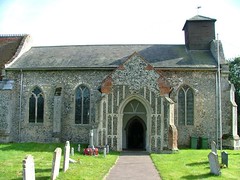
too, is a delight, and rather different to most other
medieval churches in appearance. Its pleasing and curious
shape is a result of the buffeting of the centuries. The
tower has gone, and the west end now sports a high
dutch-style gable with a bell turret. There is an
imposing red-brick and flushwork porch in what can only
be described as in a Suffolk style, and the chancel has
been rebuilt higher than the nave. Its red tiles contrast
with the slates of the nave to create an overall effect
which I liked very much. As I say, it is quite unusual.
The narrow upright lines that survive on the west wall
suggest that this was a round tower, and the filled-in
tower arch shows that it was probably of the 13th
century. Altogether, this is a quirky, homely exterior,
and that porch is really quite something.
It had been ten years since my previous visit, but I
still remembered what a friendly lot they had been here.
I'd come on a Historic Churches Bike Ride day, so it was
a little disappointing to turn up now and find the church
locked, though there was a keyholder notice which
directed me down a long, long shingle drive beside the
churchyard, crunch, crunch, crunch. I eventually
reached the back door of a large house and rang the bell.
Riiiiiiiiing. I waited. No one came. I waited
some more. Still no one came. So, disappointingly, back
up the drive, crunch, crunch, crunch. I'd gone
about fifty yards I suppose, before I heard a loud shout
behind me - 'Oi!'. So I turned back. 'I thought I heard
flat feet!' said a tall gentleman in his seventies I
suppose, dressed for gardening. I explained my mission.
'The missus isn't in', he said, 'but I can go and have a
rummage. I shall have to come to the church with you!'.
He went off into the house to have a rummage, shutting
the door behind him.
As he did so, a car pulled up the shingle drive, parked,
and a lady got out. I explained my mission again. 'Oh
dear!' she said, ' I'm terribly sorry, but I've been away
and I lent the key to someone and they haven't given it
back!'. She explained where I could find the lady she had
lent the key to. 'it's about a hundred yards up the road,
it's the only bungalow!'. I explained that her husband
was currently 'rummaging' for the key. She thought for a
moment. 'He's not my husband, he's my gardener.'
Apologising profusely and stifling my embarrassment, I
set off a hundred yards down the road into what turned
out to be a sea of bungalows. After about four hundred
yards I reach the one I was looking for. Riiiiing.
The door was answered by a very jolly lady. 'The lady in
the Old Rectory tells me that if I call here you'll give
me the church key,' I said. 'Does she now!' replied the
jolly lady. And she gave me the key quite happily, even
though she didn't know me from Adam and she wasn't one of
the people on the keyholder notice. Furthermore, she
thankfully didn't come to the church with me.
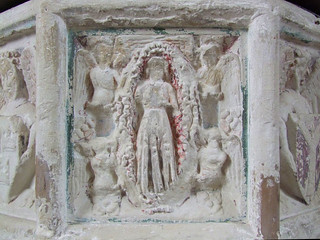
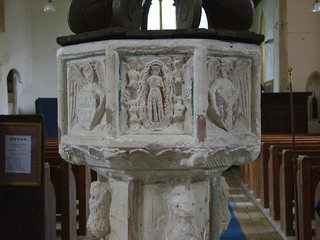
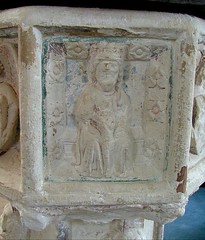
Bridgham has one of the most interesting fonts in
Norfolk. It is made of a white, chalky stone, and has
traces of its original colour. It appears eroded as much
as defaced, and is remarkable for two of its panels. That
to the west shows the Assumption of the Blessed Virgin.
This is very rare, and only occurs twice elsewhere on a
font in East Anglia, at Great Witchingham church in
Norfolk and at St Matthew's church in Ipswich in Suffolk.
The Assumption was the
great late summer feast of the late medieval Catholic
Church in England. Its celebration on August 15th
coincided with the height of the harvest. Perhaps two
hundred churches in East Anglia were dedicated to the
Assumption. However, it was heavily frowned upon by the
protestant reformers, and the Assumption does not figure
in Anglican doctrine or in its liturgical year except for
the churches in the Anglo-Catholic tradition. The
medieval image of the Assumption is consequently one of
the most haunting of survivals. It rarely survived at all
in glass, but can be found in stone bosses in Several
Norfolk churches, including Walpole St Peter and
Wymondham Abbey.
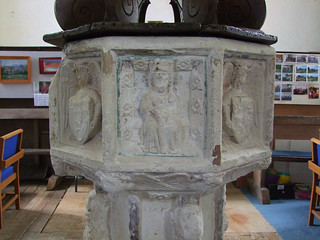
The eastern panel has another rare image, that of the
Holy Trinity. This is the traditional medieval
composition of an old man as God the Father, holding the
crucified Christ as the Son, with a dove descending to
represent the Holy Spirit. This is found on a couple of
other East Anglian fonts, most famously at Acle, and also
occasionally in stained glass. Seated clerics on two
panels may have been the donors of the font. Other panels
feature angels holding shields of the Holy Trinity, the
Instruments of the Passion, the Diocese of Ely and the
Archdiocese of Canterbury.
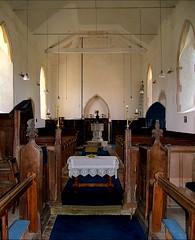
The double piscina and sedilia are rather good, too. The
other medieval survival of significance here is the dado
of the rood screen, painted in red, green and gold with
simple patterns. It must have been a very sturdy example
when it was complete. Tucked behind it, a 15th Century
bench end has been reused for a chair built into the back
of it. It is inscribed to Thomas Watson and Alys his
wyf. A bequest from Thomas and Alice Watson left the
money for the rood screen in 1475.
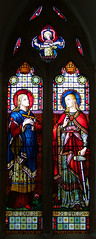
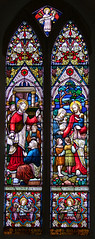
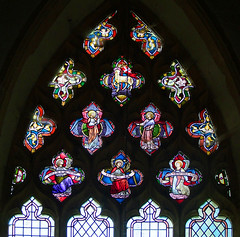
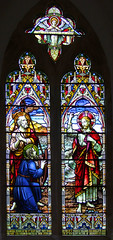
An overpowering scheme of glass was installed in the
chancel in the 1870s, and a more restrained later window
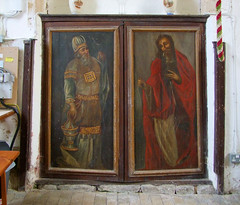
of 1900 is signed by AL Moore. More memorably, at the
west end of the church are the two surviving figures of
Aaron and Moses from the old decalogue boards, apparently
now in use as the doors of a cupboard. They look very
grand and austere.
Simon Knott, November 2020
Follow these journeys as they happen at Last Of England
Twitter.
|
|
|