home I index I latest I glossary I introductions I e-mail I about this site
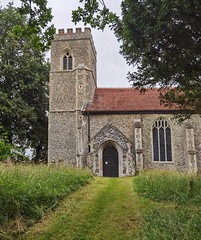
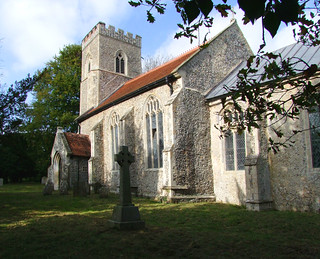
All Saints, Brandon Parva

Follow these journeys as they happen at Last Of England Twitter.
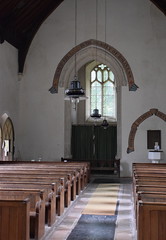
All Saints, Brandon Parva This handsome, lonely
church sits on its own at the end of a half mile track
from the Barnham Broom to Mattishall road. Years of
neglect left it feeling sad and empty, but a major
restoration in the early years of the 21st Century have
transformed it into a building that now feels cared for
and much-loved. There is no village, and the entire
parish has barely a dozen houses. The church as we see it
today seems entirely of the Perpendicular period, so
likely late 15th Century, although there was a major
restoration in the 1850s.
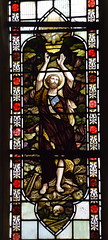
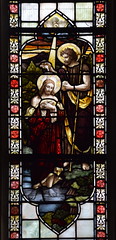
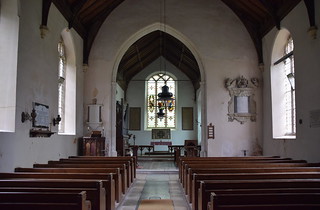
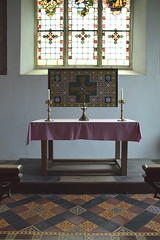
The chancel arch is wide, and the off-centre chancel is dominated by a curious east window. The upper lights of the tracery are crammed in under a flattened arch. Mortlock thought it was a Victorian design, but it seems unlikely that they would have left us with something so inarticulate and so I think it must be earlier, perhaps a repair job of the the 18th Century. You can see from outside that the wall has been rebuilt at sometime with ragstone rather than flint, which probably explains its current bulge, ragstone not being an East Anglian material. The glass in the window dates from the early 20th Century and is by Heaton, Butler & Bayne, who forty years earlier had been one of the most innovative and exciting of the 19th Century workshops. However, like a number of the Victorian mass production companies they fell out of fashion in the new century, as the preference for small scale Arts and Crafts glass, and an inevitable drop in demand for stained glass in general, dealt them a blow. In fact, they struggled on until after the Second World War, but they would never know their former success again. The glass here depicts three events concerning the appearance of the Holy Spirit, with the Baptism of Christ in the centre flanked by the prophet Ezekiel in the Valley of Dry Bones and St Peter on the Day of Pentecost. They are in the workshop's familiar early 20th Century autumnal colours and are all rather stern-faced and severe, I fear. The 1850s restoration
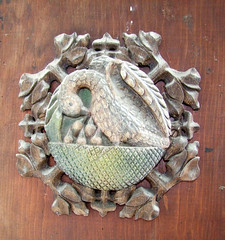
reroofed the chancel, and two bosses which are generally
assumed to have come from the old roof are on the organ
and the Priest's chair. One depicts the pelican in its
piety, feeding its chicks on blood, and the other a
rather alarming dove coming into land. However, I don't
think that these carvings are medieval at all, but
probably early 20th Century creations set on old backing
bosses. Simon Knott, December 2021 Follow these journeys as they happen at Last Of England Twitter. |




|
|||||||||||||||||||||||||||||||||||||||||||||||||||||||
|
|||||||||||||||||||||||||||||||||||||||||||||||||||||||
home I index I latest I introductions I e-mail I about
this site I glossary
Norwich I ruined churches I desktop backgrounds I round tower churches
links I small
print I www.simonknott.co.uk I www.suffolkchurches.co.uk