home I index I introductions I e-mail I about this site
St Andrew, Blofield

Follow these journeys as they happen at Last Of England Twitter.
| St
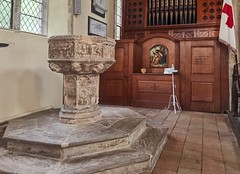
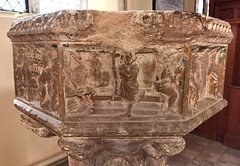
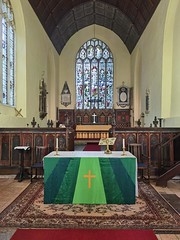
Andrew, Blofield Riding the crest of the rise like a great ship, St Andrew is the largest of the churches in the marshes that sprawl between the Bure, the Yare and the Waveney. Fifteen hundred years ago, up these rivers came the Angles, the Saxons and the Jutes. These were their first stopping off points, and as a consequence today this is still an area of tiny parishes packed like squares of wheat. However, Blofield and its neighbour Brundall now form a kind of metroland to Norwich, the middle-class late Victorian and Edwardian outer suburbs that were connected to the city by train. The name of the nearby station is Brundall Gardens, which sounds as if it has stepped out of the lines of a John Betjeman poem. The setting of St Andrew is far from suburban, being the church lane on the edge of the old village, with some pretty houses for company. The great tower, one of the tallest in Norfolk, can be seen for miles above the trees, and when you get here you find a grand wide-aisled and clerestoried nave to match. Will evidence suggests that they were built in one single campaign in the early decades of the 15th Century. The churchyard must also be one of the county's largest, as if all south-east Norfolk comes here to be buried. There was a substantial restoration here in the late 19th and early 20th Centuries, but it was of the highest quality, and the church you step into is splendid if entirely urban in character.The furnishings are of a high quality, and although almost every window is filled with coloured glass it is a catalogue of some of the best 19th and early 20th Century workshops, as we will see. But the great survival here is the 15th Century font, which presumably came as part of the rebuilding. I suppose it might be called unique, mused Cautley, for I have never seen one like it. Since my last visit it has been moved from the west end to the east end of the north aisle, but the orientation of the panels has not been changed. Unusually, the panels form a rosary sequence of scenes from the Christ story.
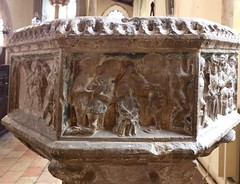
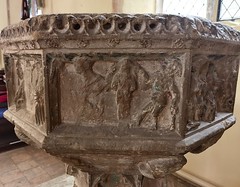
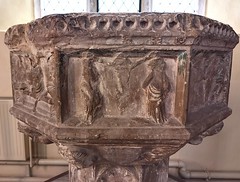
The panels depict a rosary
sequence, a series of images intended for contemplation
while 'telling bedes'. The story begins on the north-west
side with the Nativity. Mary lies in bed with the
standing Christchild, Joseph sits at the foot of the bed.
Behind, an ox an an ass reach up to eat ofut of a byre.
The story continues clockwise with the Flight into Egypt,
Joseph on foot carrying a bundle on a stick, Mary riding
on the donkey with the baby. Then come scenes from the
Sorrowful Mysteries. Christ is arraigned before Pilate,
with Dimnas and Gestas, the repentant and unrepentant
thieves, on their knees behind him. Next, Christ is
mocked and crowned with thorns, then he is scourged. In
the next panel he is crucified. A dramatic Resurrection
scene follows, showing him stepping from the tomb while
the Roman guards sleep. Finally comes the Ascension, the
disciples gathered on their knees on both sides looking
up to see Christ's feet disappearing into a cloud.
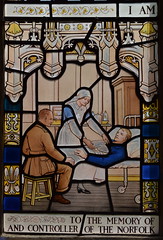
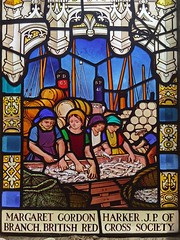
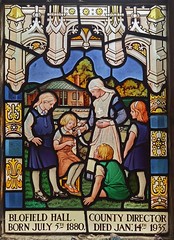
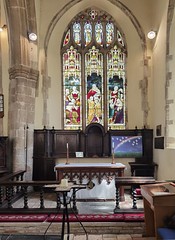
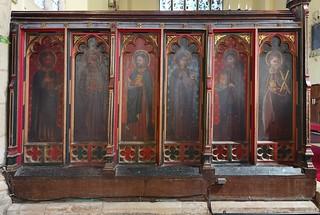
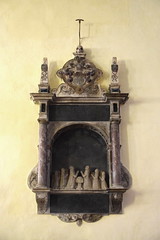
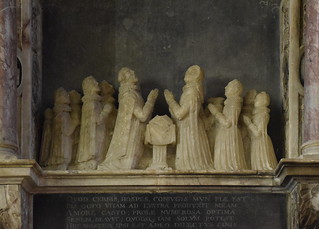
Much of the other glass is by Hardman & Co, but there is also good glass depicting three of the Works of Mercy by J & J King of Norwich, and other more workaday glass by Kempe & Co and Ward & Hughes. Some of the seating predates the restoration, and the box pews at the west end of the nave are banked up. There are some medieval benches nearer to the chancel which don't quite fit and I wondered if they had been brought here from the nearby ruined church at Burlingham St Peter. One of the carved figures is holding a rosary. The dado of the 15th Century screen separates nave and chancel under remarkably tall and wide chancel arch which seems to disappear into the fluted arcades as if they were all part of an elegant forest, although the south arcade has slipped here and a brace arch has been inserted into the aisle. The figures on the screen are all repainted. Blofield was one of the Paston parishes, and the few memorials here include that of 1630 to Sir Edward Paston esq second son of Sir Thomas Paston, knight. Edward was born in 1550, the year that his father died, and he had the honour of having the young King Edward VI as his godfather. The inscription tells us that Edward's father was one of the gentlemen of Henry the Eight his Privy Chamber, and that Edward himself was truly noble noe lesse by stocke then all manner of virtue, most skillfull of liberal sciences especially Musicke & poetry as also strange languages. The Pastons were one of the most powerful families in Norfolk, but Edward was a recusant Catholic and had to steer a wary course. Several of his daughters were admitted to religious houses on the continent, and one of his grandsons later became the president of Douai College in northern France, a seminary for Jesuit priests. On his memorial, Sir Edward kneels in alabaster opposite his wife Margaret Berney, their nine children gathered around the prayer desk with them. The memorials expert Jon Bayliss has pointed out to me that within the recess the columns have the Instruments of the Passion engraved on them, and he suggests that the broken fixing in the middle of the large space above the family group might once have held a crucifixion. This would explain why the family are looking upwards, but it would not have survived the puritan fury of the two decades after it was erected. I understand that the helm Cautley saw hanging above the memorial in the 1930s was not likely associated with the Paston family, and it is now in the Norwich Castle Museum. Simon Knott, October 2022 Follow these journeys as they happen at Last Of England Twitter.
|
|
|||||||||||||||||||||||||||||||||||||||||||||||||||||||
home I index I latest I introductions I e-mail I about
this site I glossary
Norwich I ruined churches I desktop backgrounds I round tower churches
links I small
print I www.simonknott.co.uk I www.suffolkchurches.co.uk