| |
|
St Peter,
Billingford
|
|
The
area between Fakenham and Dereham is a land of
quiet lanes and working villages, and the
churches have a sense of being at the heart of
their communities. We are not far here from the
main Norwich to Fakenham road, but the village of
Billingford feels remote, as many do around here.
I think this is because of the way the River
Wensum threads and winds through the low hills,
cutting off from each other villages which are
otherwise quite close. This Billingford is not to
be confused with the other Norfolk village with
the same name, its church dedicated to St
Leonard, across the county beyond Diss. The
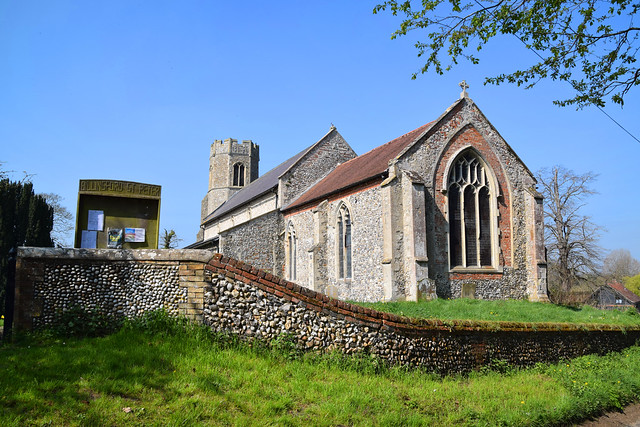
setting of St Peter, on a bluff overlooking a
valley, completes the drama. You approach the
church from the east, and here the building
presents itself intimately, the large east window
abutting almost directly onto the road. It is a
Victorian replacement, but is of more than
passing interest, as we will see. The land falls
away to the west, and by the time you reach the
base of the tower you are several metres below
the road. |
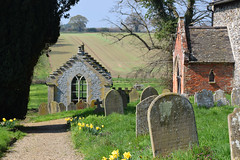
The
churchyard is a delight, the headstones scattered
higgledy-piggledy over the uneven ground with no
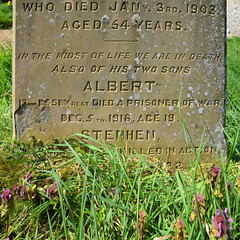
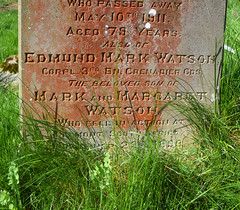
concessions to lawn-mower enthusiasts. A couple caught my
eye, one to the Howard brothers who were both killed in
the First World War aged 19 and 22, and the other to
Edmund Watson who was killed in the Boer War.
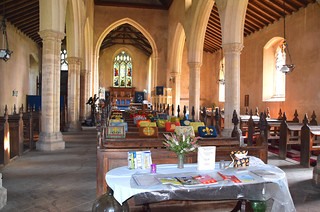
St Peter's
tower is one of Norfolk's half a dozen or so octagonal
towers, and the church is pretty much all of a 14th
century piece, with a couple of later windows. The
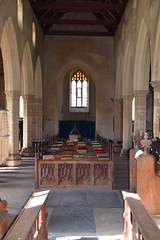
interior is a wide, open space, cleared of clutter, the
aisles empty. Tall Victorian benches fill the middle of
the nave, an unusual though by no means unique
arrangement, the space around them accentuating their
bulk. There is no central walkway, which gives the place
a singular feeling - as does the slope eastwards. You
could never mistake this interior for another.
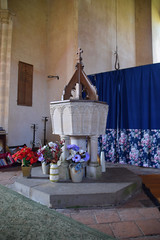
Also singular is the curious and lovely font. A sloping
octagonal bowl, its sides are carved with sets of double
arches, a grand arcade of sixteen all the way around. I
think it must predate the church slightly, and may have
come from elsewhere, or was simply reused from an earlier
building on this site.
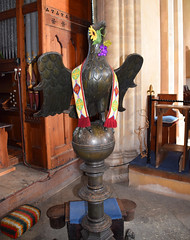
| Billingford
has one of those wonderful early 16th century
giant latten lecterns, an eagle standing on an
orb. Norfolk has about ten of these, but this is
the only one I know that isn't polished, and so
it creates a quite different effect. As Mortlock
is fond of observing here and elsewhere, they
come from the same foundry as the one at St Mark
in Venice. The lightness in the nave
is helped by the clear windows, and the east
window is filled with a very good early 20th
century representation of the Transfiguration, an
unusual subject. But I mentioned earlier that the
window itself is of interest, and this is because
this church is generally accepted as the original
source of the marvellous range of 15th century
glass now in the church at North Tuddenham.
The window you see now replaces one that was much
larger. You can see this clearly from the changes
in the plasterwork, and it may have been done for
structural reasons. The glass at North Tuddenham
was bought from a builders yard in Dereham, and
had probably been removed from the once larger
window here as part of the restoration which
fitted this one. If it had survived, medievalists
and church explorers from all over the country
would be beating a path to this church. A
startling thought.
|
|
 |
Simon Knott, May 2006, Updated March
2018
|
|
|