home I index I latest I glossary I introductions I e-mail I about this site
St Peter and St Paul, Bergh Apton


Follow these journeys as they happen at Last Of England Twitter.
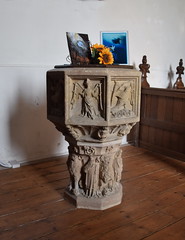
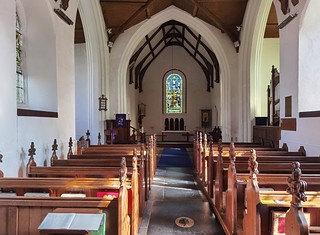
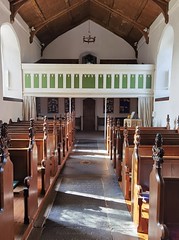
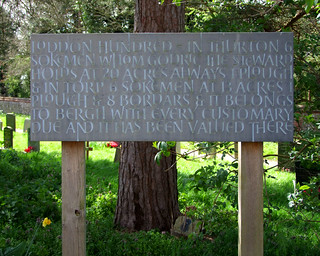
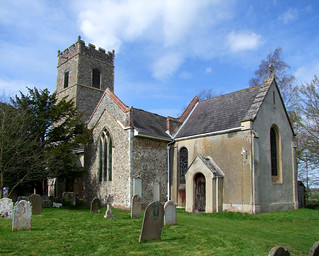
St Peter and St Paul, Bergh Apton Bergh Apton, pronounced bur ap-t'n, is one of those insubstantial, difficult to grasp parishes that are not uncommon in south-east Norfolk. The road signs that lead to it call it variously Bergh Apton, Burgh Apton and Berghapton, and the church is similarly elusive as you trawl the rambling narrow lanes. No doubt the people who live here would not have it any other way. The setting of the church, on a wide bend where the road doubles back, suggesting that this is an ancient site. We know there was a Roman camp here, but archaeological investigations have revealed something even further back, a Bronze Age settlement which may have been of some importance. And you can learn immediately the status of the parish when the Normans got here, because Bergh Apton's entry in the Domesday Book is inscribed on a slate board in the churchyard: Loddon Hundred - In Thurton 6 Sokemen whom Godric the steward holds at 20 acres always 1 plough & in torp 6 sokemen at 13 acres 1 plough & 8 bordars & it belongs to Bergh with every customary due and it has been valued there. The tower is a typical example of the end of the 14th Century, Norfolk church architecture beginning to flower again after the trauma of the Black Death. However, everything else you see is much more recent. From the outside the nave seems almost inconsequential beside the chancel, which is of an entirely different style, has a higher roofline and has been augmented by large transepts. A tension is created by the large arched transept windows and the tower appearing to squeeze the nave between them. This profile is a result of a surprisingly early 19th Century restoration of 1838 at the hands of that articulate diocesan surveyor John Brown, an enthusiastic gothicist but still with as much the mind of a carpenter as that of an architect. The arched windows in the chancel tell you that this is as much a Georgian church as a Victorian one, despite the new Queen on the throne. The north side of the church is close to the road, but the south side of the churchyard is wide and open and gives a good view of Brown's work. As you step inside, the narrowness of the nave is accentuated by the way the transepts open out. A large gallery, again the work of John Brown, fills the west end of the nave and completes the sense of a contained space. Below it is Bergh Apton's intriguing font.
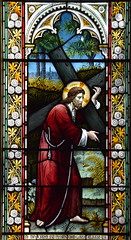
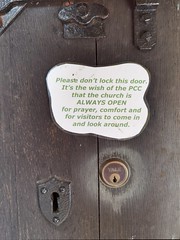
This is at first sight a typical 15th Century East Anglian font with angels and evangelistic symbols alternating on the eight panels, but when you look closer you see that the angels are standing, and the carving is idiosyncratic. It is as if a mason had heard an East Anglian font described, and created his own version of it. Brown's work gave plenty of scope to the stained glass enthusiasts of later in the century and into the next. The tall Kempe & Co glass of the Crucifixion dates from the eve of the First World War, and suits well the faux-classical profile of the east window. It's possible it may have replaced earlier glass, because Birkin Haward noted that a record exists of an 1860s window by Thomas Baillie here. The rest of the glass is by Ward & Hughes, mostly of the 1880s when they were at their peak of massed production, although the subjects here are less formulaic than often found elsewhere. They came back just before the end of the century to complete the set. Birkin Haward thought it an interesting collection, while Pevsner declared it interesting but terrible. The early restoration here is of interest, of course, but above all else it is a lovely, rural church in a pretty setting, so typical of this part of Norfolk. And the best thing about it is how welcoming it is, for on the door a notice says Please don't lock this door. It's the wish of the PCC that the church is ALWAYS OPEN for prayer, comfort and for visitors to come in and look around. Simon Knott, April 2022 Follow these journeys as they happen at Last Of England Twitter.
|
|
|||||||||||||||||||||||||||||||||||||||||||||||||||||||
home I index I latest I introductions I e-mail I about
this site I glossary
Norwich I ruined churches I desktop backgrounds I round tower churches
links I small
print I www.simonknott.co.uk I www.suffolkchurches.co.uk