| |
|
St
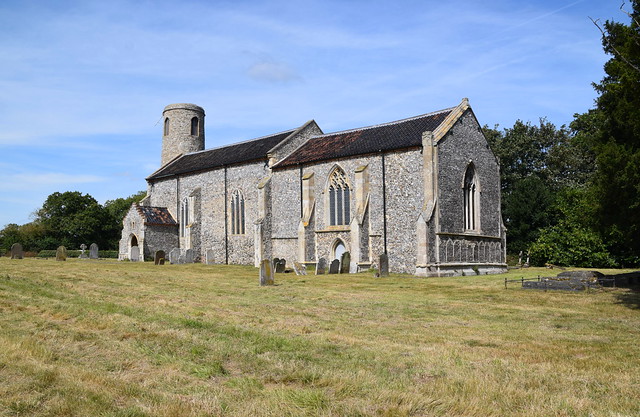
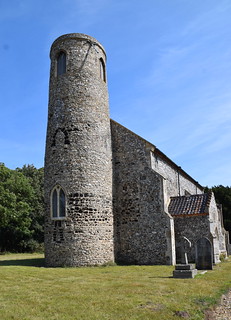
Lawrence, Beeston St Lawrence This round tower,
with its distinctive carstone detailing, will be a
familiar sight to many. It sits hard against the main
Norwich to Stalham road, and the lack of a place to park
is just one reason why it has now fallen pretty much
entirely into disuse. Another is the lack of any
parishioners, and a third may just be the loss of the
patronage that sustained it through the thin years
between the Reformation and the Victorian revival.
Externally, St Lawrence is a typical Norfolk village
church, heightened, lengthened and elaborated as the long
years went by. Although not formally declared redundant,
it is no longer used for services, so it was with some
surprise that I discovered the door was not locked - in
fact, St Lawrence is open 24 hours a day. As we shall
see, this may very well turn out to be its salvation.
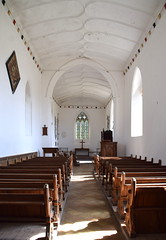
You step inside to something of a surprise. In the 18th
century, the Preston family of Beeston Hall took it upon
themselves to turn this church into their mausoleum, and
continued to be buried and remembered here in to the 21st
Century. This is the kind of thing that was common where
a church had strong ties with the Hall, especially in a
tiny village, which Beeston has always been. However, the
Prestons were actually quite restrained about their
monuments. Instead, they spent their money on
refurbishing the interior in the Gothick style of the
day, and it is a bit like entering the inside of a long,
low wedding cake.
The nave roof is vaulted with what looks like icing, so
delicate you almost feel the urge to snap bits off and
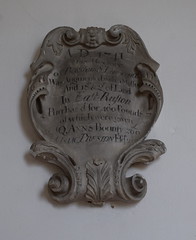
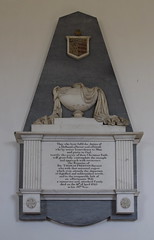
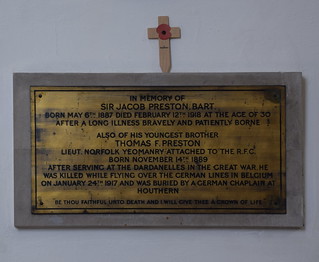
suck them.The Preston memorials and hatchments are spread
about the white walls, and when I first came here in 2004
it struck me that this still might just be any Norfolk
village church, if it wasn't for the pile of mouldering
service books, the bat and bird droppings, the layer of
dust on everything.
I found the original church sign, now propped up beneath
the tower. There was a great sadness in the air, as if
the Preston dead were all that was left it now. I
couldn't help thinking that it would have needed a
miracle for St Lawrence to survive. And yet...
I said in 2004 that this church's open door might well be
its salvation. This is because St Lawrence had become a
place of pilgrimage. The visitors book showed a constant
succession of strangers seeking sanctuary, and many had
been moved to write at great length, some in hours of
darkness by torch light. This is, of course, how the
shrines of the past came about, ordinary people finding
them and spreading the word before the Church ever
recognised them as special places. Sometimes it was the
particular character of a place that drew people to it,
or something that had happened there, even a miracle.
Perhaps that's what happened here. Perhaps St Lawrence
attracted those simply seeking spiritual refreshment and
peace. It might even have become more important for that
than for its occasional Sunday services. This was all in
my mind on a summer day in 2004. Perhaps the Church of
England will recognise it as the special place it is, I
wrote, for St Lawrence is a strong, handsome building,
worth keeping if we can, I think. All it needed is a
miracle.
And was it a miracle? I came back after 15 years to find
the door still open, and stepped inside to find the
church pleasingly cared for, the damage made good, the
space seemly and fitting for Anglican worship. A quiet
backwater, not somewhere you'd come for religious reasons
I think, unless the hunger for a quiet, well-kept
touchstone to the long Norfolk generations can be
considered a spiritual quest.
The sun shone, the birds sang, the air exhaled an almost
audible sigh of relief. And the Prestons slept on.
Simon Knott, December 2019
Follow these journeys as they happen at Last Of England
Twitter.
|
|
|